Count on It
Plus: California pushes back on DOJ’s noncitizen voting allegations. 🗳️
Early voting for the midterm elections is underway across the country. More than 20 million Americans have already cast their ballots.
But casting a ballot is just the beginning of the voting process. Each state has its own process for counting them: For example, some states allow election officials to begin processing mail ballots before Election Day, while others only begin on Election Day. So, results can take time—but when that happens, it’s a sign that the process is working and that election officials are ensuring the results are accurate.
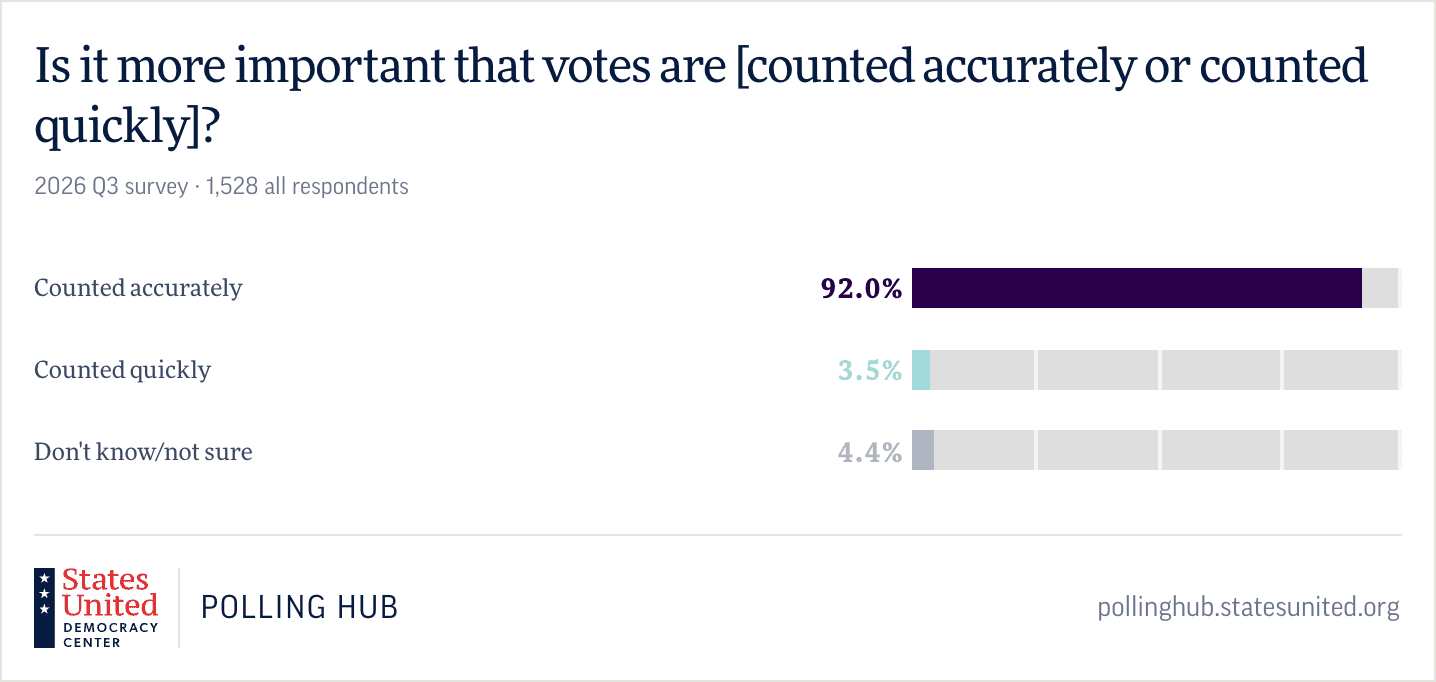
A new States United survey released this week found that Americans overwhelmingly agree that an accurate count is more important than a quick one, and that making sure every legal vote is counted is more important than having one’s preferred candidates win.
States United also released polls this week showing that most Americans want the federal government to invest more in elections—specifically in cybersecurity and election administration—and that most oppose the Trump administration’s efforts to gain access to voters’ private information.
You can find all of our surveys on elections, democracy, and the rule of law on our Polling Hub, and get weekly updates by signing up for our Polling Roundup newsletter.
This Week in Democracy
DOJ tells states where federal election monitors will be in November
The Justice Department began sending notices to states this week about which counties it intends to send election observers to next month.
Observation of elections—including by federal officials—is a normal part of the American democratic process. (Federal monitors have already been present at polling places this year, largely without incident.) In nearly every state, certain individuals are authorized to watch parts of the voting and vote-counting process to promote transparency and public confidence in elections. But no matter which state they’re in, election monitors cannot interfere with election officials’ work or intimidate voters.
➡️ MORE: Sharing the Facts About Election Monitors
California rebuts DOJ’s claims about noncitizens voting
After the Justice Department alleged last week that there were thousands of noncitizen voters on California’s voter registration lists, election officials investigated. In a court filing, Dean Logan, the top election official for Los Angeles County, wrote that his office reviewed a sample of the names provided by the department and found that roughly one-quarter of them were born in the United States. More than 70% never voted, Logan said in a statement.
➡️ MORE: What’s Breaking Through About False Claims of Noncitizen Voting
DOJ sues Alaska to block election certification
The Trump administration sued Alaska election officials, asking a federal judge to preemptively block them from certifying the results of the U.S. Senate election if the incumbent loses narrowly.
The administration is arguing that the candidacy of Dan J. Sullivan—a different person than incumbent Dan S. Sullivan—is “frivolous” and likely to confuse voters. (Alaska ballots denote which candidate is the incumbent.) The lawsuit seeks to block officials from certifying the election results, pending an investigation, if the votes for Dan J. going to Dan S. would mean Dan S. would have won.
Legal experts quickly noted that the administration’s arguments are “absurdly thin.” The Alaska Supreme Court also considered the issue earlier this year and allowed Dan J. Sullivan to remain on the ballot.
Judge limits DHS’s election investigations
A federal judge limited the Department of Homeland Security’s (DHS) investigations into noncitizen voting in nine states, ruling that the department was relying on unreliable data to determine which people to investigate. The federal data, the judge wrote, “is widely known to inadvertently include U.S. citizens.”
The Trump administration is planning to cut disaster aid to states
The administrator of the Federal Emergency Management Agency (FEMA) told state officials that his agency is planning to reduce the amount of federal aid available to states to help them recover from natural disasters. An analysis conducted by Politico earlier this year found that President Trump has rejected the most disaster aid in FEMA’s history.
The Trump administration has disrupted more than $24 billion in disaster aid to states since returning to office last year, according to Lost Funds, a project of States United and Grant Witness. At campaign events, President Trump has threatened to condition even more funding on the results of the midterm elections.
➡️ EXPLORE: LostFunds.org
State of the States
In California, a federal appeals court upheld a lower court ruling that barred the Trump administration from taking control of the state’s National Guard troops and deploying them to Los Angeles. The lower court judge had ordered officials to end the deployment in December, writing in his ruling that the administration’s arguments for claiming unchecked control of the troops—over the objections of Gov. Gavin Newsom—were “shocking.”
Nearly a dozen retired senior military officers and Vet Voice Foundation, represented by States United, filed an amicus brief in the case in September, urging the appeals court to uphold the lower court’s ruling. Deploying National Guard troops domestically, the group argued, risks the nonpartisan reputation, integrity, and morale of the military.
➡️ MORE: About the brief
In Texas, state election officials learned of another system error that resulted in thousands of voter registrations going unprocessed. It’s the second error discovered in recent weeks, but—like the first one—election officials are working with counties to resolve the issue and ensure that the backlogged registrations are processed quickly.
In the News
The Associated Press: Meet the researchers leaving the US because of Trump’s funding cuts and politicization of science
But the erosion of reputation and the talent drain may not be over. The Trump administration has cut or frozen up to $174 billion in federal grants since the president’s second term began, according to a tracking tool released by the States United Democracy Center and the organization Grant Witness. And a proposed rule from the Office of Management and Budget could give political appointees more control over what future projects are funded. A resolution approved by Congress has delayed a final decision on the rule until December.
Newsweek: Trump Threatens California Election Officials With Jail. Could It Happen?
Samantha Trepel, Rule of Law program director at the States United Democracy Center, separately criticized the administration’s actions in an attributable statement to Newsweek.
“The Justice Department has a responsibility to enforce the law based on evidence. Instead, DOJ is using the threat of investigations and criminal prosecution to intimidate state election officials who are just doing their jobs,” Trepel said.
“Noncitizen voting is already illegal and exceedingly rare. The Trump administration’s recent actions in California are yet another attempt by the federal government to interfere with how states run our elections,” she added. “They’re trying to undermine confidence in our elections and create doubt about results before voters even cast their ballots.”
The Independent: Trump’s war on science sparks American brain drain as top researchers flee overseas
Nevertheless, concerns persist regarding the ongoing erosion of reputation and talent. The Trump administration has cut or frozen up to $174 billion in federal grants since the president’s second term began, according to tracking data compiled by the States United Democracy Center and Grant Witness.
Arizona PBS: Trump administration halted millions in education funding for Arizona
The States United Democracy Center and Grant Witness came together to launch Lost Funds, an interactive website that tracks federal funding that has been canceled, withheld, or disrupted since Trump’s 2025 presidency.
Kelly Rader is the Research Director at States United Democracy Center, a nonpartisan group that promotes and supports fair elections. Rader said it was important to track lost federal funding in order to educate and help make the data visible to the public.
“We like to say these cuts aren’t business as usual. This is completely unprecedented action from a federal administration to disrupt funding that was already promised to states and recipients,” Rader said.
Harvard Law Today: The worry over federal incursions into state, local elections
Chelsea Rice, senior counsel in the Rule of Law Program at States United Democracy Center, also noted the expansion of the Department of Justice’s role in elections, saying it is being used to “undermine voters’ confidence in elections, to target certain states and jurisdictions, and really completely eliminate many policies and norms that were in place.”
… Rice said she found the California case particularly concerning. The letter sent last week to California Secretary of State Shirley Weber, and signed by Acting Deputy Attorney General Trent McCotter, alleged that the state had 190,000 noncitizens on its voter rolls, but did not provide evidence. (California does not allow noncitizens to vote.) The state was ordered to withhold mail-in ballots from anyone on a list whose citizenship could not be verified within 48 hours; the Justice Department sued California two days after sending the letter.
“The fact that this letter was signed by the deputy attorney general is quite chilling and stunning, and completely out of line with anything that would have happened with previous deputy attorneys general under any administration,” Rice said.
Recommended Reading
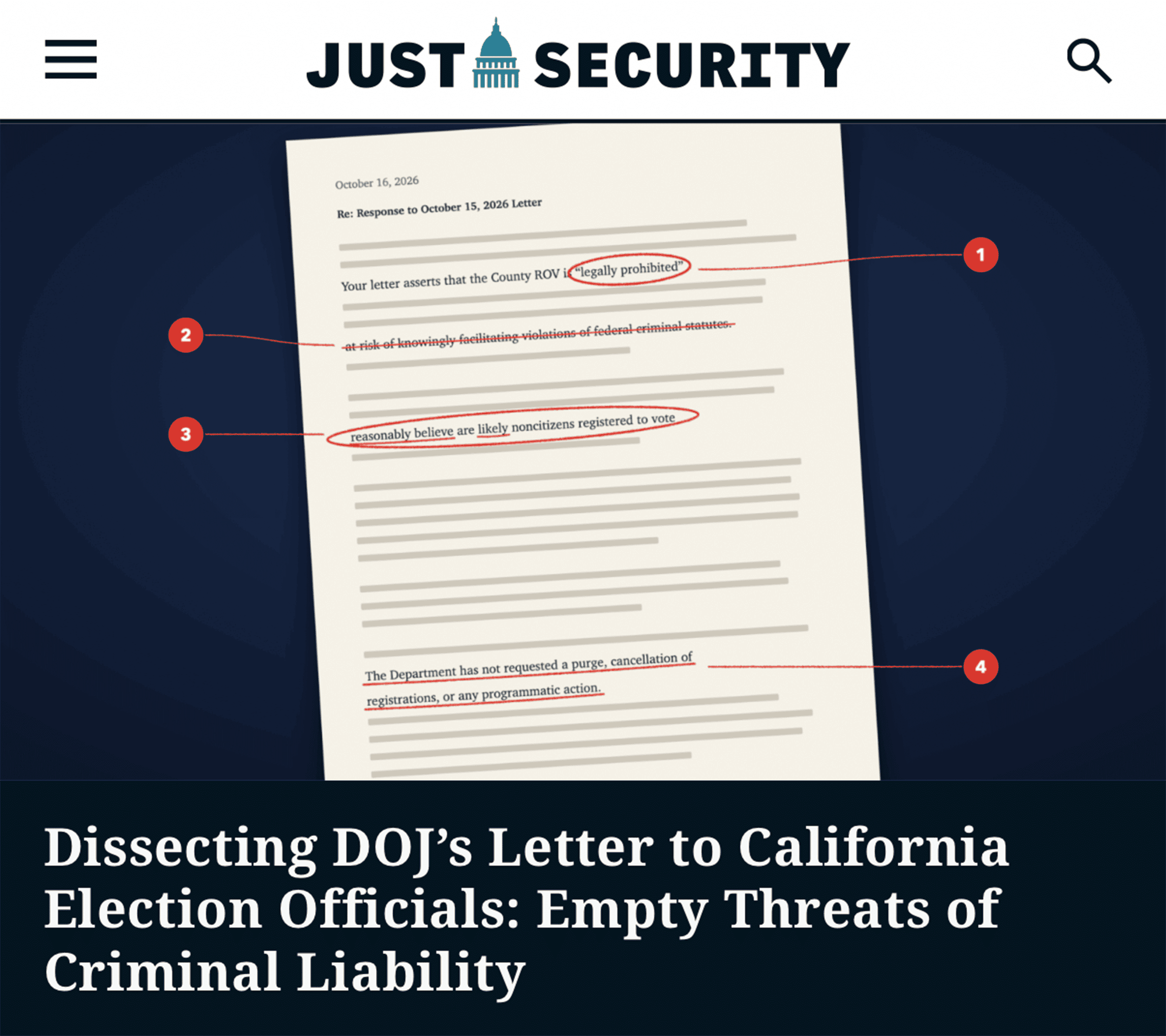
Samantha Trepel, States United’s Rule of Law Program Director, breaks down the Justice Department’s letter threatening California election officials with criminal charges in a new piece for Just Security.
“Even the issuance of an ultimately empty threat is dangerous to the functioning of the democratic election system and deeply unfair to the hardworking state and local election officials who keep it running,” Trepel argues.
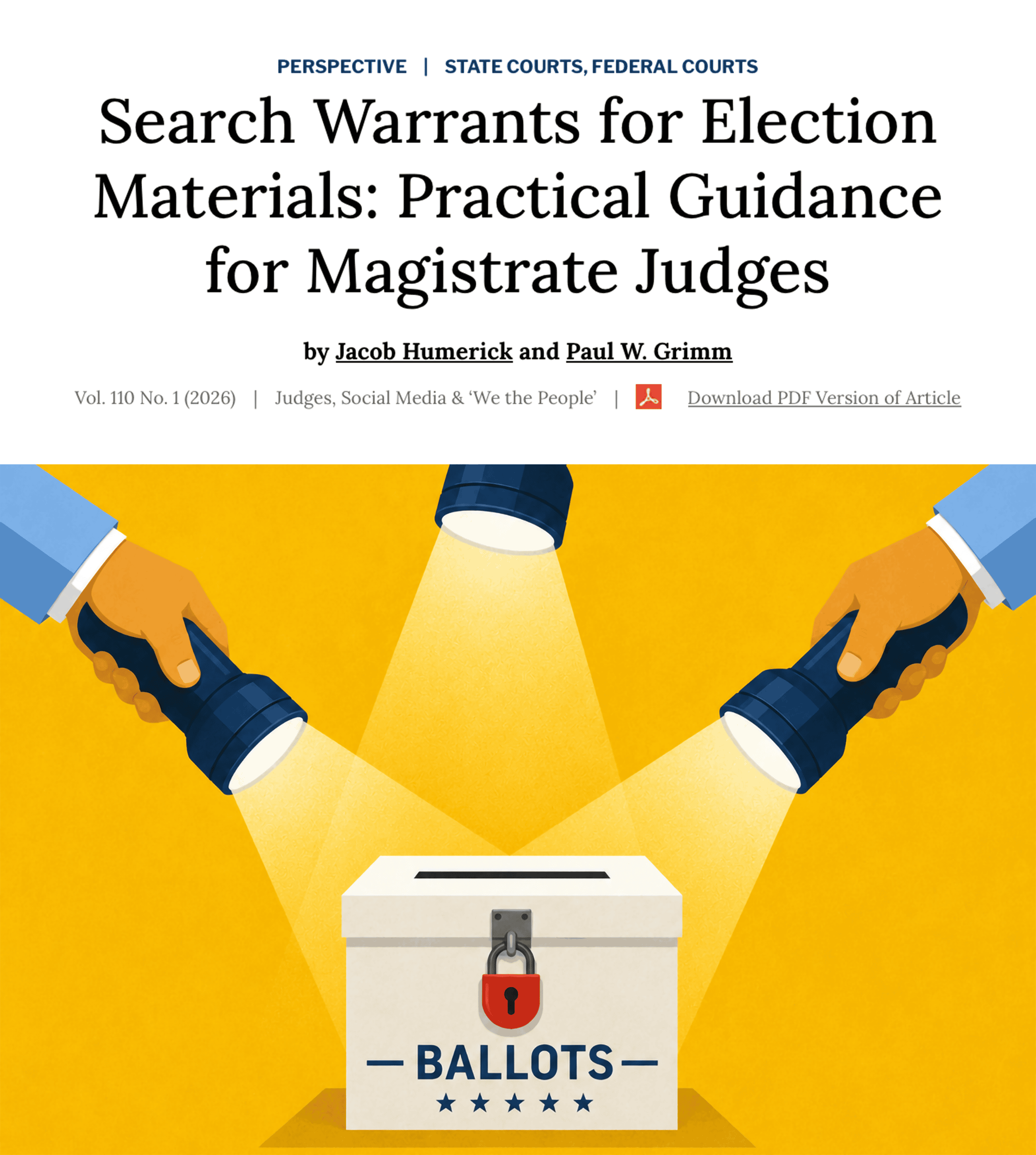
And in Duke Law School’s Judicature, States United Counsel Jacob Humerick and former U.S. District Judge Paul W. Grimm discuss federal magistrate judges’ role in evaluating search warrants for election materials and the resources available to them.
“The American public—regardless of political affiliation—will be looking to courts to swiftly handle any election-related cases with the utmost care, impartiality, and transparency,” the pair write. “By doing so, judges will uphold confidence in case outcomes and in our election system.”
Watch This
States United partnered with the National Policing Institute to create a new training resource to help law enforcement leaders prepare for election-related calls for service. The resource provides guidance from three former police chiefs on how to respond to safety incidents at polling places, mitigate threats to election officials, address situations concerning election monitors, and more.
The full resource—including a 13-minute video and facilitator guide—is free to access at this link.