Survey: Most Americans Oppose DOJ Demands for Private Voter Information
In This Resource
Most Americans oppose the Trump administration’s efforts to gain access to voters’ private information and give the federal government more control over state-run elections.
Since 2025, the U.S. Department of Justice (DOJ) has demanded that states turn over their complete voter registration lists, including sensitive personal information like birth dates, driver’s license numbers, and partial Social Security numbers. The department has sent letters to nearly every state and filed dozens of lawsuits against state officials who refused to comply. The administration says it needs the information to ensure states are maintaining accurate voter lists.
But states have successfully fought these demands in court. Federal judges have repeatedly dismissed DOJ lawsuits seeking access to voters’ private information, and a recent ruling in a lawsuit found that the administration’s broader voter-data collection policy violated federal law and intruded on states’ authority over elections.
The public is similarly opposed to expanding the federal government’s power over elections. A new survey finds that most Americans do not want the DOJ accessing voters’ sensitive personal information or forcing states to run elections according to President Trump’s demands.
States United Democracy Center partnered with YouGov on a national survey of 1,528 adult Americans from Aug. 17 to 21, 2026, to better understand Americans’ views on voter privacy and federal involvement in elections.
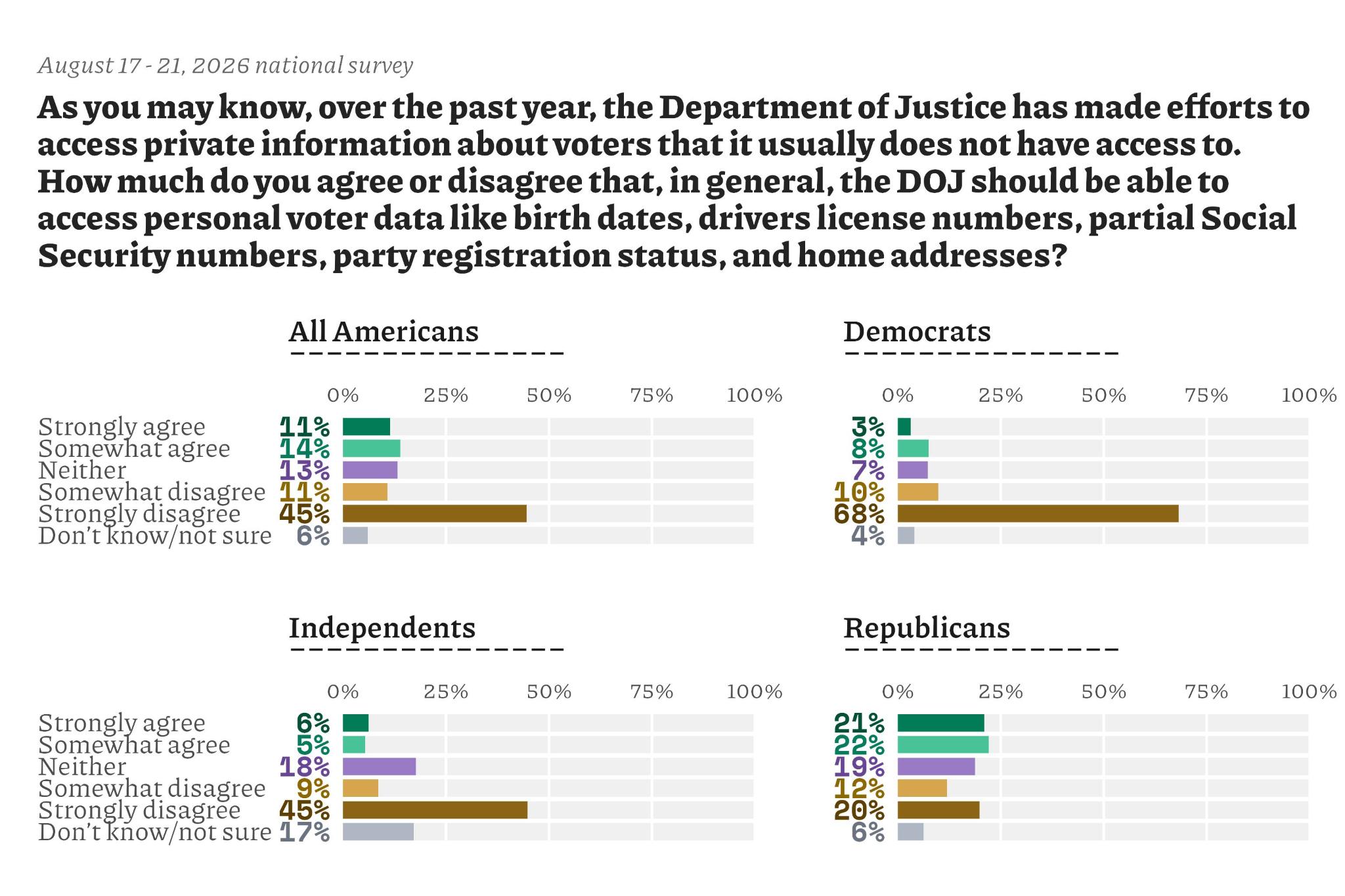
- Most Americans (56%) disagree that the DOJ should be able to access voters’ private information, including birth dates, driver’s license numbers, partial Social Security numbers, party registration, and home addresses. Just 25% agree.
- Majorities of Democrats (78%) and independents (54%) disagree, while a plurality of Republicans (43%) agree.
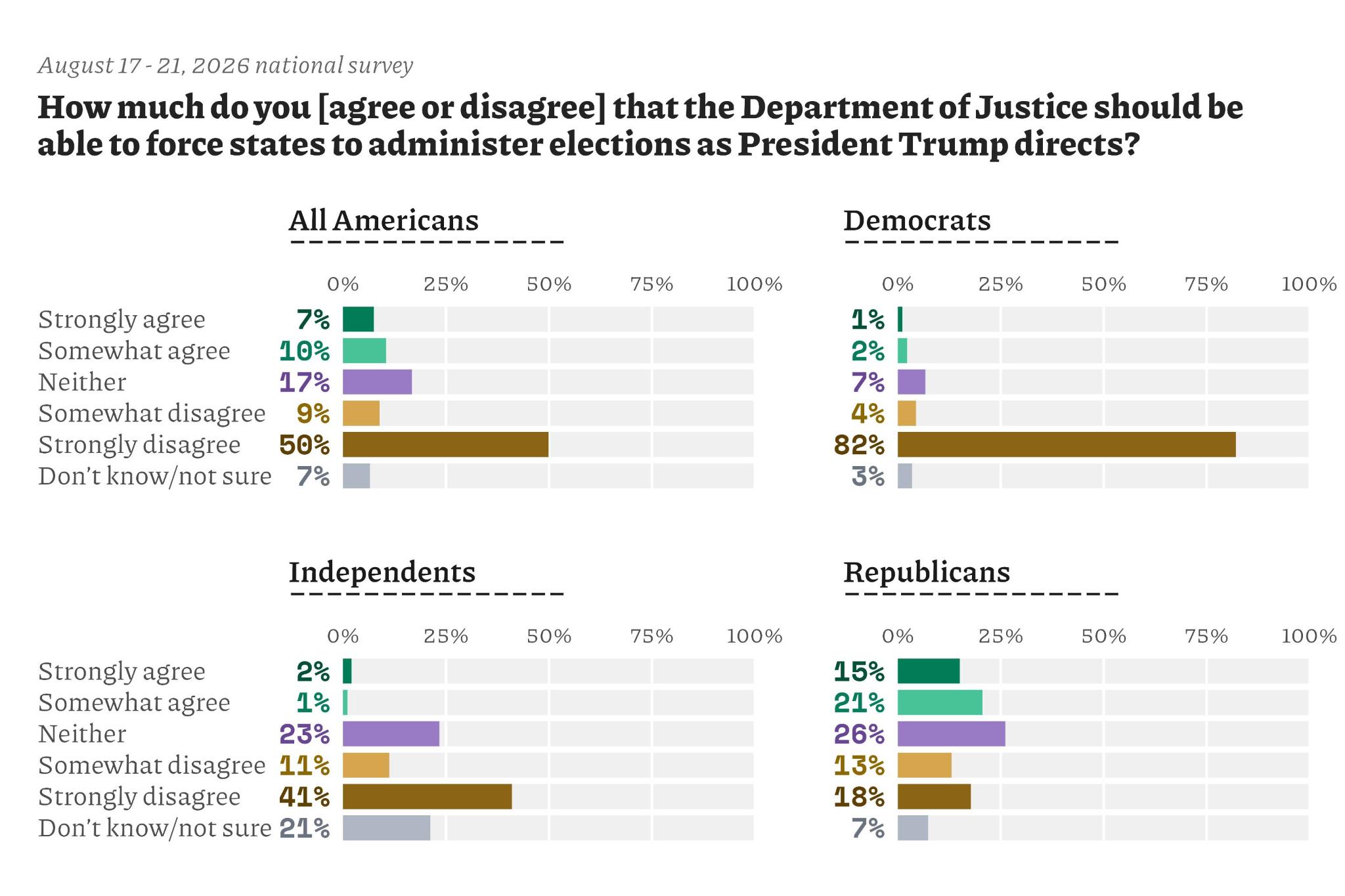
- Nearly 6 in 10 Americans (59%) disagree that the DOJ should be able to force states to administer elections as Trump directs. Just 17% agree.
- Majorities of Democrats (86%) and independents (52%) oppose the DOJ forcing states to follow Trump’s directions on running elections. Republicans are more divided, with 36% agreeing and 31% disagreeing.
We asked Americans how much they agreed or disagreed that the DOJ should be able to access voters’ personal information, including birth dates, driver’s license numbers, partial Social Security numbers, party registration, and home addresses. A majority (56%) strongly or somewhat disagreed, compared with just 25% who expressed some level of agreement.
Opposition was strongest among Democrats (78%), while a majority of independents (54%) also disagreed. Republicans were more supportive of DOJ access to voter information, though fewer than half (43%) agreed.
We also asked whether the DOJ should be able to force states to administer elections as Trump directs. Nearly 6 in 10 Americans (59%) disagreed, while just 17% agreed.
Partisan differences were again significant. The vast majority of Democrats (86%) disagreed, along with a majority of independents (52%). Republicans were more divided, with 36% agreeing and 31% disagreeing.
These data are taken from a States United survey based on 1,528 interviews conducted on the internet of U.S. adults. Participants were drawn from YouGov’s online panel and were interviewed from Aug. 17 to 21, 2026. Respondents were selected to be representative of American adults. Responses were additionally weighted to match population characteristics with respect to gender, age, race/ethnicity, education of registered voters, and U.S. Census region based on voter registration lists, the U.S. Census American Community Survey, and the U.S. Census Current Population Survey, as well as 2022 midterm turnout and 2020 and 2024 presidential vote. The margin of error for this survey is approximately ± 2.8 percentage points, though it is larger for the analysis of partisan subgroups described above. Therefore, sample estimates should differ from their expected value by less than the margin of error in 95% of all samples. This figure does not reflect non-sampling errors, including potential selection bias in panel participation or measurement error.
Following best research practices, we define “independents” as respondents with no partisan attachments and classify independent leaners as partisans.