Sharing the Facts About Americans’ Trust in How They Vote
Voting by mail is widely popular throughout the country and used by Americans of different ages, political parties, and locations. Though rules vary by state, each has procedures in place to ensure the process is safe and secure.
In fact, nearly a third of Americans voted by mail in 2024 and 2022, according to States United research.
But throughout his second term, President Trump has continued to escalate his attacks on mail voting.
Despite repeatedly voting by mail himself, the president’s attacks on mail voting have evolved from conspiracy-laden posts that threatened to ban it outright, to a 2026 executive order that sought to put severe limits on who could cast their ballots that way. The recent order constitutes a major grab in election powers constitutionally designated to states. Simply put, that sort of executive action would be unlawful.
The president has also attacked voting machines. A large majority of Americans vote using paper ballots, and almost every American who votes—including those who vote on machines—does so with a verifiable paper trail, which state and local election officials use in audits and recounts. Those security procedures ensure elections remain safe, secure, and accurate.
- Voting by mail is widely trusted and popular.
- Consistent with surveys over time, polling shows most Americans express either a great deal or a fair amount of trust in casting a ballot by mail.
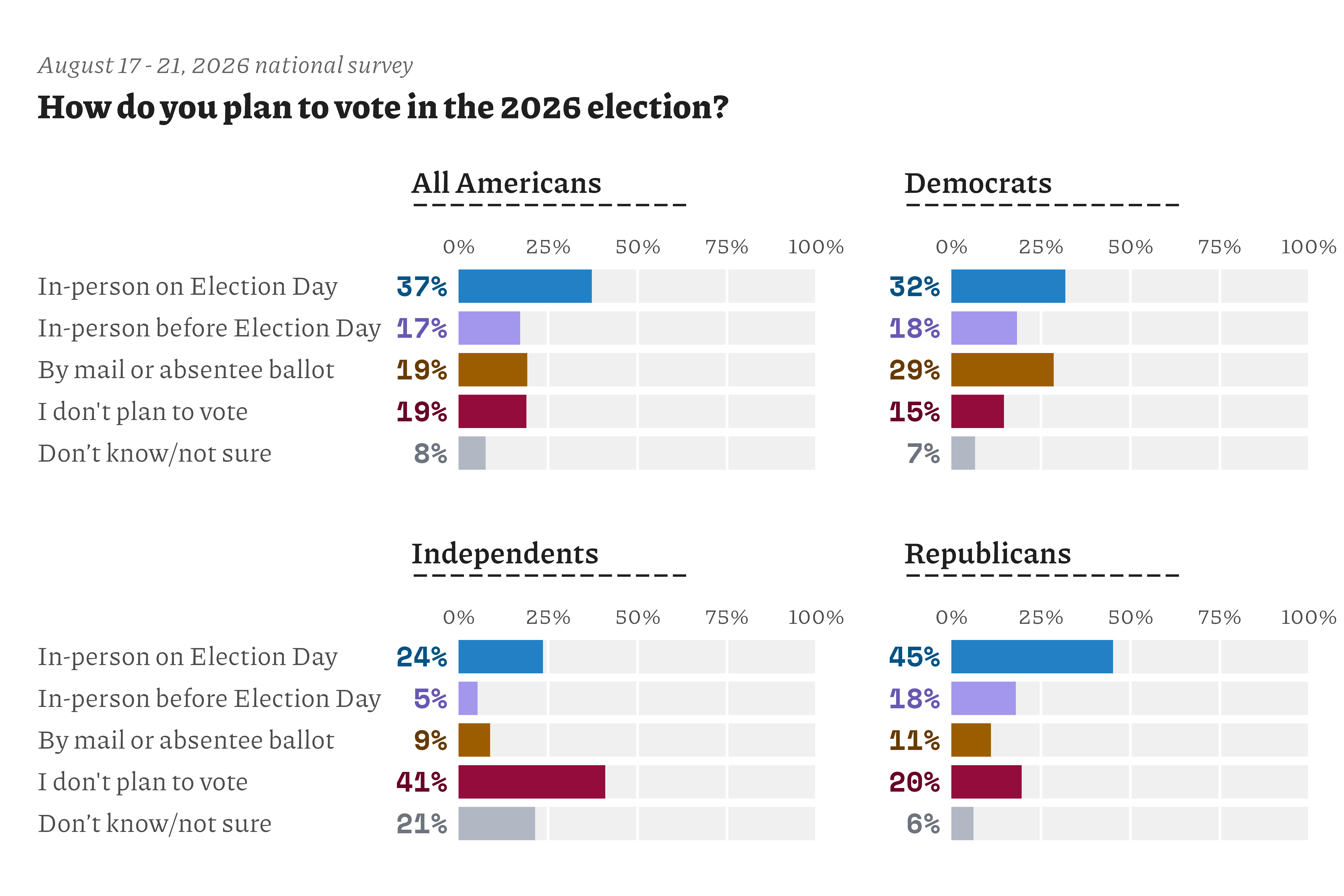
- More than a quarter of Americans who plan to vote in the 2026 midterms say they’ll do so by mail or by absentee ballot.
- Americans trust the ways we count ballots.
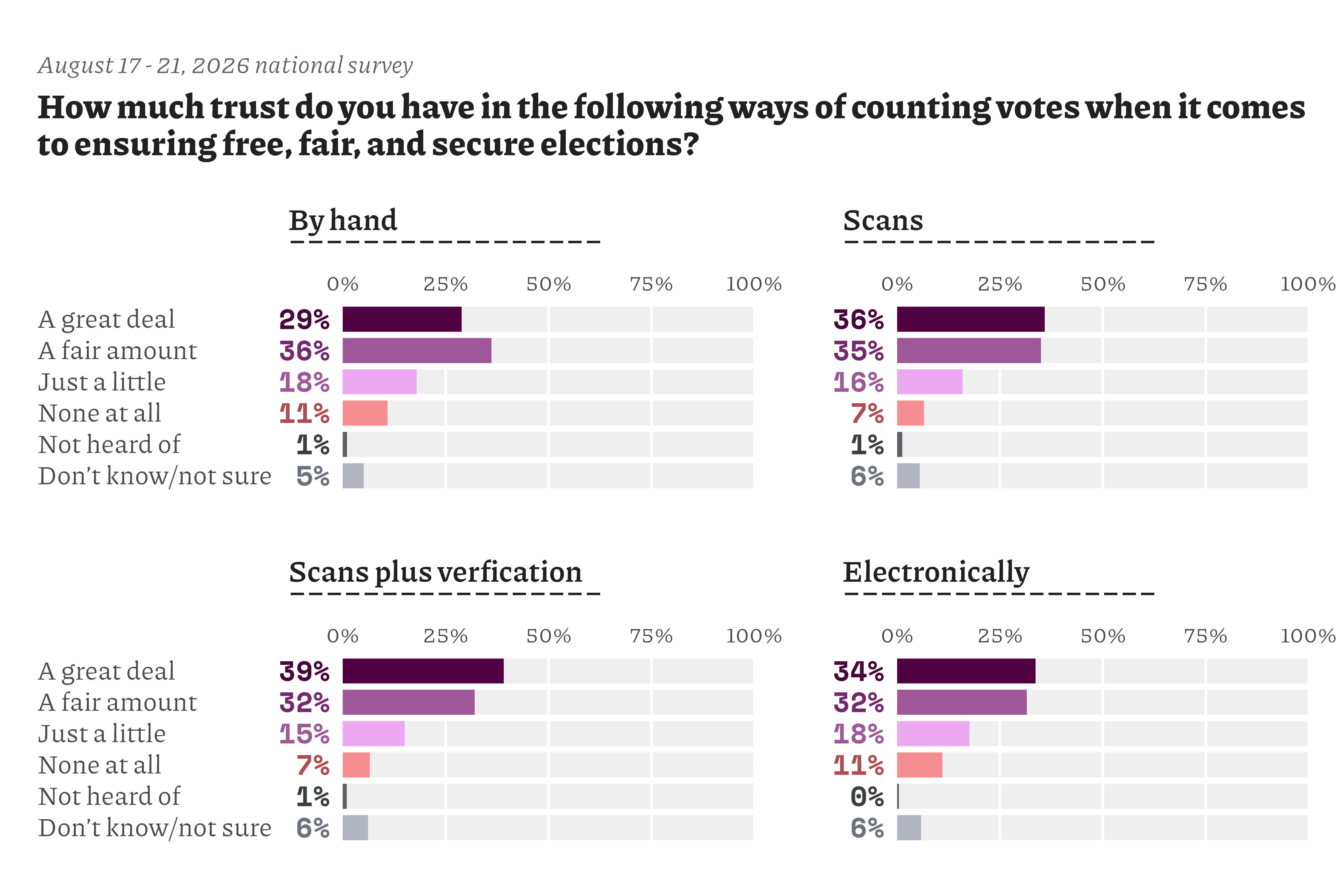
- States United polling shows Americans report high levels of trust in different methods of counting votes, including through scans, scans with additional verification, and electronically. The idea that Americans want to change these methods is not backed up by data.
- Mail voting is safe and secure. If you choose to vote by mail, state election officials will make sure your vote is counted.
- Any executive order that would ban mail-in ballots and voting machines nationwide would be illegal.
- The president’s only job in elections is to run for office. The Constitution gives states the power to run the voting process. It should concern all Americans when a president tries to change the way elections operate by himself to rig the process for his own benefit.
- Mail voting is popular. Every U.S. state offers some form of mail voting, and its use has steadily grown over time as a convenient way for voters to make their voices heard.
- States have overlapping systems in place to protect the security of mail voting. Procedures vary by state, but those systems include:
- Signature verification, overseen by trained election workers. (In some states, law enforcement conducts anti-forgery training. In some states, questionable matches are sent to a bipartisan review team.)
- Unique serial numbers and bar codes that make sure each voter can return only one valid ballot.
- Verification procedures that make sure each ballot is sent to the correct voter.
- Tracking procedures that let both voters and election officials track every ballot, from when it goes in the mail to when it’s counted.
- Stiff criminal penalties, up to prison time, for anyone who tries to tamper with mail voting.
- Americans care about an accurate vote count. That’s why we’ve trusted machines to count votes for decades. They’re certified, tested, and accurate.
- Modern vote-counting systems are accurate and secure. They are subject to extensive security protections and accuracy checks. And they have to meet strict requirements to be certified for use in an election.
- Voting machines are tested prior to every election. Those tests include observers from all parties in the race.
- State and local election officials are preparing every day to deliver another election that’s free, fair, safe, and secure. They’ll make sure every eligible vote, and only every eligible vote, is counted.
States United partnered with YouGov on a national survey of 1,528 adults from Aug. 17 to 21, 2026, to better understand Americans’ views on this issue.
The survey found widespread trust among Americans for the ways we cast ballots, including by mail. That survey also showed most Americans trust the ways election officials count ballots, which often involve scanners and electronic machines.
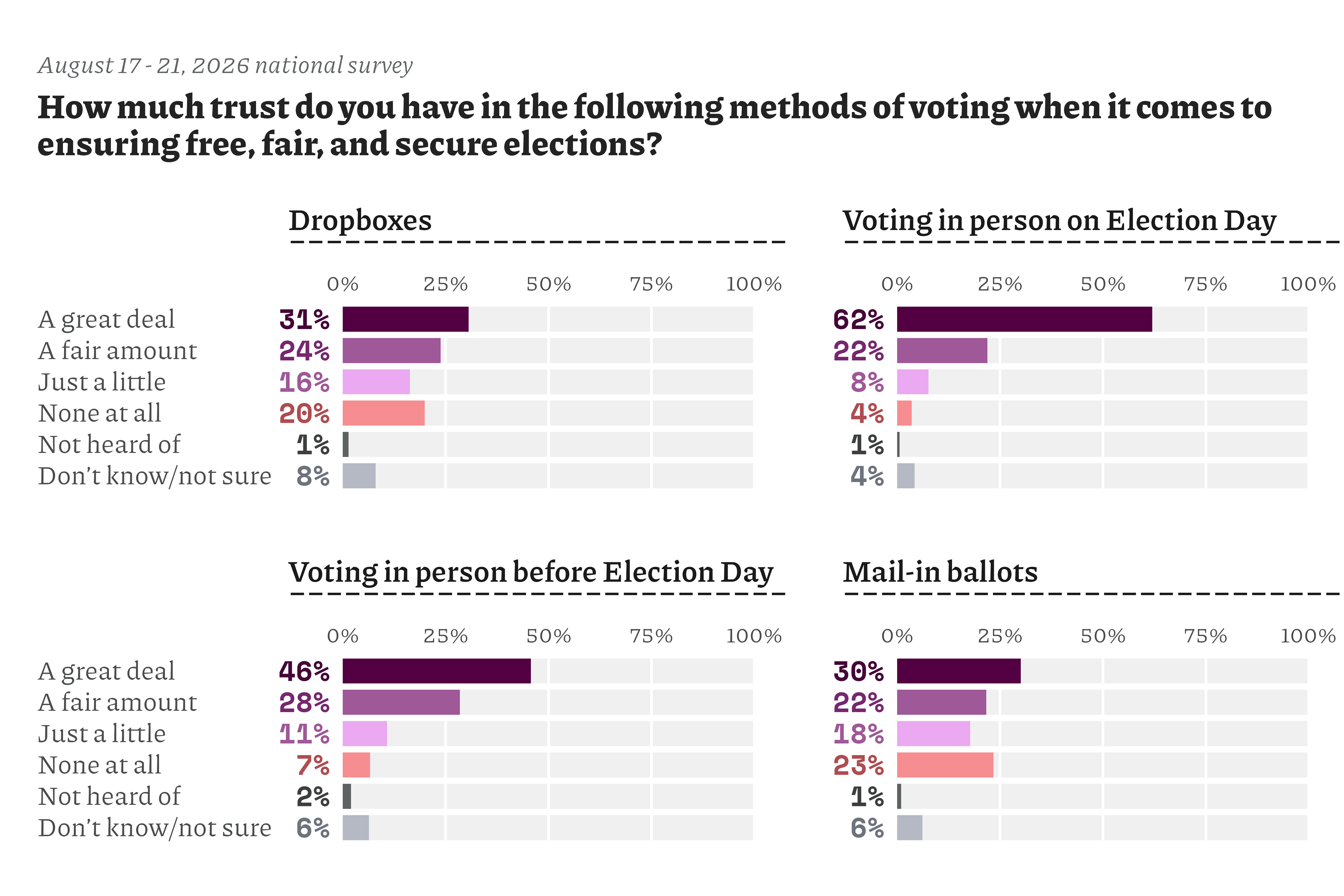
In the first set of key questions, Americans were asked how much they trusted the following methods of voting when it comes to ensuring free, fair, and secure elections: ballot drop boxes, voting in person on Election Day, voting in person before Election Day, and mail-in ballots. Most Americans showed a great or fair amount of confidence in each method of casting their ballot.
We also wanted to understand how Americans plan to vote in the 2026 midterm elections. Of those polled, 19% said they plan to vote by mail or by absentee ballot. That eclipses the number of Americans who plan to vote in person before Election Day (17%) and is about the same size as the share who say they will not vote at all (19%). Voting in person on Election Day remains the most popular way to vote (37%).
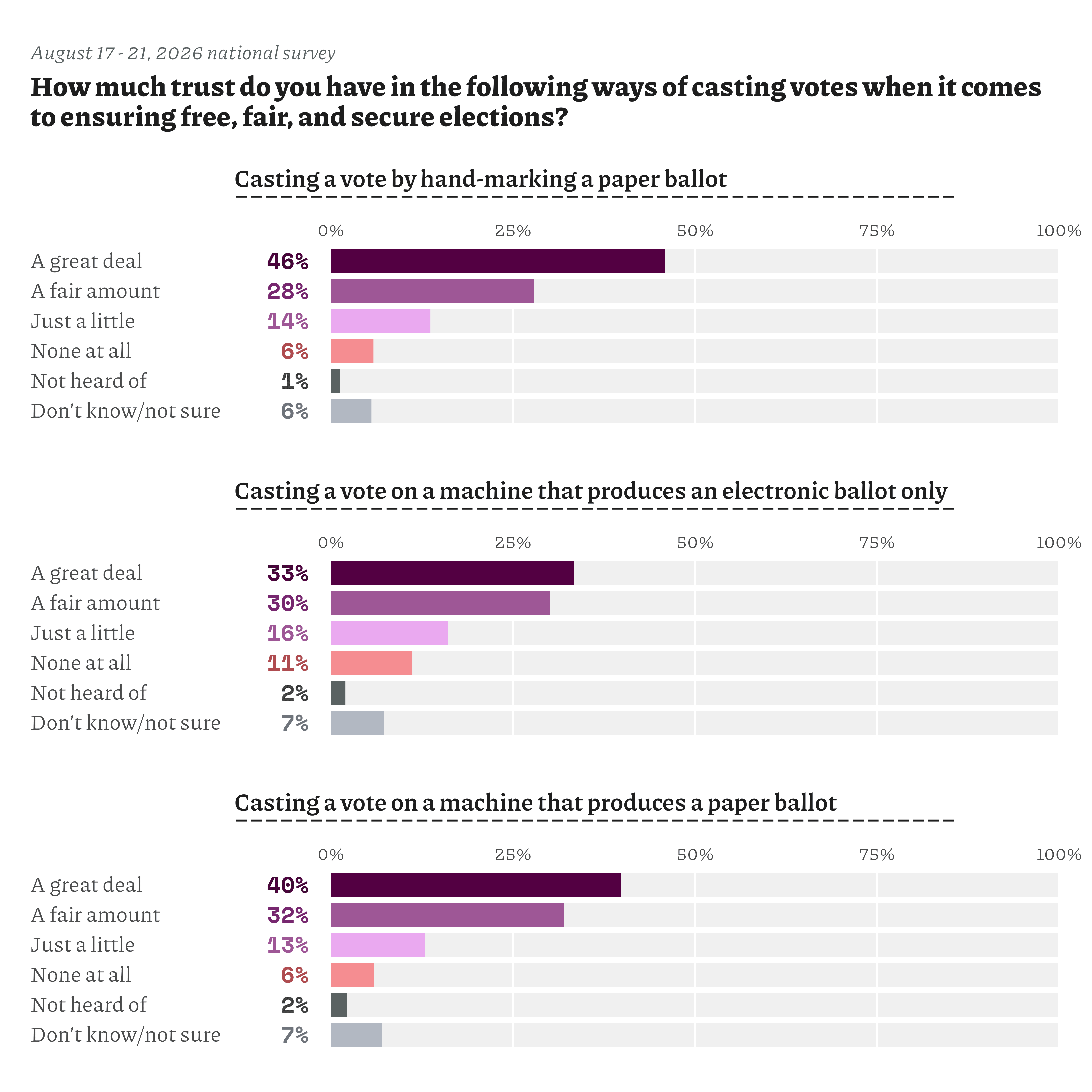
We asked Americans about their levels of trust in different ways of casting votes. Every way—hand-marking a paper ballot, using a machine that produces an electronic ballot, and using a machine that produces a paper ballot—was trusted either a great deal or a fair amount by a majority of respondents. Hand-marking a paper ballot received the highest marks, with 46% of respondents saying they trusted it a great deal.
States United also asked Americans how much they trust different ways of counting votes. Those included counting votes entirely by hand, using machines that scan paper ballots, using machines that scan paper ballots that are later verified by a hand count, and completely electronically using machines. Again, large majorities of Americans expressed either a great or a fair amount of trust in each.
These data are taken from a States United survey based on 1,528 interviews conducted on the internet of U.S. adults. Participants were drawn from YouGov’s online panel and were interviewed from Aug. 17 to 21, 2026. Respondents were selected to be representative of American adults. Responses were additionally weighted to match population characteristics with respect to gender, age, race/ethnicity, education of registered voters, and U.S. Census region based on voter registration lists, the U.S. Census American Community Survey, and the U.S. Census Current Population Survey, as well as 2022 midterm turnout and 2020 and 2024 Presidential vote. The margin of error for this survey is approximately ± 2.8 percentage points, though it is larger for the analysis of partisan subgroups described above. Therefore, sample estimates should differ from their expected value by less than the margin of error in 95% of all samples. This figure does not reflect non-sampling errors, including potential selection bias in panel participation or measurement error.
Following best research practices, we define “independents” as respondents with no partisan attachments and classify independent leaners as partisans.