Nearly 1 in 3 Americans From Across the Aisle Voted by Mail in 2024 and 2022
States United analysis reveals that white voters, voters 65+, and overseas U.S. military voters are among the groups that relied significantly on voting by mail in the last presidential election.
In This Resource
When Americans exercise their right to vote, they have the option to cast their ballot in a variety of ways according to the laws of their state. Voting by mail is one of the most widely used and trusted methods of voting, offered by every state in the country in some form. Voting by mail is a secure and reliable way that U.S. citizens make their voices heard.
On March 31, 2026, President Trump signed an executive order that bars the U.S. Postal Service from sending mail ballots to any voters not on a federal list. He also previously pledged to “get rid of mail-in ballots” entirely. But the U.S. Constitution gives states the power to decide how to run elections, including setting their policies for different voting methods based on what works for their communities.
States United sought to understand the use of mail voting today and the potential impact if it were not an option for voters. We examined the verified voting records of the 2024 general election and 2022 midterm elections and looked at the demographic breakdown of how Americans used this method of voting.
The results are clear: Tens of millions of Americans—from all political affiliations, backgrounds, and regions of the country—use mail voting to participate in our democracy.
- Nearly 1 in 3 Americans (31%) voted by mail in the 2024 general election, accounting for more than 48 million votes.
- Similarly, in 2022, nearly a third of Americans (32%) who cast a ballot did so by mail, accounting for more than 35 million votes.
- People of all demographics used mail voting. Some used it more than others:
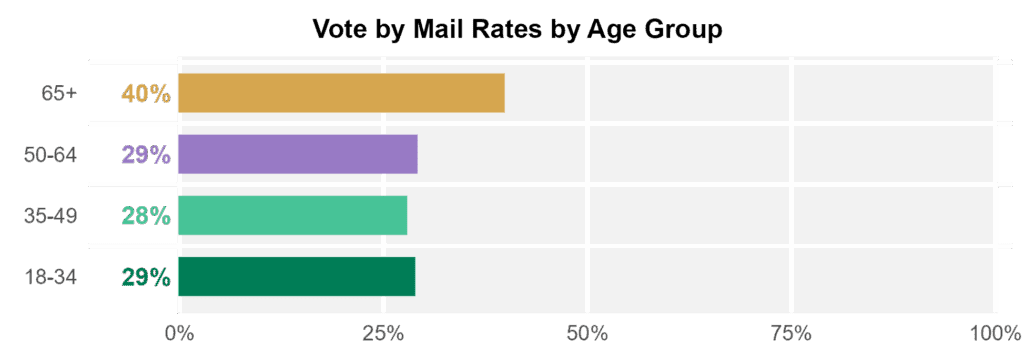
- Age: Voters ages 65 and older were most likely to use mail voting. Mailed ballots accounted for almost 40% of votes cast by this group in 2024 and 44% in 2022.
- Race: 1 in 3 white voters cast ballots by mail in 2024 and 2022, totaling over 27 million votes in 2024 and 23 million in 2022. White voters cast the greatest number of mail ballots of all racial demographic groups in both elections.
- Urbanicity: Voters in every geographic setting used mail ballots at high rates. In 2024, 1 in 3 suburban voters, 1 in 3 city voters, and 1 in 4 rural voters cast mail ballots. In 2022, just over 1 in 4 rural voters, 1 in 3 suburban voters, and roughly 2 in 5 urban voters cast their ballot by mail.
- Abroad: Hundreds of thousands of members of the U.S. military and U.S. citizens living abroad rely on mail ballots to cast their vote, sending 905,343 votes through the mail in 2024 and (fewer, as expected for a midterm election rather than a presidential year) 257,657 in 2022. Alabama and Florida were the states that received the largest number of mail ballots from U.S. citizens living and serving abroad in 2024, while Florida and California accounted for the top states in 2022.
- Party: Voters of every political affiliation cast ballots by mail. In 2024, both President Trump and Vice President Harris won multiple states in which the majority of ballots were cast by mail.
- In 2024, about 1 in 4 registered Democrats and 1 in 5 registered Republicans voted by mail, as well as 1 in 5 voters who registered with other parties or with no party. In 2022, around 1 in 3 registered Democrats, 1 in 6 registered Republicans, and 1 in 4 voters who registered with other parties voted by mail.
- If we consider the estimated party of voters (based on statistical modeling to include voters in states that don’t require party registration for primaries), more than 1 in 3 estimated Democrats, almost 1 in 4 estimated Republicans, and almost 1 in 3 estimated independents voted by mail in 2024. In 2022, 2 in 5 estimated Democrats, just under 1 in 3 estimated Republicans, and nearly 1 in 3 estimated independents cast mail ballots.
- In 2024, about 1 in 4 registered Democrats and 1 in 5 registered Republicans voted by mail, as well as 1 in 5 voters who registered with other parties or with no party. In 2022, around 1 in 3 registered Democrats, 1 in 6 registered Republicans, and 1 in 4 voters who registered with other parties voted by mail.
- In 2024, more than 1 in 3 registered Republicans voted by mail in five states (California, Colorado, Maine, Nevada, and Wyoming) and the District of Columbia.
- In 2024, more than 1 in 3 registered Democrats voted by mail in six states (California, Colorado, Iowa, Maine, Nevada, and Wyoming) and the District of Columbia.
Note: These demographic findings are based on 32 states with available data. The analysis reflects vote type data for 113,841,164 voters out of the total 156,766,239 voters who cast ballots in the 2024 general election, or roughly 72% of all votes cast. Additionally, this analysis reflects vote type data for 80,692,155 voters out of the total 108,717,981 voters who cast ballots in the 2022 midterm election, or roughly 74% of all votes cast.
See Methodology for more details.
By Age
For every age group, at least 1 in 4 voters cast a ballot by mail in 2024. Voters ages 65 and older were the most likely to vote by mail. These voters cast nearly 40% of their votes by mail.
By Race
White voters were the largest group of voters to cast votes by mail in 2024. About 1 in 3 white voters voted by mail, accounting for over 27 million votes in the states analyzed.

By Urbanicity
Americans chose to vote by mail in every type of geographical setting in the country. Nearly 1 in 4 rural voters, roughly 1 in 3 suburban voters, and just over 1 in 3 urban voters cast their ballot by mail.

By Voters Abroad
Hundreds of thousands of members of the U.S. military and U.S. citizens living abroad relied on mail ballots in 2024. Often referred to as UOCAVA voters (named after the Uniformed and Overseas Citizens Absentee Voting Act), these citizens accounted for 905,343 ballots cast in 2024.
The states with the largest number of ballots cast by members of the U.S. military and U.S. citizens abroad were Alabama (131,961), Florida (92,268), and California (82,549).
By Political Party
Registered Party
To assess mail voting trends by political affiliation, we first looked at available data from 10 states with closed primaries, where voters are required to register by party if they want to vote in a primary. (See Methodology for the full list of states.)
Mail voting was popular among registered voters across all parties in 2024. It was a voting option used by about 1 in 4 Democrats, 1 in 5 Republicans, and 1 in 5 voters registered to other parties.
In five states (California, Colorado, Maine, Nevada, and Wyoming) and the District of Columbia, more than 1 in 3 Republicans voted by mail.
In six states (California, Colorado, Iowa, Maine, Nevada, and Wyoming) and the District of Columbia, more than 1 in 3 Democrats voted by mail.

Estimated Party
For a fuller picture of vote type choices by voters across parties beyond what party registration can tell us, we examined vote type by estimated party—a modeled variable in the voter file that takes into account information about an individual to estimate which political party they likely identify with. We did this both because people often register as independent or unaffiliated even if they lean toward one political party or the other, and because some states do not have required party registration at all. This analysis by estimated party covers all 32 states that provide vote type data to the voter file, including those that do not have party registration.
The analysis confirmed that mail voting was popular among voters across all parties in 2024. It shows that when we include states without closed primaries in the analysis, we see even higher rates of mail voting.
More than 1 in 3 estimated Democrats, about 1 in 4 estimated Republicans, and almost 1 in 3 estimated independents, voted by mail.

Registered Party vs. Estimated Party
Using both registered party and estimated party to understand mail voting rates can be useful for different reasons. Mail voting rates by registered party offer concrete, clear statistics that make intuitive sense to a variety of audiences. We can be 100% certain of someone’s registered party, as it is an objective statistic recorded by secretaries of state, based on someone’s voter registration.
Mail voting rates by estimated, or modeled, party are useful for two reasons:
To include a greater number of states—32 in our analysis, as opposed to the 10 closed primary states for which we have data. Using estimated party allows us to include states that do not have party registration.
To capture partisan leanings by those voters who may register independent but align with a party ideologically or in how they personally identify. There can be large numbers of these voters in open primary states, where party registration is not required to vote in a primary.
To get a sense of how many voters may cast a ballot by mail in 2026, it’s better to compare data from the last midterm cycle in 2022. Compared to presidential elections, like 2024, fewer voters typically cast ballots in midterm years, and those who turn out for midterms tend to be more interested and invested in politics and, in turn, are more dedicated to voting.
Overall, around a third (32%) of those who cast a ballot in the 2022 midterms did so by mail, accounting for more than 35.7 million voters.
By Age
Voters who were 65 and older were the most likely to vote by mail (45%), while all other age groups hovered around 1 in 3 voters.

By Race
White voters cast more votes by mail than any other racial group, accounting for around 1 in 3 ballots cast by white voters (22.5 million).

By Urbanicity
Americans who live in every type of geographic setting chose to vote by mail. Roughly 2 in 5 urban voters, 1 in 3 suburban voters, and just over 1 in 4 rural voters cast their ballot by mail.

By Voters Abroad
Hundreds of thousands (257,657) of UOCAVA voters relied on mail voting in 2022. The states with the largest number of ballots cast by members of the U.S. military and U.S. citizens abroad were Florida (38,987), California (31,774), and Washington (26,579).
By Political Party
Registered Party
Using the same methodology as the 2024 data, we can see that mail voting was popular among registered voters across all parties in 2022. Just under 1 in 3 Democrats, roughly 1 in 6 Republicans, and just under 1 in 4 voters registered to other parties cast their ballots by mail.

Estimated Party
With the same methodology and similar outcomes as the 2024 data, we see that just under 1 in 3 estimated Republicans voted by mail, along with almost 1 in 3 estimated independents and more than 2 in 5 estimated Democrats.

Though there are some similarities in who voted by mail in 2024 and 2022, including around age and urbanicity, there are some notable differences.
By race, relatively fewer Hispanic voters and relatively more African American voters cast their ballots by mail in 2022 than 2024, compared to the number of voters casting their ballots by mail in other racial groups.
By party, there was a larger gap in the percentage of registered Democrats who cast votes by mail in 2022 compared to 2024 than there was for registered Republicans. Among Democrats, 30% cast mail ballots in 2022 compared to 26% in 2024. Among registered Republicans, the percentage was similar across the two years: 17% cast mail ballots in 2022 and 18% cast mail ballots in 2024.
Each state sets its own laws about voting by mail. As a result, usage of mail voting varies by state.
Some states conduct their elections primarily by mail. Concentrated in the Western part of the country, these states allow no-excuse absentee voting: California, Colorado, Hawaii, Nevada, Oregon, Utah, Vermont, and Washington. All of these states, except Oregon and Washington, also allow anyone the option to vote in person if they prefer. In Oregon and Washington, there is no in-person voting. However, if voters need assistance with mail ballots, they can go to certain voting offices for help.
On the other hand, several states offer more limited options for mail voting and see far fewer ballots cast by mail as a result. Concentrated in the South and substantial portions of the Northeast, states that require a specific excuse for mail voting (such as being sick, over the age 65, or out of the county during an election) include Alabama, Arkansas, Connecticut, Delaware, Indiana, Kentucky, Louisiana, Mississippi, Missouri, New Hampshire, South Carolina, Tennessee, Texas, and West Virginia.
Data were drawn from both the Election Administration and Voting Survey (EAVS) Comprehensive Report and the TargetSmart voter file accessed via Civis. In states where in-person or vote-by-mail EAVS data was incomplete (Alabama, Connecticut, Iowa, Mississippi, Montana, New Jersey, and Oregon), we included state-specific secretary of state voting data. The links to those state-specific totals can be found below:
- Alabama: Comprehensive Voter Turnout 1986-2024
- Connecticut: 2024 Statement of Vote
- Iowa: REPORT OF VOTERS REGISTERED AND VOTING
- Mississippi: Certification of Vote for Electors for President and Vice President and 2024 November General Election Absentee Report (November 4)
- Montana: 2024 Montana General Election Absentee Ballot Counts and Statewide Voter Turnout
- New Jersey: Total Number of Registered Voters, Ballots Cast, Ballots Rejected, Percentage of Ballots Cast and the Total Number of Election Districts in New Jersey
- Oregon: STATISTICAL SUMMARY November 5, 2024, GENERAL ELECTION
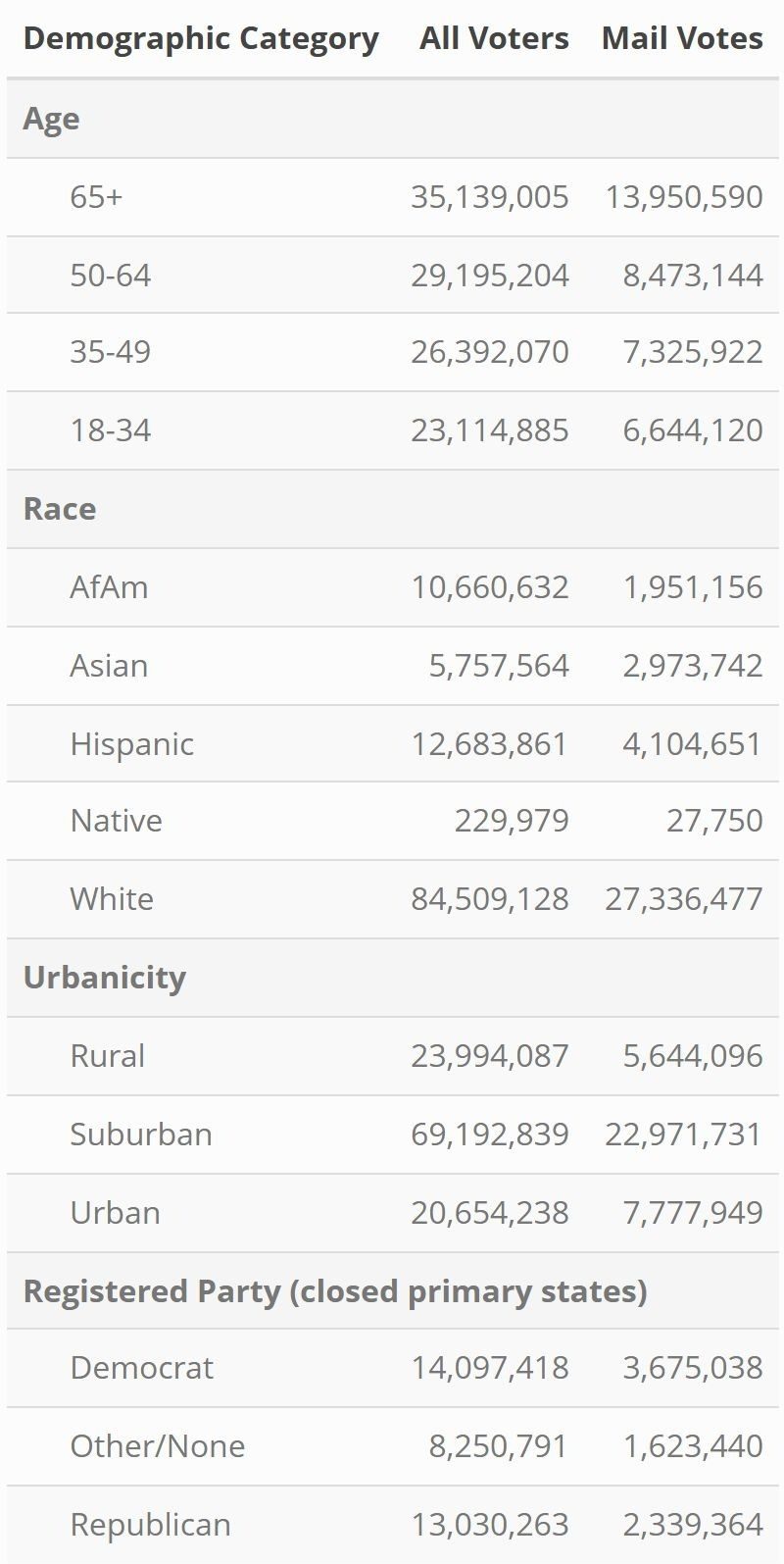
The table below provides the raw numbers on which the demographic charts are based: total numbers of those who voted from each demographic group and the numbers who voted by mail.
The following states are excluded from the demographic analysis because the TargetSmart voter file does not have any vote type data for them: Alabama, Delaware, Illinois, Kansas, Kentucky, Louisiana, Massachusetts, Michigan, Mississippi, Missouri, Nebraska, North Dakota, Ohio, Oregon, South Carolina, South Dakota, Utah, and Vermont.
For the analyses using registered political party, we examined states with closed primaries that require voters to register by party to vote in primary elections. Fourteen states and the District of Columbia have closed primaries: Connecticut, Delaware, Florida, Kentucky, Maine, Maryland, Nevada, New York, Oklahoma, Oregon, Pennsylvania, South Dakota, Utah, and Wyoming. Of these states, our analysis reflects nine of them, because five of these states did not have vote type data in the voter file. The five closed-primary states not reflected in this demographic analysis are: Delaware, Kentucky, Oregon, South Dakota, and Utah. For analyses using estimated political party, the modeled variable comes from TargetSmart. See here for more information on their methodology.