Dollars and Sense
Plus: The DOJ sues California over its voter rolls. 🗳️
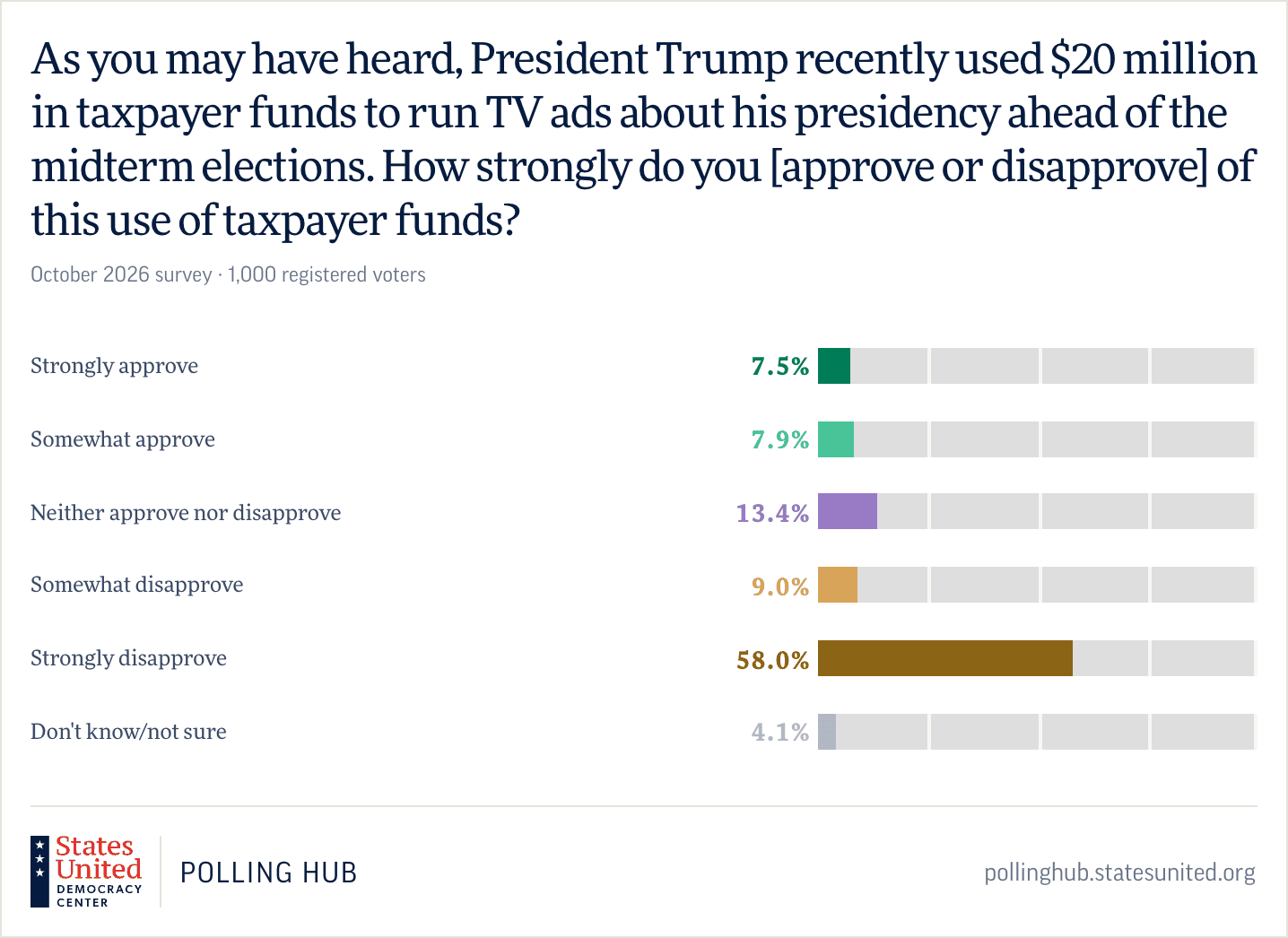
Last weekend, a federal judge in New York ordered the Trump administration to cancel its taxpayer-funded television ads containing political, pro-Trump messages. The Wall Street Journal reported that the ad campaign was paid for using money from the Department of Homeland Security (DHS).
After the ads first aired last month, the president said that his political action committee would pay for them instead of using DHS money. But an NPR analysis found that the administration spent nearly $10 million on the ads after that announcement. It has spent more than $20 million in total on the campaign.
States United surveyed registered voters about the administration’s use of taxpayer dollars to pay for the ads and found that a clear majority—67%—disapprove. A similar survey conducted by Reuters found that nearly nine in ten Americans said it’s inappropriate to use taxpayer money to fund election-related TV ads featuring the president or his cabinet.
States United continues to survey Americans about elections, democracy, and the rule of law. You can find all our surveys on our Polling Hub.
This Week in Democracy
The Trump administration sues California over allegations about voter rolls
The Justice Department sued top election officials in California, alleging that “likely noncitizens” in the state received mail ballots. The lawsuit is asking a judge to order election officials to set aside thousands of ballots in the November elections.
California Secretary of State Shirley Weber pushed back on the federal government’s demands, noting that they risk denying thousands of Californians the right to vote and that the department refused to provide any details about how it identified the voters.
“California’s elections officials work every day to ensure that only eligible voters are registered, to maintain accurate voter rolls, and to guarantee that no eligible voter is denied the opportunity to vote,” Weber wrote in her response, adding that she would not deprive thousands of Californians of their right to vote based on the administration’s “unsupported and likely inaccurate” allegations.
➡️ MORE: What’s Breaking Through About False Claims of Noncitizen Voting
Judge halts the Justice Department’s pursuit of state voter data
A federal judge ruled that the Trump administration overstepped its authority and violated federal law in its effort to essentially take over the responsibility of list maintenance from the states, writing that the federal effort “removed United States citizens from the voter rolls in their home states and risks disenfranchising many more.”
Some states willingly provided voter data to the administration. The Justice Department has brought 31 lawsuits seeking voter data from states that did not voluntarily provide the data; it has yet to win any of them.
➡️ MORE: Sharing the Facts About Federal Efforts to Compile State Voter Data
Judge blocks the White House’s press ban
A federal judge issued another ruling blocking the Trump administration from banning CNN, MS NOW, and Politico from White House grounds. The president announced the ban last month, saying that their coverage of him was too negative. The news organizations quickly sued, arguing that the ban was a “direct assault on the First Amendment.” The administration has appealed this week’s ruling.
Relatedly, the Justice Department is investigating five major U.S. television networks over their collective decision to suspend coverage of Trump after the White House barred CNN from covering him.
➡️ MORE: Survey: Americans Don’t Believe Critical Press Coverage of Trump Is ‘Really Illegal’
The Trump administration is still targeting the president’s political rivals
Federal agents searched the home of U.S. Rep. Ilhan Omar as part of an investigation into immigration paperwork from her childhood. Omar, a naturalized U.S. citizen, wrote on social media that the search was “an attempt to target political enemies and weaponize federal law enforcement.”
Trump also ordered the creation of a committee to investigate Federal Reserve governor Lisa Cook, who has refused his calls to quickly lower interest rates. It’s the president’s latest attempt to oust Cook from her position; he attempted to fire her last year, but she sued to block him from doing so.
➡️ MORE: How Politicized Prosecutions Undermine the Rule of Law
State of the States
In D.C., an appeals court heard arguments about the Trump administration’s deployment of National Guard troops in the nation’s capital. According to reports, the three-judge panel appeared likely to uphold a lower court ruling that ordered federal officials to end the deployment.
“It violates the law and the principles on which this country was founded to have the U.S. military policing the streets of any American community, including the District of Columbia,” D.C. Attorney General Brian Schwalb said in a statement.
➡️ MORE: Survey: Americans Say Local Law Enforcement Should Handle Crime—Not the National Guard
In Colorado, the Trump administration sued Denver over a city policy that bans law enforcement officers from wearing masks. The city adopted the policy in March in response to federal immigration enforcement operations.
“We think law enforcement should be transparent and accountable,” Denver Mayor Mike Johnston said in a video.
“We will make sure that every law enforcement officer, local or federal, that operates in Denver does not wear a mask and is easily identifiable to the public,” Johnston added. “That’s the way to keep the city safe, and we’re going to stand by it.”
The Government Accountability Office, a federal watchdog agency, recommended that ICE agents should wear cameras that activate automatically in specific circumstances, like when a vehicle’s emergency lights are turned on. This week, the Department of Homeland Security—ICE’s parent agency—rejected that recommendation.
➡️ MORE: What’s Breaking Through About Federal Law Enforcement Tactics
In New York, a federal judge dismissed the Trump administration’s lawsuit against New York City. The administration filed the lawsuit last year over city policies that limit the extent to which local law enforcement can cooperate with federal immigration authorities.
“The federal government came to court seeking to force New York City to turn its public servants into deportation agents and divert our resources toward carrying out ICE’s cruel agenda,” New York Mayor Zohran Mamdani said in a statement. “Today, they lost.”
In Wisconsin, state election officials issued guidance to help clerks prepare for the possibility of federal law enforcement appearing at polling places in November.
“We expect voters to have the same experience that they’ve had at previous elections, and so by no means are we looking to make anybody feel panicked or anything about this,” said Meagan Wolfe, the administrator of the Wisconsin Elections Commission. “But clerks are asking very directly for this type of information because they are getting hundreds of emails from voters and from groups asking, ‘Do you have a plan if these sorts of things were to happen?’ And so, I see this just like any other contingency planning that we do to assist our clerks.”
➡️ MORE: What’s Breaking Through About Deploying Federal Agents to Polling Places
In the News
Reuters: Nine ways the Trump administration could interfere with the midterms
The apprehension about election interference is heightened by the rise in the number of state officials who have embraced Trump’s false claims that the 2020 election was stolen. States United Action, which tracks candidates who challenge the legitimacy of US elections, says such officials now hold at least one statewide office with election oversight authority in 20 states, up from 17 in the previous election cycle.
The Atlantic (gift link): What Trump’s Chatbot Told Me About the Election
The Brennan Center study—and similar tests run this year by other organizations, including the pro-democracy group States United—found that it has become easy for AI to create confusion before, during, and after an election. …
The chatbots did provide some guardrails. When researchers posed as election skeptics and tried to prompt various chatbots to confirm a series of conspiracy theories, the models consistently tried to debunk such claims. The States United probe found that the models improved their accuracy over time, and ChatGPT and Google AI both became markedly more accurate in answering election-related inquiries from late 2025 to early 2026.
Talking Points Memo: Docs Reveal New Details About Dramatic Admin Efforts to Substantiate the Non-Citizen Voting Myth
There are by one tally a staggering 197 election deniers on the midterm ballots next month, according to newly released research from States United Action.
… “Our 2026 research shows how deeply embedded the election denial movement is, even as fewer Election Deniers are running for office than we saw in 2022,” Kelly Rader, Research Director at States United Action, said in a press release this week. “The election denial movement is showing up across every facet of our democracy — from the ballot box to the White House.”
Votebeat Pennsylvania: Bucks County sheriff joins movement pledging not to interfere with elections
Both of those sheriffs were associated with the constitutional sheriffs movement, which, according to the States United Democracy Center, believes that a sheriff’s authority within their county is supreme, superseding that of other law enforcement agents or government officials. Membership in the Constitutional Sheriffs and Peace Officers Association is not public, but leaders have said as many as 10% of the county’s sheriffs are a part of that movement.
MassLive: Project tracking Trump’s funding cuts finds $5.91B in losses to Mass.
The Lost Funds Project, an initiative by Grant Witness and the nonpartisan States United Democracy Center, has counted $174 billion in canceled and slowed funding across the nation during the Trump administration. At the same time, states have turned to the courts, joining together to file 23 lawsuits, which has helped restore about $35 billion, according to the project.
… Kelly Rader, States United Democracy Center research director, said in a statement that the project shows the effects of the cuts on the American people.
“Congress approved this funding, and the Trump administration does not have unilateral authority to simply override those decisions and withhold money from the communities it was meant to serve,” Rader said.
Reno Gazette Journal (Column): Nevada’s election challenge: Secretary of state candidates
The good news in one study: Data from the States United Democracy Center found that “roughly 65% to 67% of adults express higher trust in local election officials, compared to much lower confidence in broader national election systems or federal oversight.”
Recommended Reading
The New York Times asked a group of election experts about the Trump administration’s attempts to take more power over election administration ahead of the midterms. The group included Vanita Gupta, former U.S. Associate Attorney General and a member of States United’s Bipartisan Advisory Board.
“The Constitution gives primary authority over elections to states, not to the president,” Gupta said. “Trump is deploying federal agencies to hunt for fabricated problems, with a goal of discrediting results he doesn’t like. This playbook will fail because our elections are decentralized and because state officials and organizations have been preparing for it.”
You can read the full piece at this link, no subscription required.