This One Is Illegal Too
Plus: A new court filing from States United. 🗳️
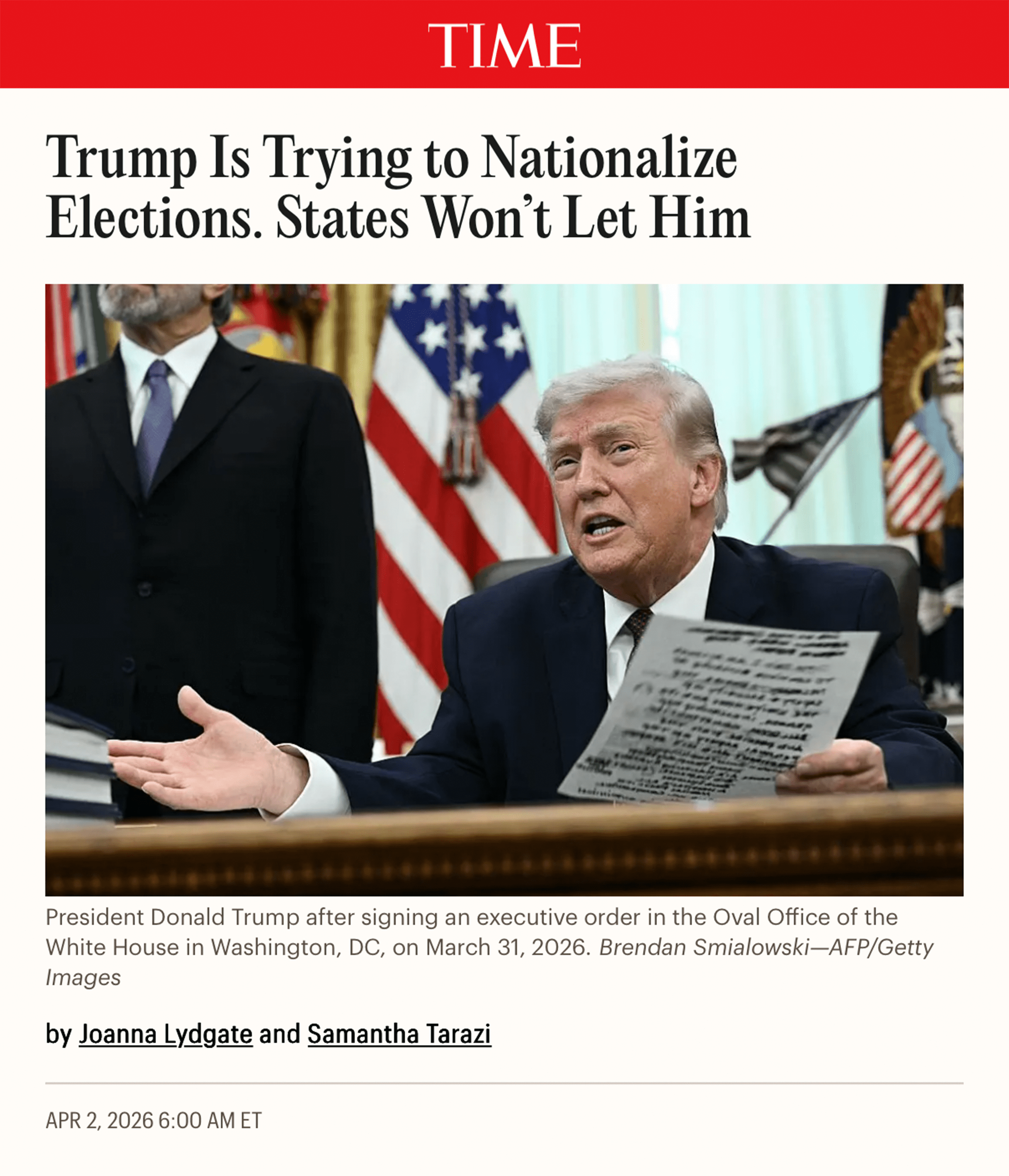
President Trump’s latest election-focused executive order, just like the last, has one big thing standing in its way: the Constitution of the United States.
At its core, the president’s order attempts to tell state election officials how to do their jobs. But the Constitution is clear: States run elections. It’s written plainly in Article I, which says that “The Times, Places and Manner of holding Elections … shall be prescribed in each State by the Legislature thereof”.
Congress is the only branch of the federal government with the power to set election laws. The president is given no authority over elections, and States United research shows that the American people don’t want him to be involved in how elections are run. The president’s only job in elections is to run for office.
State officials across the country from both parties know this and were quick to push back on the president’s order.
New Hampshire Secretary of State David Scanlan, a Republican, said in a statement that the Trump administration “cannot usurp New Hampshire’s express constitutional authority to run elections,” nor can it force state officials to violate state and federal election laws, “including those that protect the privacy of voter information.”
The order is “another desperate, illegal power grab,” said Oregon Secretary of State Tobias Read, a Democrat. “The Constitution is clear: states run elections.”
“My message to the President: we’ll see you in court,” Read added.
➡️ READ: Sharing the Facts About Trump’s Second Executive Order on Elections
This Week in Democracy
- President Trump signed a second executive order targeting elections, this time attempting to limit who can use mail ballots to vote and ordering the U.S. Department of Homeland Security to create lists of U.S. citizens in each state. Like the first, the order is fundamentally illegal and is already facing multiple lawsuits, including one by 23 state attorneys general.
“President Trump has once again signed an unconstitutional executive order trying to grab that power for himself,” States United CEO Joanna Lydgate said in a statement. “But it won’t work—states have successfully fought this type of illegal overreach once, and they’ll do it again.”
➡️ READ: Sharing the Facts About Trump’s Second Executive Order on Elections
- A group of professors and scholars represented by States United filed a brief urging a court to uphold district court decisions blocking Trump’s executive orders targeting law firms. The executive orders, signed by the president early last year, attempted to penalize law firms associated with his political rivals. Judges quickly blocked the orders from going into effect, ruling that they unconstitutionally tried to limit free speech.
➡️ MORE: About the brief
- The U.S. Supreme Court heard arguments about the constitutionality of Trump’s executive order that seeks to end birthright citizenship, the constitutional guarantee that everyone born on American soil—with few exceptions—is automatically granted U.S. citizenship. According to reports, a majority of justices seemed skeptical of the order and are likely to strike it down.
- Trump fired U.S. Attorney General Pam Bondi, reportedly in large part because the Justice Department’s attempts to prosecute his political rivals have been unsuccessful.
➡️ READ: How Politicized Prosecutions Undermine the Rule of Law
State of the States
In Colorado, the state Court of Appeals upheld Tina Peters’ conviction but ordered a judge to reconsider her nine-year sentence.
Peters is a former county clerk who was convicted of participating in a security breach of her county’s election equipment in an effort to prove the 2020 election was rigged against President Trump. The president has been pressuring Gov. Jared Polis to free Peters from prison, including by attempting to freeze the state’s federal funding. Trump also signed a pardon for Peters, even though presidential pardons have no impact on state crimes.
“Whatever happens with her sentence, Tina Peters will always be a convicted felon who violated her duty as Mesa County clerk, put other lives at risk, and threatened our democracy,” Colorado Attorney General Phil Weiser said in a statement following the appeals court’s decision. “Nothing will remove that stain.”
In Texas, voting rights groups sued state officials, arguing that the state used a faulty program to verify the citizenship status of the state’s registered voters and asking a judge to bar the state from continuing to use it.
The program, known as Systematic Alien Verification for Entitlements (SAVE), is run by the U.S. Department of Homeland Security and was originally designed to verify the citizenship status of people applying for benefits like food stamps and Medicaid. The Trump administration repurposed SAVE to verify voters’ citizenship, but it has proven to be unreliable. Last year, Texas county election officials found that hundreds of people identified by the program as “potential noncitizens” had, in fact, already provided proof of their citizenship to the state’s Department of Public Safety.
➡️ READ: More about SAVE
Recommended Reading
States United CEO Joanna Lydgate and Samantha Tarazi, the CEO of Voting Rights Lab, write in Time that state leaders have a responsibility to stand up to President Trump’s attempts to take election powers from states.