Americans Have Concerns About Elections. But They Still Believe Their Votes Will Count.
Voters are heading into November’s midterms on the heels of years of lies and attacks designed to undermine confidence in our elections.
Those attacks have intensified during President Trump’s second term. The Trump administration has tried to assert more federal control over state-run elections, continued to push false claims about widespread fraud, and took actions based on conspiracy theories about the 2020 election.
All of that takes a toll on how people feel about elections.
But new States United research shows something important: Americans have concerns about our elections, but most still believe their votes will count.
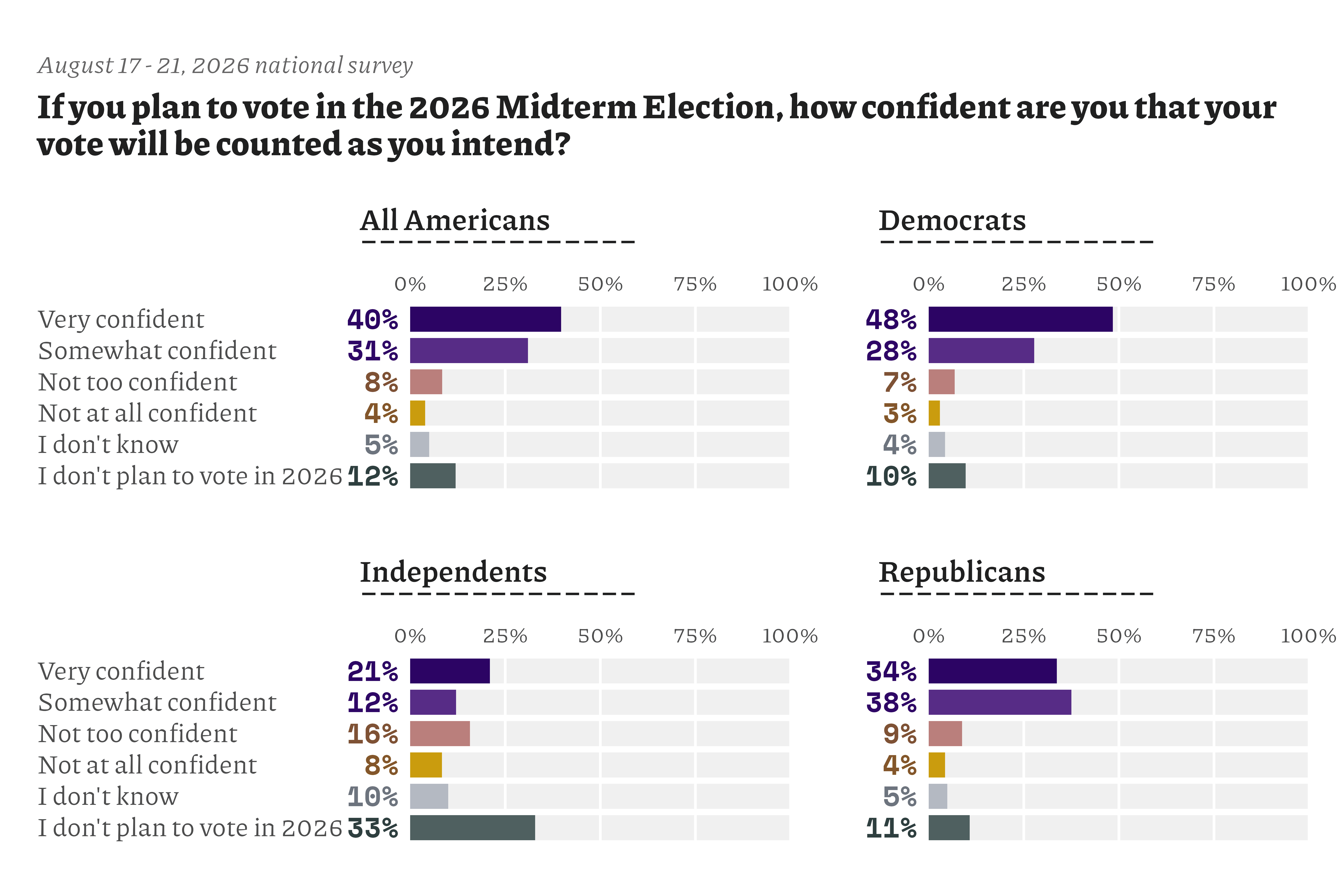
Just over 7 in 10 Americans say they are confident their own vote will be counted as intended in the 2026 midterms. Around six in 10 are confident that votes across the country will be counted as intended.
That confidence matters.
“People have real anxieties about the election, and those anxieties have shifted over the past year,” said Kelly Rader, Research Director at the States United Democracy Center. “But the good news is that Americans remain very confident their own votes will count—and we know that confidence is closely connected to whether people cast a ballot.”
These findings offer a more complicated—and more encouraging—story about voter confidence than political rhetoric might suggest.
Americans Trust That Their Votes Will Count
When Americans are asked whether elections are free, fair, and secure, their answers are mixed. But ask them a more concrete question—how confident are you that your vote will be counted as you intend?—and confidence is much higher.
Seventy-one percent of Americans say they are very or somewhat confident their ballot will be counted as intended this November.
And this isn’t a partisan story. Seventy-six percent of Democrats and 72% of Republicans say they are confident their own vote will count.
Americans are confident in other people’s votes, too. Sixty percent say they are very or somewhat confident that votes nationwide will be counted as intended.
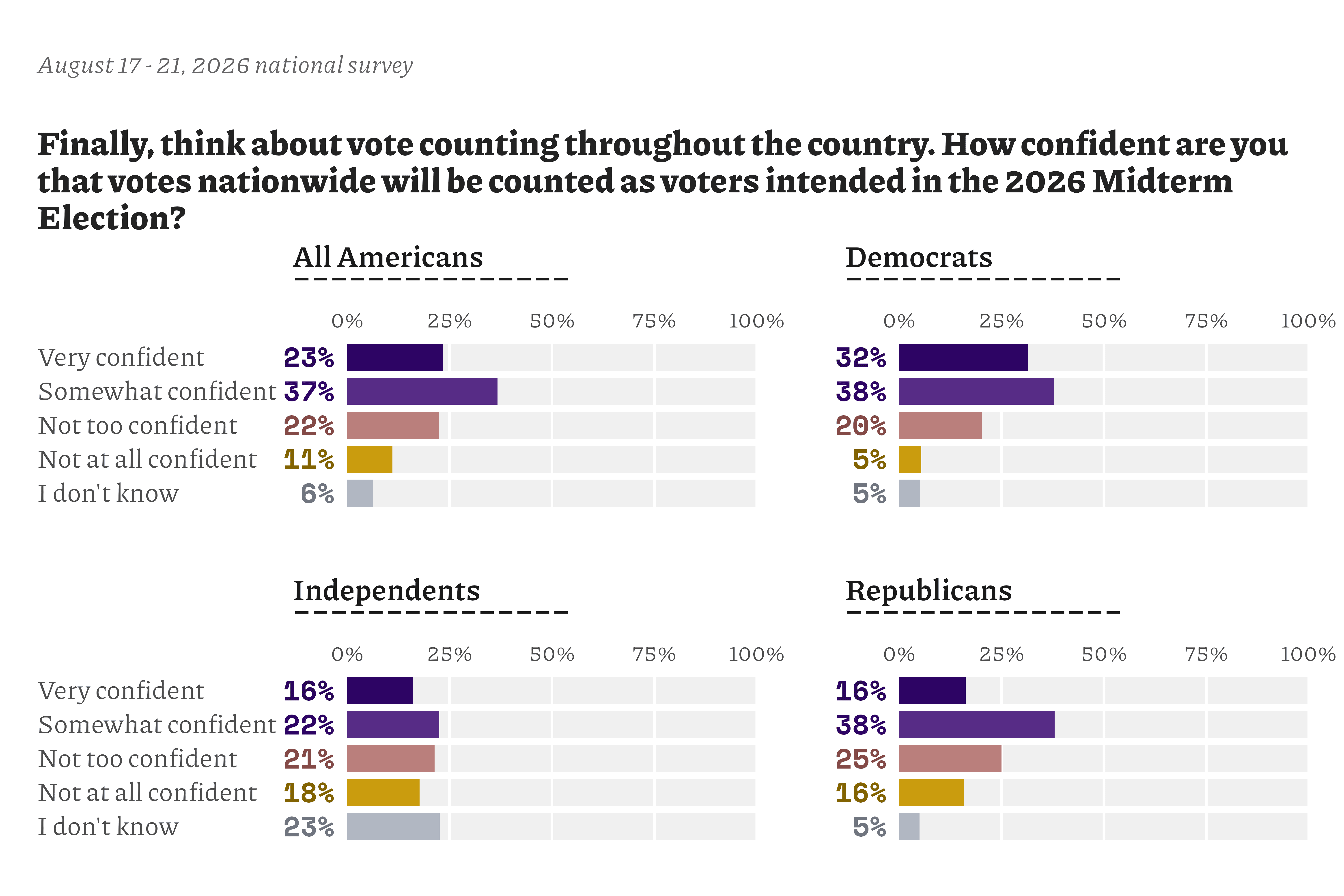
While there is a gap between how people feel about their own ballot and how they feel about votes in the country as a whole, there is also a broad foundation of confidence in one of the most fundamental promises of American democracy: You cast your vote, and that vote counts.
The Bigger Picture Is More Complicated
Americans are less confident when asked about elections in the abstract.
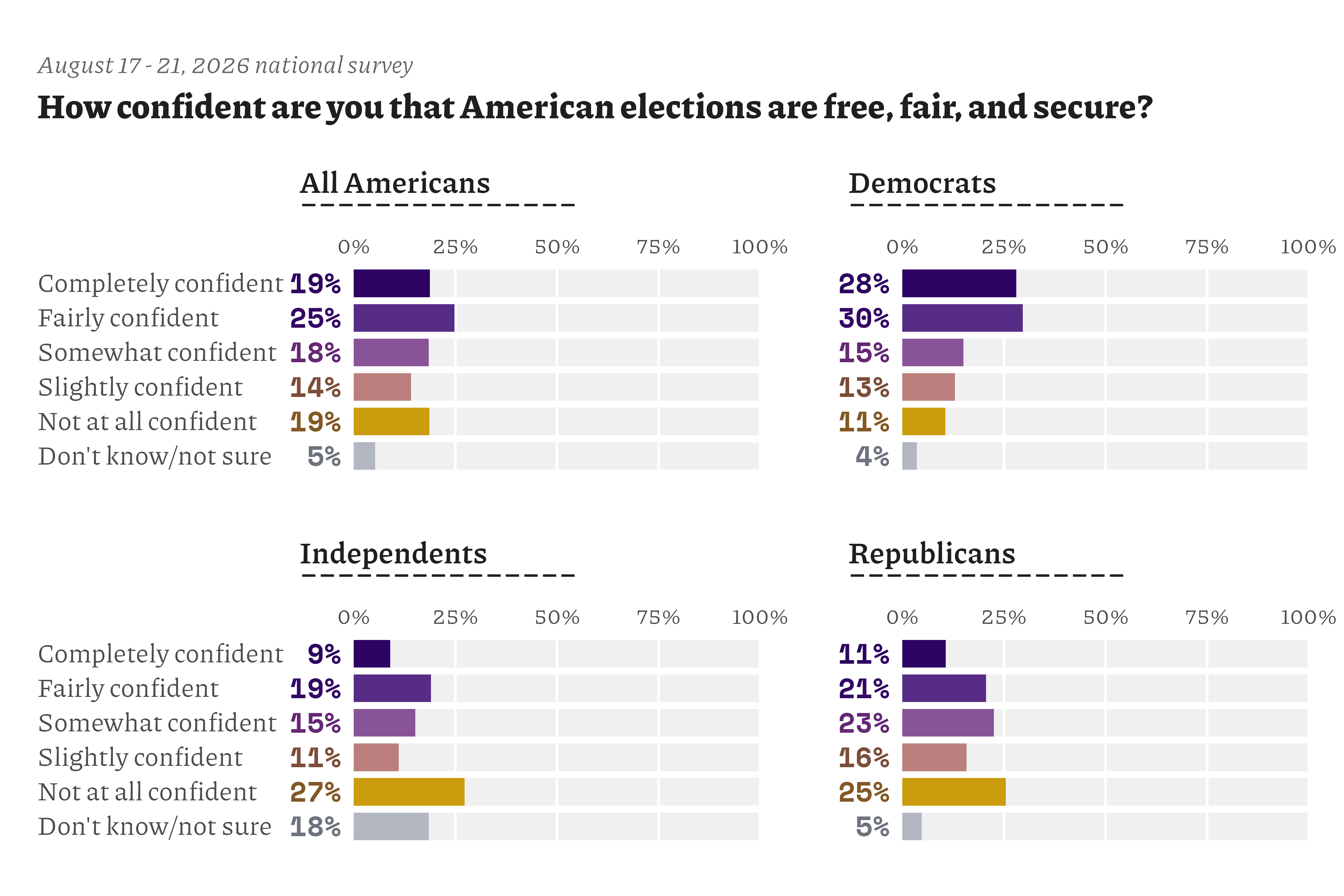
Forty-four percent say they are fairly or completely confident that American elections are free, fair, and secure. Thirty-three percent express low confidence.
Those views are also more partisan. Fifty-eight percent of Democrats express high confidence in American elections, compared with 32% of Republicans and 28% of independents.
And confidence has moved around considerably since the 2024 election.
Immediately after Trump’s victory, Republican confidence jumped while Democratic confidence fell—a familiar pattern after elections. But something unusual happened next: Confidence continued to decline throughout 2025 across both parties.
By December 2025, just 34% of Americans expressed high confidence that elections were free, fair, and secure—down from 47% just before the 2024 election. Since then, the numbers have started moving in the other direction. By August 2026, high confidence had risen to 44%.
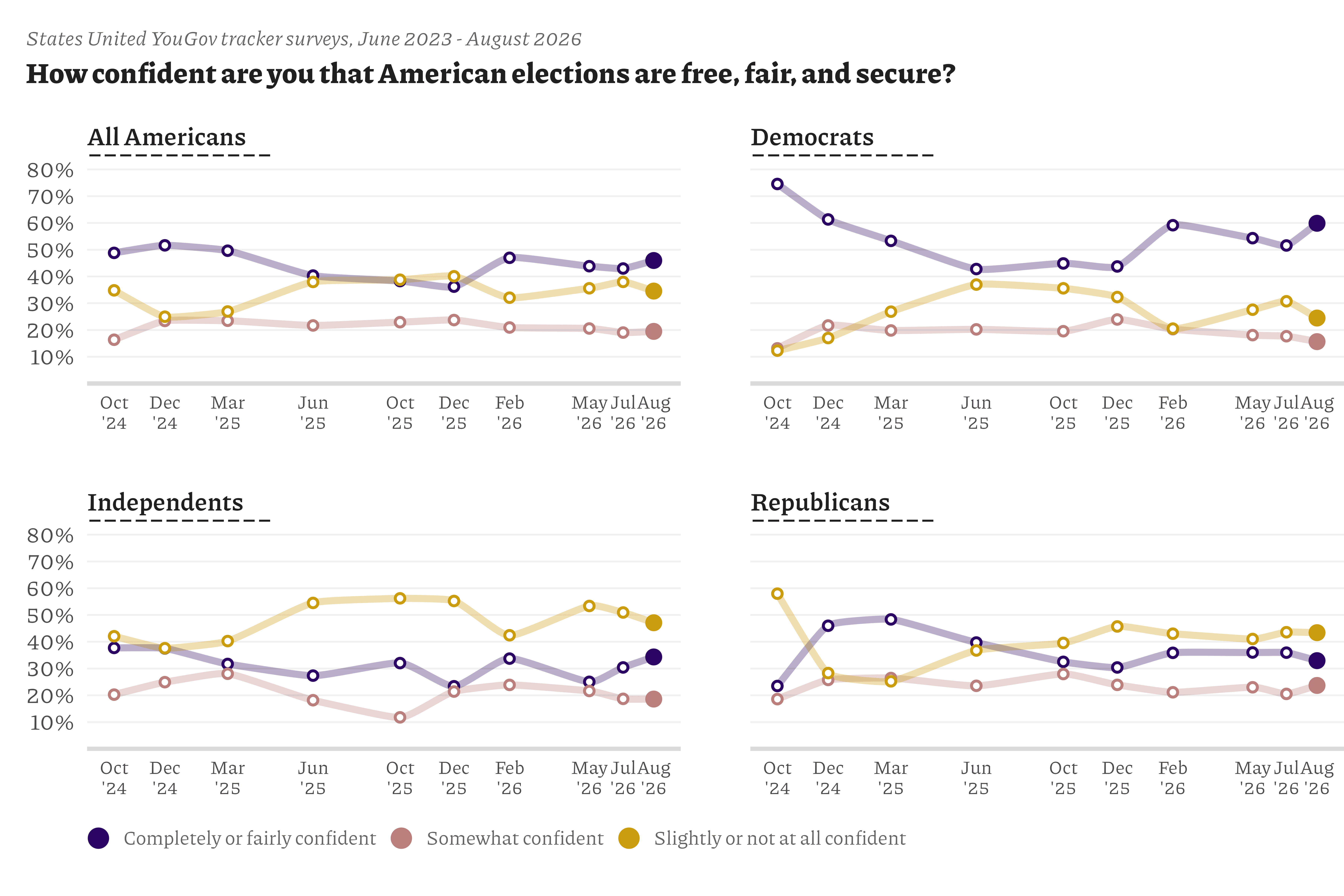
That recovery is encouraging. But the data also show the lasting effects of years of attacks on elections.
Election Lies Have Left a Mark
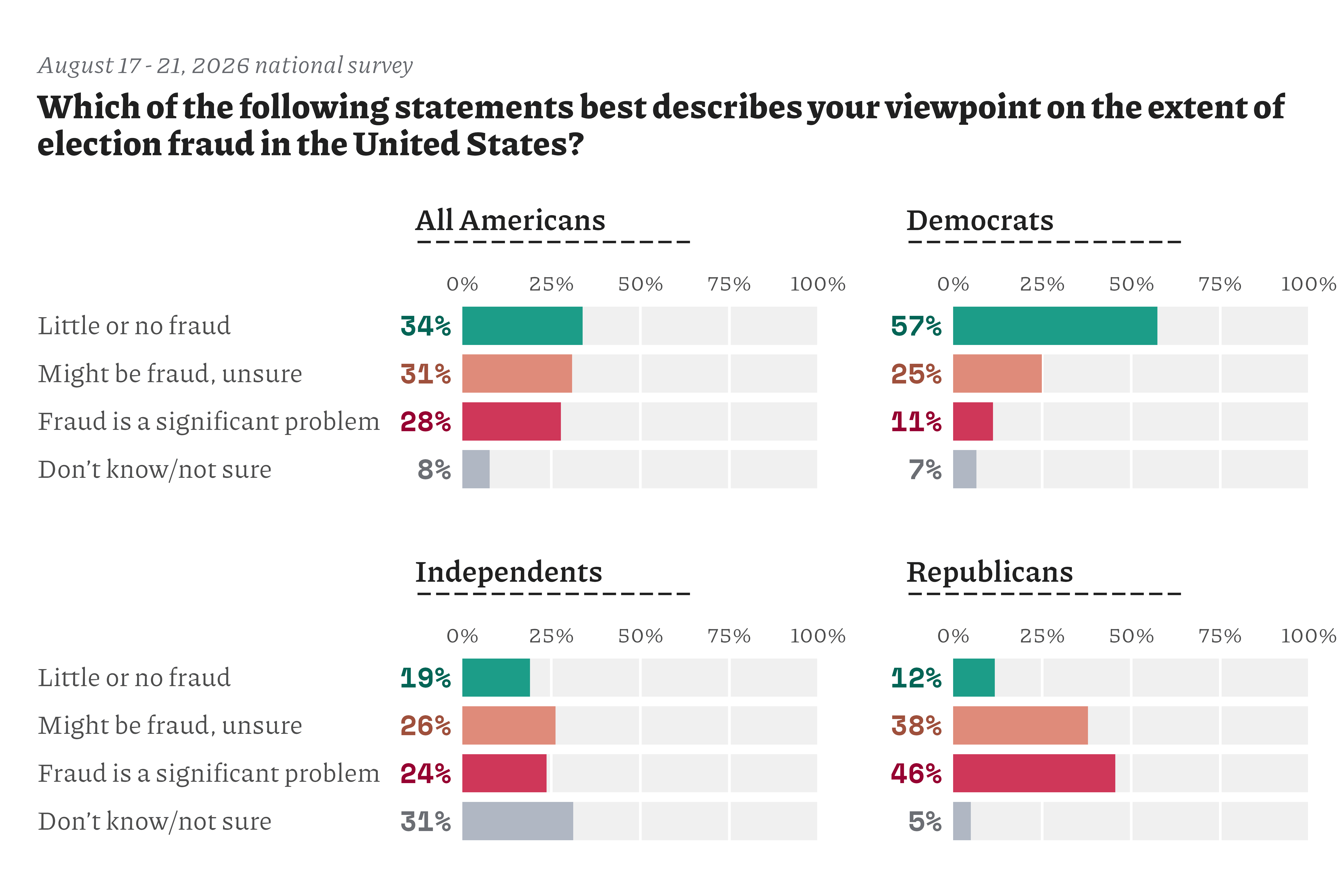
About a quarter of Americans (28%) believe election fraud is a significant problem. Another 31% worry there might be fraud but aren’t sure how common it is.
The partisan divide is striking. Forty-six percent of Republicans say fraud is a significant problem, compared with far fewer Democrats (just 11%).
Still, election denial has not won over most Americans.
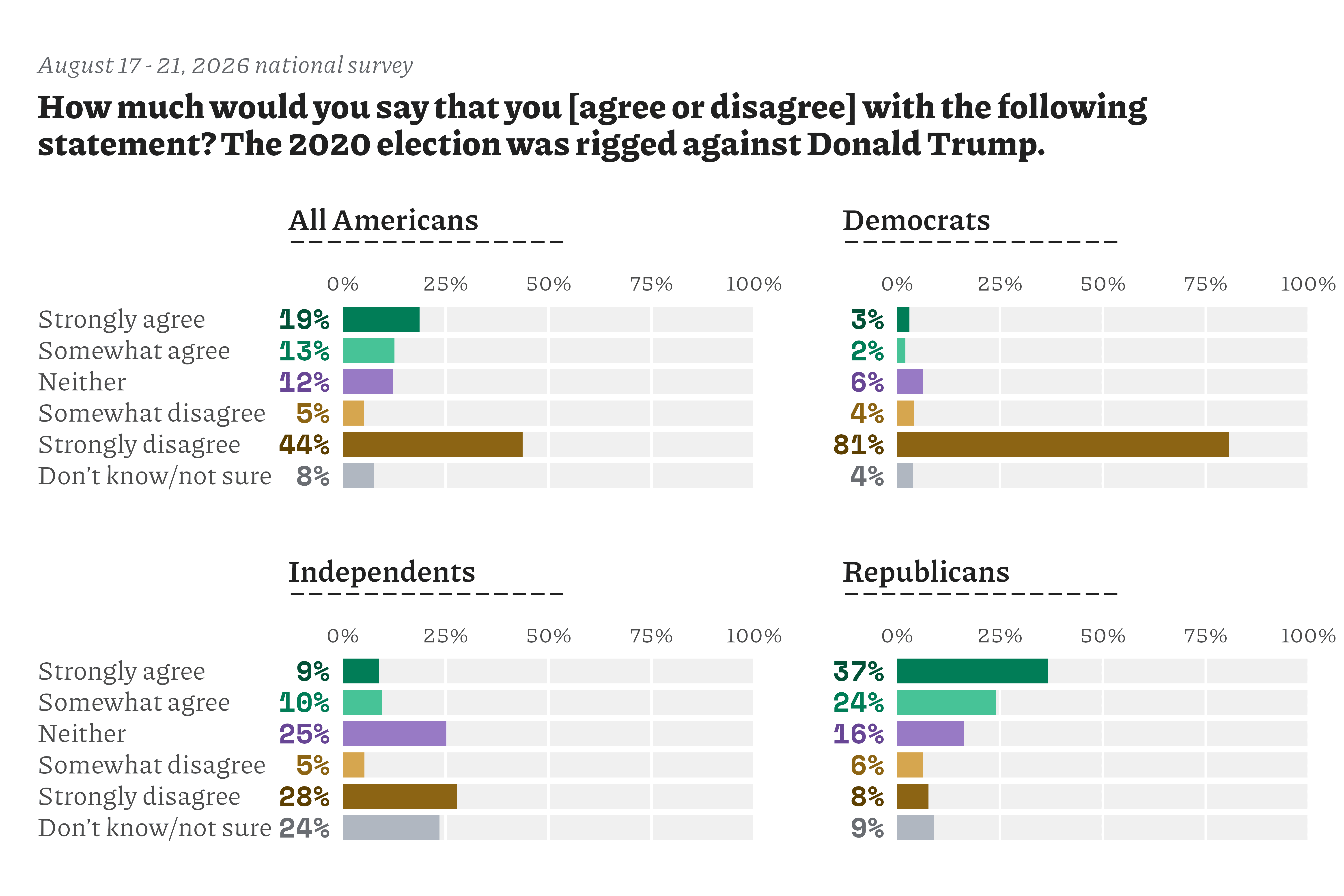
Nearly half of Americans (49%) disagree that the 2020 election was rigged against Trump: just 32% agree.
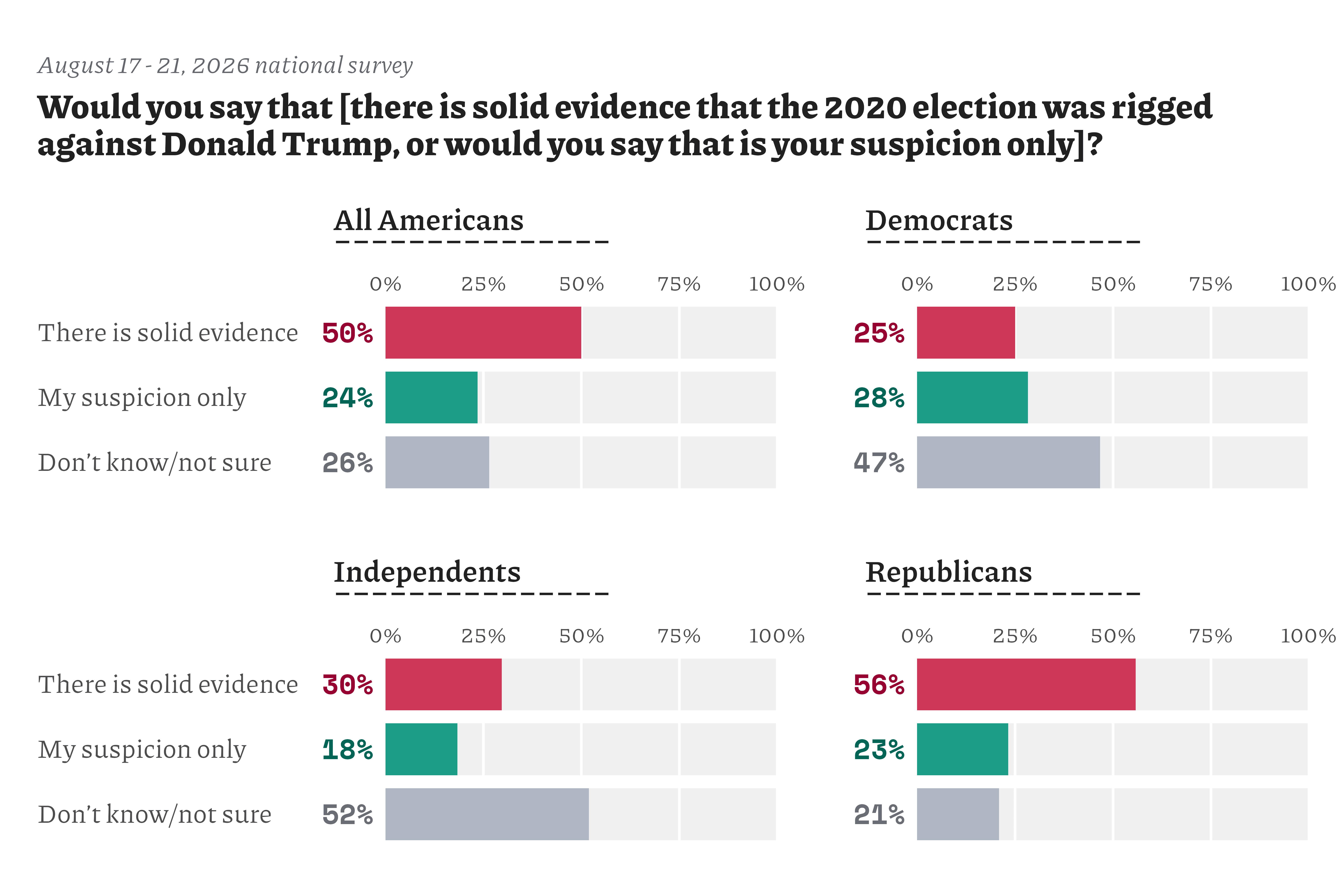
Among those who agree, half believe there is solid evidence while the rest are either unsure or say they’re only suspicious.
Our focus groups put some of these numbers into perspective.
Democrats raised concerns about federal interference and what the Trump administration might do around elections. Republicans talked about voter fraud, voter ID, and lingering suspicions about 2020. Independents voiced concerns from both directions.
But one theme crossed party lines: People tended to have more confidence in elections close to home.
“I absolutely trust the elections in our county are honest whether the person I want has won or not,” one Republican woman told us.
An independent man described a similar divide: “My confidence has only changed nationally as opposed to locally.”
That distinction matters. Elections aren’t an abstract national process. They are run in communities across the country by state and local officials who follow detailed procedures to make sure eligible voters can cast a ballot, and those ballots are counted accurately.
There’s a Strong Foundation to Build On
Years of election lies have created real doubt. That shouldn’t be ignored. But neither should the other side of this story.
Most Americans believe their votes will count. Democrats and Republicans share remarkably similar levels of confidence in their own ballots. And after falling in 2025, broader confidence in elections is beginning to recover.
“Concerns about elections are real, and officials should take them seriously,” Rader said. “But voters also have a strong foundation of confidence in the part of democracy that matters most to participation: the belief that when they cast a ballot, it will be counted. The work now is to protect and strengthen that confidence heading into November.”
Election officials can help do that by continuing what they already do every election: run careful, transparent processes and give voters reliable information about how voting works.
Because amid all the noise surrounding elections, Americans still believe in something fundamental: Their vote matters.
Methodology
These data are taken from a States United survey based on 1,528 interviews conducted on the internet of U.S. adults. Participants were drawn from YouGov’s online panel and were interviewed from Aug. 17 to 21, 2026. Respondents were selected to be representative of American adults. Responses were additionally weighted to match population characteristics with respect to gender, age, race/ethnicity, education of registered voters, and U.S. Census region based on voter registration lists, the U.S. Census American Community Survey, and the U.S. Census Current Population Survey, as well as 2022 midterm turnout and 2020 and 2024 Presidential vote. The margin of error for this survey is approximately ± 2.8 percentage points, though it is larger for the analysis of partisan subgroups described above. Therefore, sample estimates should differ from their expected value by less than the margin of error in 95% of all samples. This figure does not reflect non-sampling errors, including potential selection bias in panel participation or measurement error.
The data used to make the figure showing people’s levels of confidence that American elections are free, fair, and secure come from several other YouGov surveys collected as described above (except that surveys conducted in 2024 didn’t weight on 2024 presidential vote), each of which included about 1,500 respondents who were selected to be representative of American adults. Data were collected in quarterly surveys conducted between October 2024 and August 2026. The margins of error for each survey varied between ± 2.7 and 2.8 percentage points.
Focus group participants were recruited from a panel survey in fall 2025, in which we recontacted participants who had taken one of three States United surveys in fall 2024, including 525 from a survey from June 4 to 11, 2024, 1,294 from a survey from Sept. 23 to 30, 2024, and 587 from a survey from Oct. 10 to 16, 2024. These participants comprised subsets of the initial samples for those three surveys who responded when re-contacted to take another survey between Oct. 21 and Nov. 13, 2025. All participants were drawn from YouGov’s online panels. The combined sample of 2,406 respondents who answered both waves of surveys was weighted to the population characteristics as described above. The margin of error of the recontact survey was ± 2.5 percentage points.
In keeping with best research practices, we classify independent voters who reported “leaning” toward either the Democratic or Republican parties as partisans. Therefore, we define “independents” as those respondents who professed no partisan attachments whatsoever.