Executive (Dis)Order: Trump’s Unprecedented Use of Executive Orders and How States Are Fighting Back
The high volume of President Trump’s executive orders now surpasses the full two-term totals of Presidents Barack Obama and George W. Bush.
During President Trump’s second term in office, the use of executive orders has skyrocketed. New analysis from States United shows that from Jan. 20, 2025, to Oct. 22, 2026, President Trump issued 292 executive orders. The volume and pace of Trump’s executive orders far exceed every other president in contemporary history.
Nearly two years into Trump’s second term, this new data highlights a governing style that relies heavily on unilateral action—even at a time when the president’s party controls both chambers of Congress. The analysis also shows how Trump’s use of executive orders has repeatedly overstepped the limits of presidential authority, forcing states and other parties to push back, resulting in courts invalidating several of his most prominent initiatives.
While executive orders are a powerful tool to guide the management of the federal government that have been deployed by presidents of both parties, they have clear limits. Executive orders cannot conflict with laws passed by Congress, and they cannot infringe on constitutional rights. They are not statutes and issuing them is not a substitute for the actions of Congress. They are, in short, written directives on how the executive branch seeks to apply and enforce current laws and regulations.
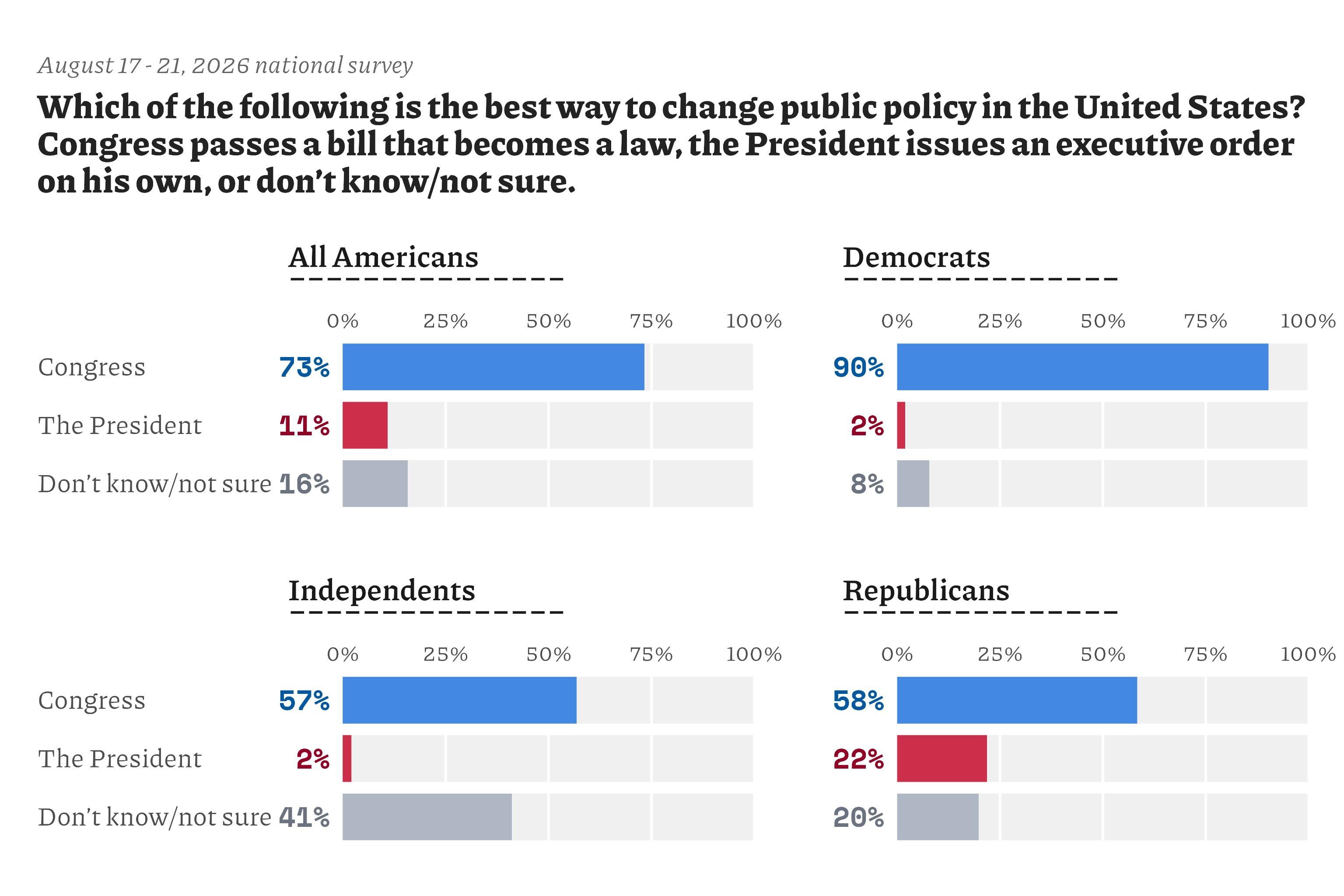
States are directly impacted by the president’s executive orders, on topics including law enforcement, elections, and birthright citizenship, and states continue to play a leading role in challenging the administration’s actions in court. In 2026, that role extended to the rules for November’s federal elections, after numerous states challenged an executive order directing new federal rules for mail ballots. And the American people aren’t on board either. States United polling shows that Americans think the best way to change public policy is for Congress to pass legislation rather than the president issuing executive orders on his own.
This report highlights the pattern of unilateral executive action that characterizes the second Trump administration by examining the president’s use of executive orders through Oct. 22, 2026. The analysis focuses on Trump’s second term, rather than his combined first and second terms, to highlight the extraordinary use of unilateral actions during his second term. (The analysis focuses exclusively on executive orders and does not include other presidential actions like memorandum and proclamations.)
- From Jan. 20, 2025, through Oct. 22, 2026, Trump issued 292 executive orders.
- The volume and pace of Trump’s executive orders exceed every other president in contemporary history. Trump has issued more executive orders than Presidents Obama (276) or George W. Bush (291) did over two full terms. His second-term pace of about 167 orders per year is the highest of any president since Franklin D. Roosevelt.
- Courts have invalidated several of Trump’s most prominent initiatives issued by executive order, including his imposition of new and expanded tariffs and his attempt to end birthright citizenship for U.S.-born children of certain immigrants. Many others are in ongoing litigation.
- States are directly impacted by the president’s executive orders—and they play a leading role in challenging them in court, including the successful 2026 challenge by a multi-state coalition to prevent new federal mail ballot rules from taking effect for the November elections.
- States United polling shows that 73% of Americans think the best way to change public policy in the U.S. is by Congress passing a bill that becomes a law, compared to just 11% who say policy change should happen by executive orders issued from the president.
Since returning to office in January 2025, Trump has issued 292 executive orders through Oct. 22, 2026. The pace and volume of the administration’s use of executive orders is unprecedented in contemporary American history.
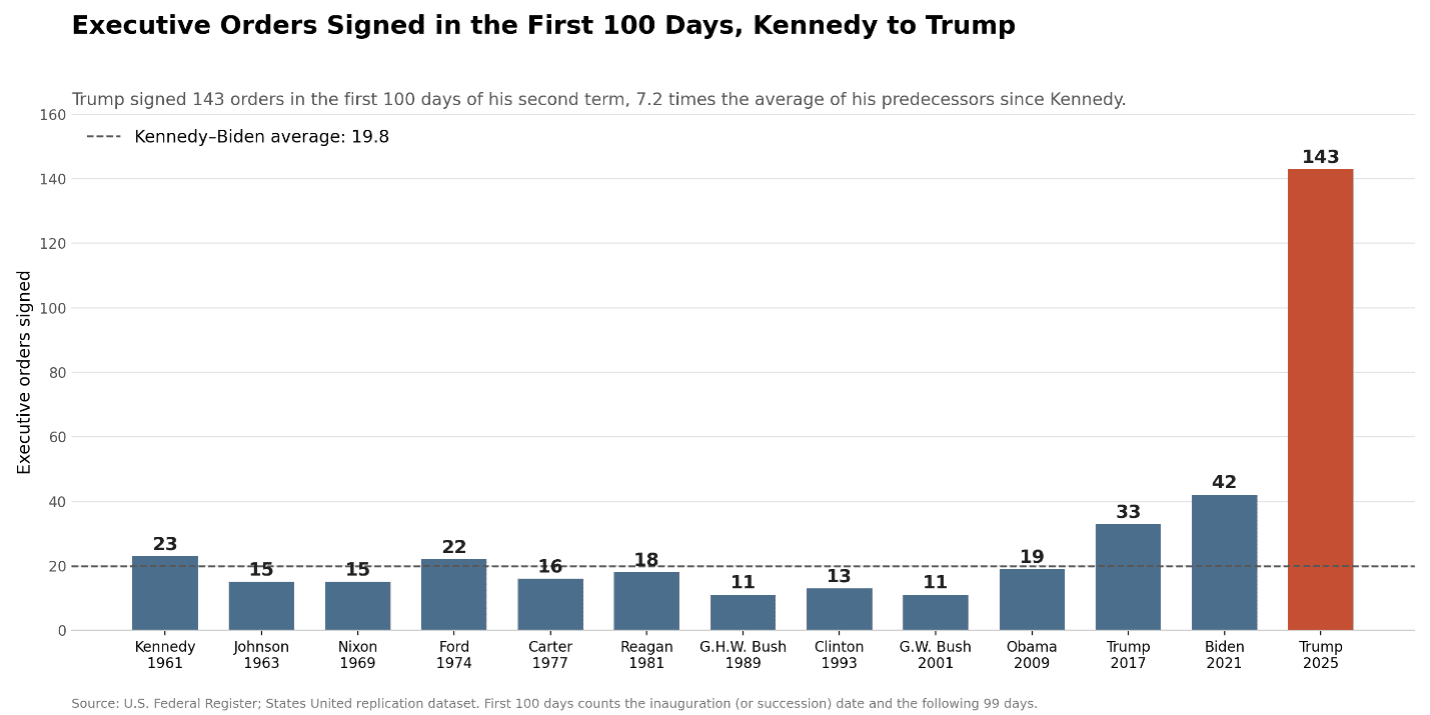
In his first 100 days, Trump’s second term use of executive orders stood out dramatically: He issued 143 orders during that time. In contrast, presidents from John F. Kennedy to Joe Biden issued an average of 19.8 executive orders in their first 100 days. Most of Trump’s predecessors, from Kennedy to Barack Obama, fell within a relatively narrow band of 12 to 23 orders in their first 100 days. Biden issued 42 executive orders in his first 100 days, which itself was a record at the time among recent presidents. Trump’s use of executive orders in his first 100 days was 7.2 times the historical average and more than 3.4 times the number used by Biden.
Source: U.S. Federal Register list of Executive Orders
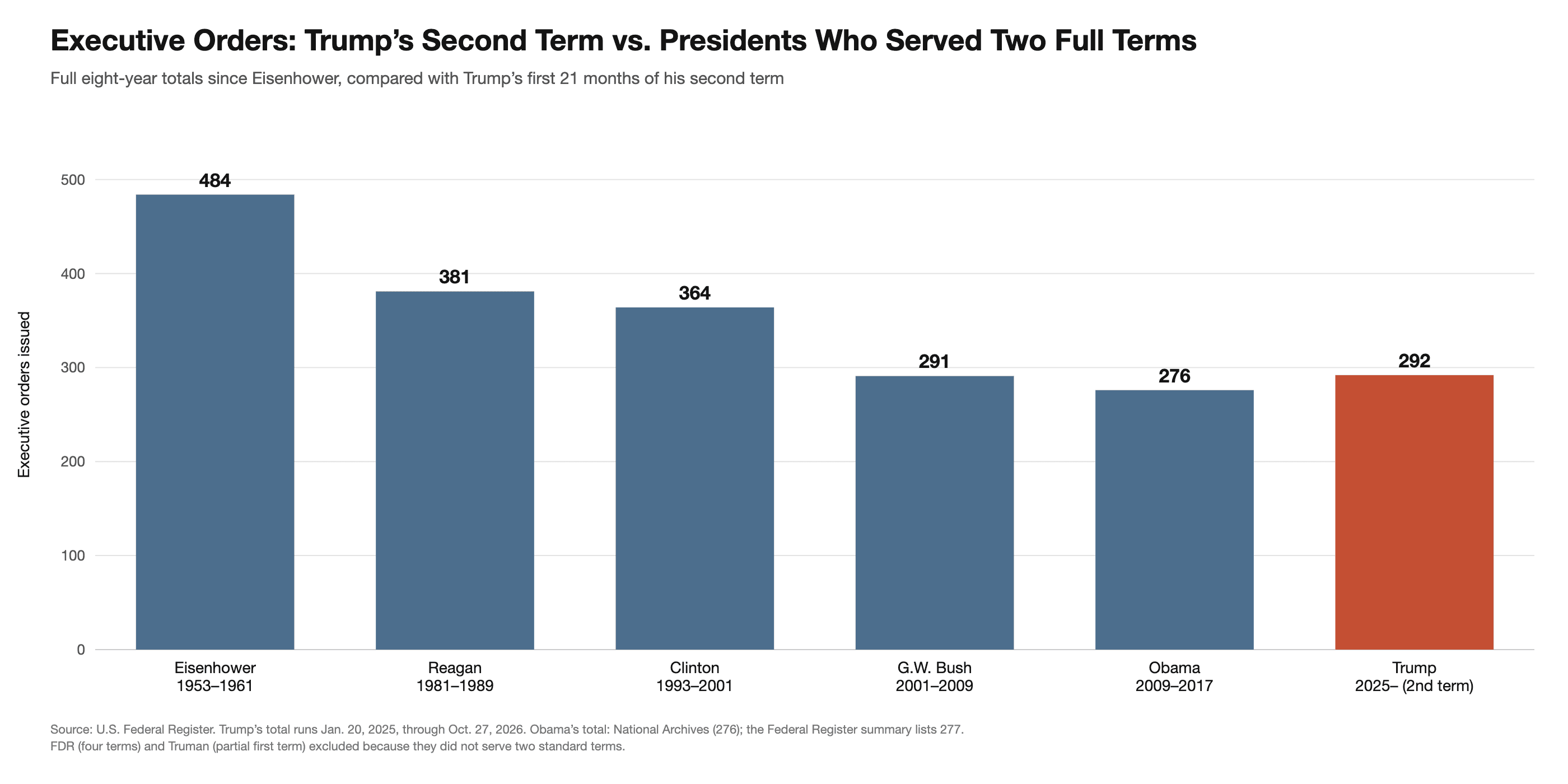
Trump’s frequent use of executive orders in his second term did not stop after the first 100 days. His 292 executive orders in his second term exceeds the number issued by the two most recent eight-year presidents: Obama signed 276 from 2009 to 2017 and George W. Bush signed 291 from 2001 to 2009. Bush’s 291st order came on Jan. 16, 2009, four days before he left office. Trump passed that total on day 641 of his second term, less than halfway through a single four-year term.
Source: U.S. Federal Register list of Executive Orders
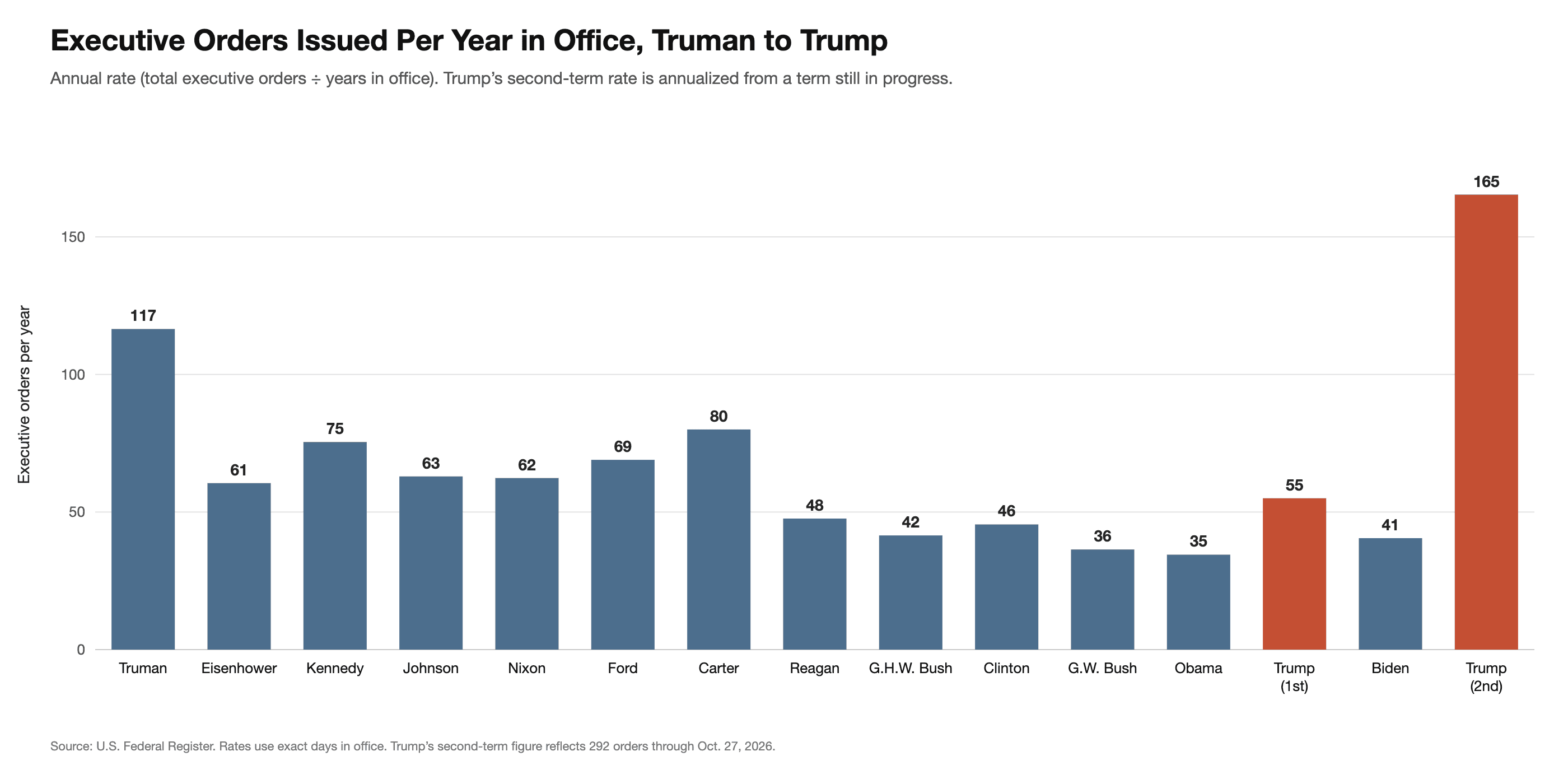
The pacing of Trump’s executive orders also stands out against presidents of both parties. Trump’s second-term pace is roughly 167 orders per year. This is the highest annual rate of any president since Roosevelt.11 Executive orders were not published or numbered consistently until the Federal Register Act of 1935, and the Federal Register began publication in March 1936. The Federal Register’s executive order records therefore begin partway through President Franklin D. Roosevelt’s presidency (1933–1945). The Federal Register lists 2,023 executive orders for Roosevelt from 1937 through his death in April 1945, about 245 per year. The American Presidency Project, which reconstructs his earlier orders from historical sources, counts 3,721 across his full presidency, about 307 per year. Because counts for his early years vary by source, this report’s figures begin with President Truman. Under either count, Roosevelt’s annual rate remains higher than that of any later president. It is about 4.7 times the rate of Obama and Bush, who issued executive orders at an average of about 35 per year. (Obama issued executive orders at the lowest annual rate of any president in the Federal Register’s executive order records, which begin with Franklin D. Roosevelt.)
Trump’s pace also exceeds that of Harry Truman, who averaged about 117 orders a year during and after World War II, the only president since Roosevelt to average more than 100. Because Trump’s term is still in progress and his orders were concentrated early, his annualized rate will likely fall as the term continues.
Source: U.S. Federal Register list of Executive Orders
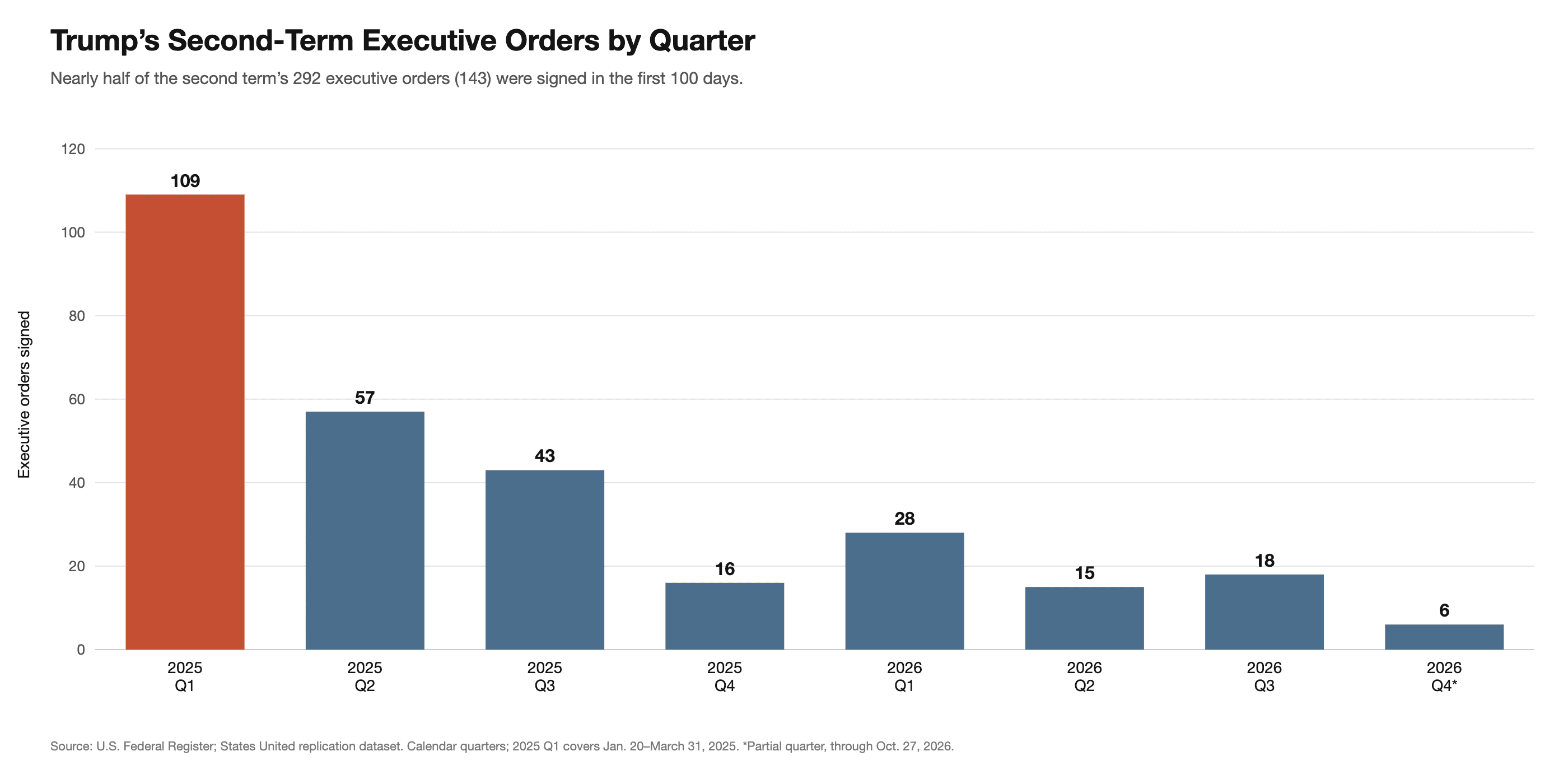
Even as Trump’s output of executive orders has slowed across his second term, the pace remains high compared to his predecessors. After issuing nearly half of his second-term orders (143) in his first 100 days, quarterly totals fell through 2025, from 109 in the first quarter to 16 in the fourth. In 2026, his output has ranged from roughly 15 to 28 per quarter.
Trump has signed 67 executive orders so far in 2026, an annualized pace of about 83 per year. That slower pace is still well above the averages of the five presidencies that immediately preceded Trump’s second term.
Source: U.S. Federal Register.
Trump could still surpass three further benchmarks of two-term presidents during his second term alone: Bill Clinton’s 364 executive orders, Ronald Reagan’s 381, and Dwight Eisenhower’s 484. At his pace over the last three months (about 79 orders per year), Trump would pass Clinton around late 2027 and Reagan around late 2027. Reaching Eisenhower’s total before Trump’s second term ends in January 2029 would require roughly 86 orders per year for the rest of the term.
Executive orders are often described as a tool presidents turn to in the face of gridlock and legislative opposition when one or both chambers of Congress are controlled by the opposing party. Trump’s first term fits that account: his pace of executive orders rose after control of the House changed away from his party in 2019.
But there is another, opposite pattern with regard to congressional makeup and executive orders that Trump’s second term pushes to an extreme. All of his second-term executive orders have been issued while his party controls both the House and Senate. Previous presidents—Truman, Eisenhower, Clinton, Obama, and Biden—similarly issued orders faster under unified government than divided (measured as orders per year). But what sets Trump apart is the pace: roughly 167 orders per year, well above any other president’s rate under either condition since Roosevelt.
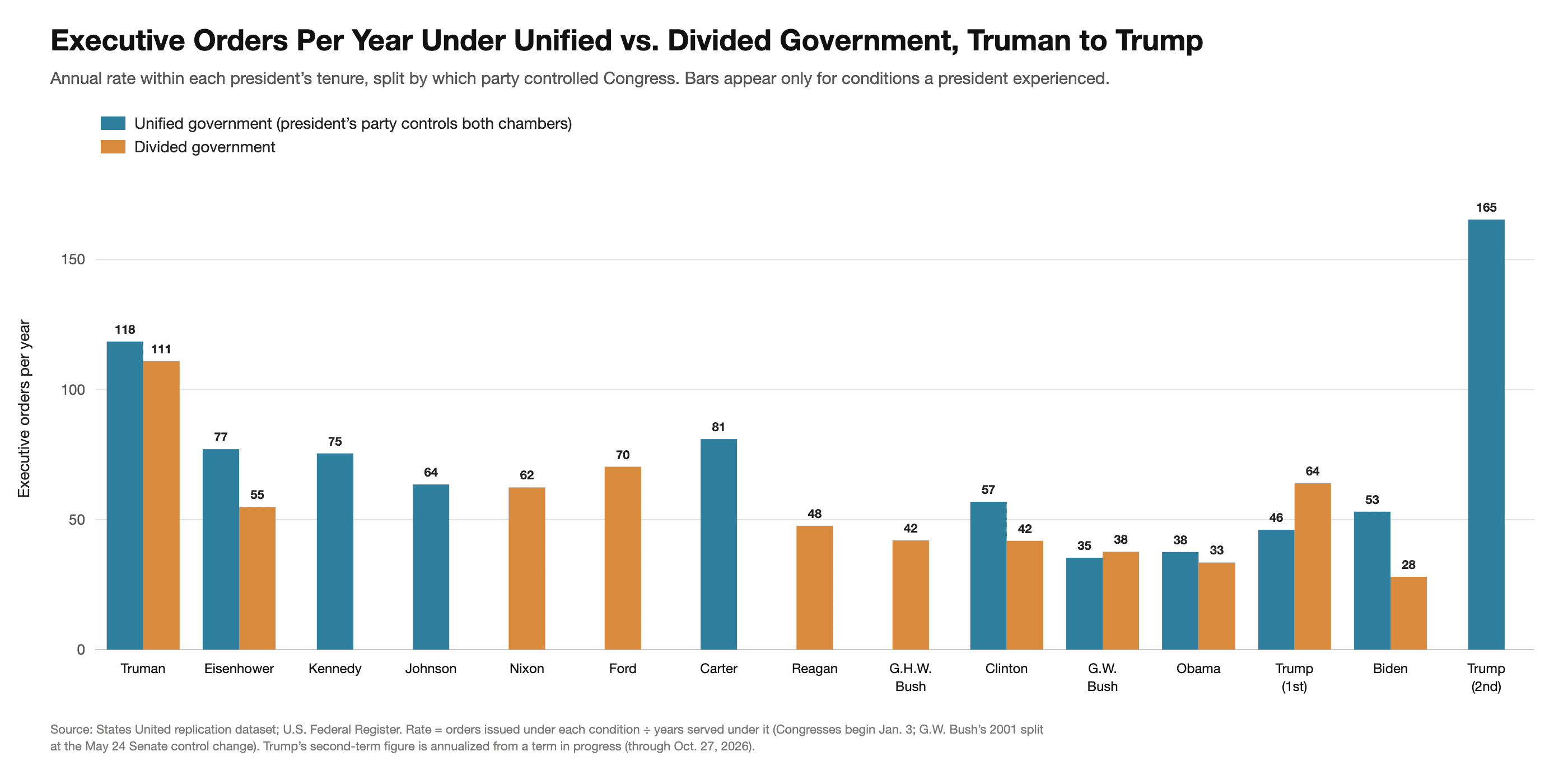
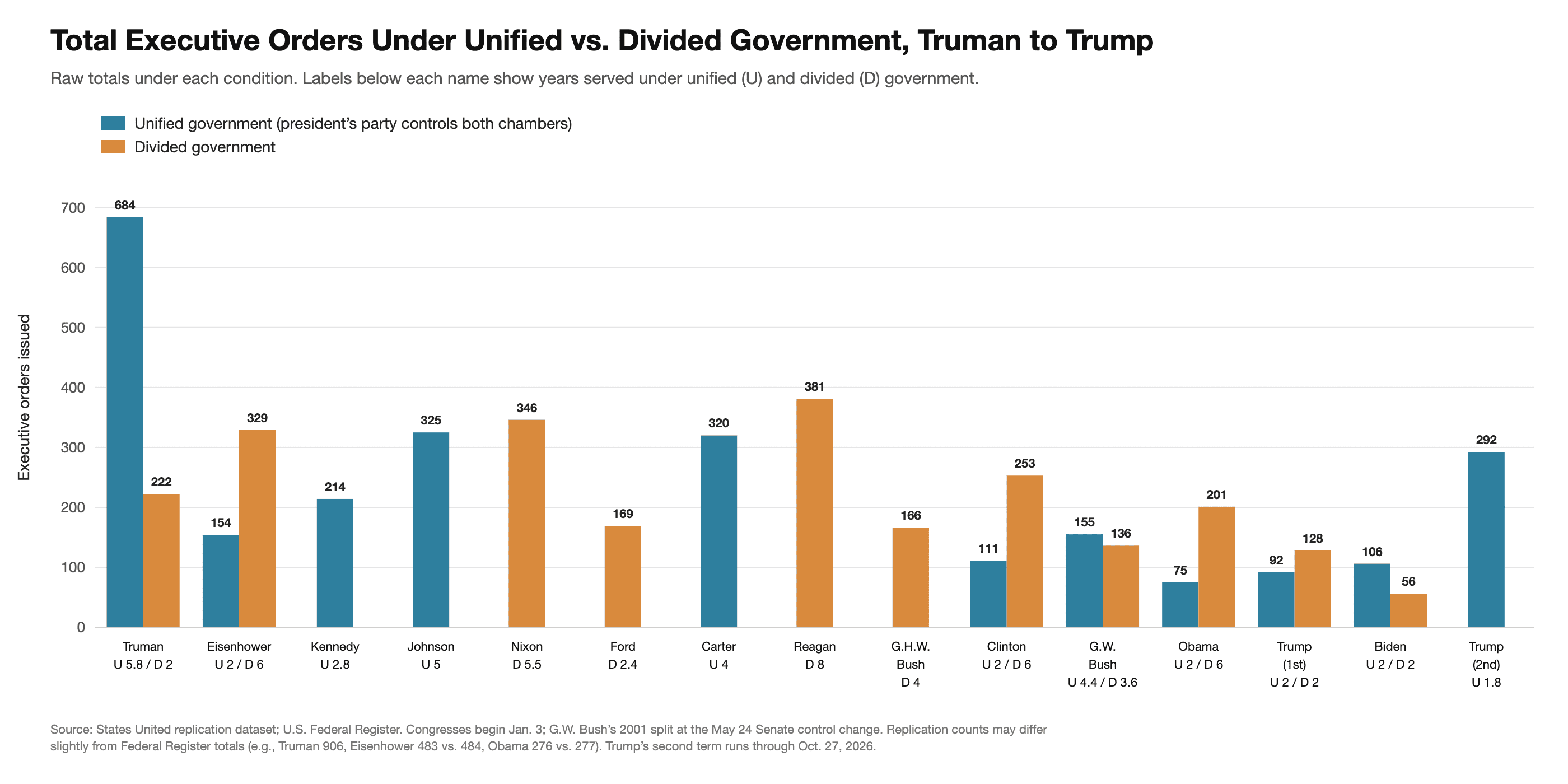
Source: U.S. Federal Register
The milestone of Trump’s 292 second-term executive orders directly impacts states. Every executive order is a directive that federal agencies are expected to carry out, and many of them reach directly into programs that states run or help fund, from election administration to law enforcement to public health. As the total grows, so does the number of federal directives that state officials must evaluate, implement, or—where they conclude an order exceeds presidential authority and injures the state—challenge in court.
During Trump’s first term, states and other litigants brought 246 total court cases that challenged his administration. The Trump administration prevailed in only 22% of those cases, losing nearly four out of five times. Successful lawsuits also specifically blocked unlawful executive orders. These included the first travel ban against seven predominantly Muslim countries (EO 13769), which was met with several lawsuits, blocked by the courts, and eventually replaced by new travel bans; Trump’s attempt to condition federal grants on “sanctuary” policies (EO 13768), which was ruled unconstitutional by the Ninth Circuit; his refugee-consent order (EO 13888) allowing state and local authorities to turn away refugees, which was blocked by a federal court; and an order limiting contractor diversity training (EO 13950), which was also blocked by a federal court.
Trump’s second term follows a similar pattern of court challenges. At least 34 of the president’s 292 executive orders have faced federal court challenges, according to Just Security’s Litigation Tracker. Some of his most controversial executive orders have been blocked, even though many of these cases continue moving through the courts and remain pending on appeal.
Below we provide prominent examples of executive orders from 2025 and 2026 that have impacted state and local governments, and related legal challenges often brought by multi-state coalitions to push back:
- Executive Order 14160, which sought to end birthright citizenship for U.S.-born children of certain immigrants. Twenty-two states and the District of Columbia filed lawsuits arguing that the order violates the 14th Amendment’s Citizenship Clause. Multiple federal courts agreed and blocked the order nationwide. The Trump administration asked the U.S. Supreme Court to partially pause these rulings and in June 2025, the Court decided that the injunctions were broader than necessary and limited the availability of nationwide injunctions going forward. The Court did not address the constitutionality of the order itself. Following that ruling, states again secured nationwide preliminary relief, while private-party plaintiffs obtained nationwide class-action injunctions protecting children who would have been denied citizenship under the order. When one of those class-action cases reached the Supreme Court, attorneys general from 23 states and D.C. filed a brief supporting the challenge. On June 30, 2026, the Supreme Court ruled that all children born in the U.S., with very limited exceptions, are citizens at birth, rejecting the administration’s interpretation and finding the executive order unconstitutional.
- Executive Order 14248, the president’s first elections-related executive order, which attempts to assert control over state and local election practices. The order, among other things, directs the Election Assistance Commission to take steps to require documentary proof of citizenship for voter registration, requires states to reject absentee and mail-in ballots received after Election Day, and threatens to withhold federal funding from states that do not comply with the order. The order has been challenged in multiple lawsuits, including by a coalition of nineteen states in California v. Trump, No. 25-cv-10810 (D. Mass.), and in a separate action brought by Washington and Oregon, Washington v. Trump, No. 25-cv-00602 (W.D. Wash.). The plaintiff states argue that the order unlawfully claims federal control over election administration, an area that the Constitution reserves for the states and Congress, by violating the Elections Clause and separation of powers principles. These state challenges have successfully blocked key provisions of the order. Most recently, in June 2026, the federal court in California v. Trump permanently barred the administration from implementing most of the challenged provisions, including the proof of citizenship requirements, holding that the Constitution “does not grant the President any specific powers over elections.” The administration has filed appeals to the First Circuit in both cases.
- Executive Order 14399, the president’s second elections-related executive order, signed March 31, 2026, which directs the Department of Homeland Security to compile federal lists of voting-age citizens and send them to state election officials, directs the U.S. Postal Service to write new rules for mail ballots in federal elections, directs the attorney general to prioritize prosecution of election officials who issue ballots to ineligible individuals, and calls for withholding federal funds from noncompliant states and localities. Twenty-three states and the District of Columbia sued in California v. Trump, No. 1:26-cv-11581 (D. Mass.), arguing that the order unlawfully claims presidential control over election administration, which the Constitution assigns to the states and Congress. In June, a federal court in Massachusetts blocked key provisions of the order for the November 2026 midterm elections in the plaintiff states. On Aug. 24, the Supreme Court, in a 6–3 decision, lifted that injunction, reasoning that the states had sued before the order was implemented. While the Supreme Court was considering the case, the Postal Service issued its final mail-ballot rule, effective Aug. 21, which would implement portions of the executive order. Twenty-four states and D.C. filed a new lawsuit challenging the rule itself. A federal court blocked the rule’s mandatory provisions, and on Sept. 14 the Supreme Court declined the administration’s request to lift that order. As a result, the new federal mail-ballot requirements will not apply to the November 2026 elections; the rule’s longer-term fate and the executive order remain in litigation.
- Executive Orders 14252, 14333, and 14339, which direct federal agencies to exert expanded authority over law-enforcement operations in Washington, D.C., in response to the president’s declaration of a “crime emergency.” The orders require increased enforcement of certain criminal laws in the District, particularly those relating to immigration enforcement, and the mobilization of a “specialized” unit within the D.C. National Guard dedicated to ensuring “public safety” and deputized “to enforce Federal law” in the capital. A related presidential memorandum further directed the secretary of defense to coordinate with governors to deploy members of their National Guard forces to the District. National Guard units from at least 24 states were deployed to D.C. In September 2025, D.C. Attorney General Brian Schwalb filed a lawsuit challenging the president’s authority to deploy National Guard troops to the District. The suit alleges that the administration’s deployment of National Guard troops violates D.C.’s autonomy under the Home Rule Act; that enlisting the National Guard, pursuant to Executive Order 14339, for domestic law enforcement violates the Administrative Procedures Act and the Posse Comitatus Act; and that the administration’s actions in D.C. exceed longstanding limits on executive power, including separation of powers principles and the Take Care Clause. Twenty-two states filed an amicus brief supporting the District’s position. In November 2025, a federal court granted D.C.’s request for immediate relief and temporarily blocked the Department of Defense from deploying or requesting deployment of National Guard members to the District. In December 2025, the D.C. Circuit, in a 3-0 decision, stayed the lower court’s order, permitting the deployment of National Guard forces in D.C. pending appeal. In May 2026, a multistate coalition filed another amicus brief supporting the District on the merits of the appeal and urging the D.C. Circuit to affirm the lower court’s ruling. Oral argument is scheduled for Oct. 14, 2026.
- Executive Orders 14193, 14194, 14195, 14257, and 14266, which imposed new or expanded tariffs on imports, including on products imported from Canada, Mexico, and China under the authority of the International Emergency Economic Powers Act (IEEPA). A coalition of 12 states, led by the Oregon Department of Justice, challenged these orders, arguing that they exceeded presidential authority because the Constitution gives Congress—not the president—the power to set tariffs, and IEEPA does not authorize tariffs of this kind. The states also contend that these tariffs effectively raise taxes on Americans and circumvent the legislative process. In May 2025, the U.S. Court of International Trade agreed with the states, granting summary judgment and permanently blocking enforcement of the tariffs. The Federal Circuit affirmed the decision. In February 2026, the U.S. Supreme Court affirmed the judgment in the states’ case, holding that IEEPA does not authorize the president to impose tariffs. Following the Supreme Court’s decision, the president attempted to impose a new global 10% tariff pursuant to Section 122 of the Trade Act of 1974. Twenty-four states sued to stop the tariff arguing that the executive branch was once again illegally bypassing Congress. In May 2026, the U.S. Court of International Trade struck down the new tariff. Following the decision, the president imposed new tariffs of 10% to 12.5% on imports from 60 trading partners under Section 301 of the Trade Act. In August 2026, a coalition of 25 states challenged the tariffs in Oregon v. Trump, No. 1:26-cv-03467 (Ct. Int’l Trade). The case remains pending following oral argument on Sept. 30, 2026.
Recent polls show that many Americans are uneasy with how Trump is governing, particularly in his use of executive power. A spring 2026 Gallup–Kettering Foundation survey found that nearly 6 in 10 Americans (59%) believe the presidency and executive branch have too much power, compared with just 34% who say they have the right amount of power, and only 7% who say they have too little. By comparison, 38% of Americans say the Supreme Court and judicial branch have too much power, and 34% say the same of Congress. A slim majority (51%) also rate the division of power among the three branches as working poorly, up from 47% in 2025, while only 20% say it is working well.
Most Americans want checks and balances preserved and object to Trump’s unilateral approach to advancing his agenda. States United polling from August 2026 found that 73% of Americans believe the best way for public policy to change is by Congress passing a bill that becomes a law.
Trump’s use of executive orders is unprecedented. In less than two years, he has issued more executive orders than two recent presidents each issued in eight. An executive order is one administrative tool that U.S. presidents use to guide policy priorities, but Trump’s use of them exemplifies a unilateral approach to governance that routinely side-steps Congress and results in federal overreach that can exceed the boundaries of presidential and executive authority.
States have been directly impacted by the president’s executive orders across a range of policy areas—from public health funding to law enforcement to the administration of federal elections—and multi-state coalitions have successfully challenged many of these orders in court.
Americans ultimately prefer the president to adhere to the separation of powers and work with Congress to pass legislation that becomes law, rather than attempt to assert new policy approaches through unilateral executive action.
This analysis is based on presidential executive orders posted on the Federal Register and the White House’s Executive Order announcement page. The dataset includes every executive order issued from Truman through Trump’s current term (as of Oct. 22, 2026), categorized by the political alignment of government control at the time. (At the time of publication, two executive orders were still listed as “pending” on the White House’s Executive Order page.)
The number of executive orders currently facing federal court challenges was obtained using the Just Security Litigation Tracker: Legal Challenges to the Trump Administration. This tracker compiles all known cases challenging executive actions and identifies which specific executive order is being challenged.
Annual rates divide each president’s total by his exact time in office; Trump’s second-term rate is annualized from a term still in progress. Rates under unified and divided government divide the orders issued under each condition by the years a president served under it, with each Congress dated from Jan. 3 and Bush’s 2001 split at the May 24 change in Senate control. Quarterly totals use calendar quarters; the first quarter of 2025 begins Jan. 20.
Polling data are taken from a States United survey based on 1,528 interviews conducted on the internet of U.S. adults. Participants were drawn from YouGov’s online panel and were interviewed from August 17 to 21, 2026. Respondents were selected to be representative of American adults. Responses were additionally weighted to match population characteristics with respect to gender, age, race/ethnicity, education of registered voters, and U.S. Census region based on voter registration lists, the U.S. Census American Community Survey, and the U.S. Census Current Population Survey, as well as 2022 midterm turnout and 2020 and 2024 Presidential vote. The margin of error for this survey is approximately ± 2.8 percentage points, though it is larger for the analysis of partisan subgroups described above. Therefore, sample estimates should differ from their expected value by less than the margin of error in 95% of all samples. This figure does not reflect non-sampling errors, including potential selection bias in panel participation or measurement error.
Following best research practices, we define “independents” as respondents with no partisan attachments and classify independent leaners as partisans.
Sources
1 Executive orders were not published or numbered consistently until the Federal Register Act of 1935, and the Federal Register began publication in March 1936. The Federal Register’s executive order records therefore begin partway through President Franklin D. Roosevelt’s presidency (1933–1945). The Federal Register lists 2,023 executive orders for Roosevelt from 1937 through his death in April 1945, about 245 per year. The American Presidency Project, which reconstructs his earlier orders from historical sources, counts 3,721 across his full presidency, about 307 per year. Because counts for his early years vary by source, this report’s figures begin with President Truman. Under either count, Roosevelt’s annual rate remains higher than that of any later president.