Survey: Americans Oppose Executive Overreach in Elections
States run elections. Attempts to expand presidential power over elections are unpopular with Americans.
States United polling has previously shown that Americans don’t want President Trump more involved in elections. And they don’t think the Justice Department should be able to force states into running elections the way the president directs—which Trump called for in his March 2026 executive order.
But Trump continues to suggest ways for the federal government to interfere in the 2026 midterms. He has said “we shouldn’t even have an election” and that he “should have” ordered the National Guard to seize voting machines after the 2020 election.
States United partnered with YouGov on a national survey of 1,570 adults from February 11 through 19, 2026, to better understand Americans’ views on specific forms of executive overreach in elections.
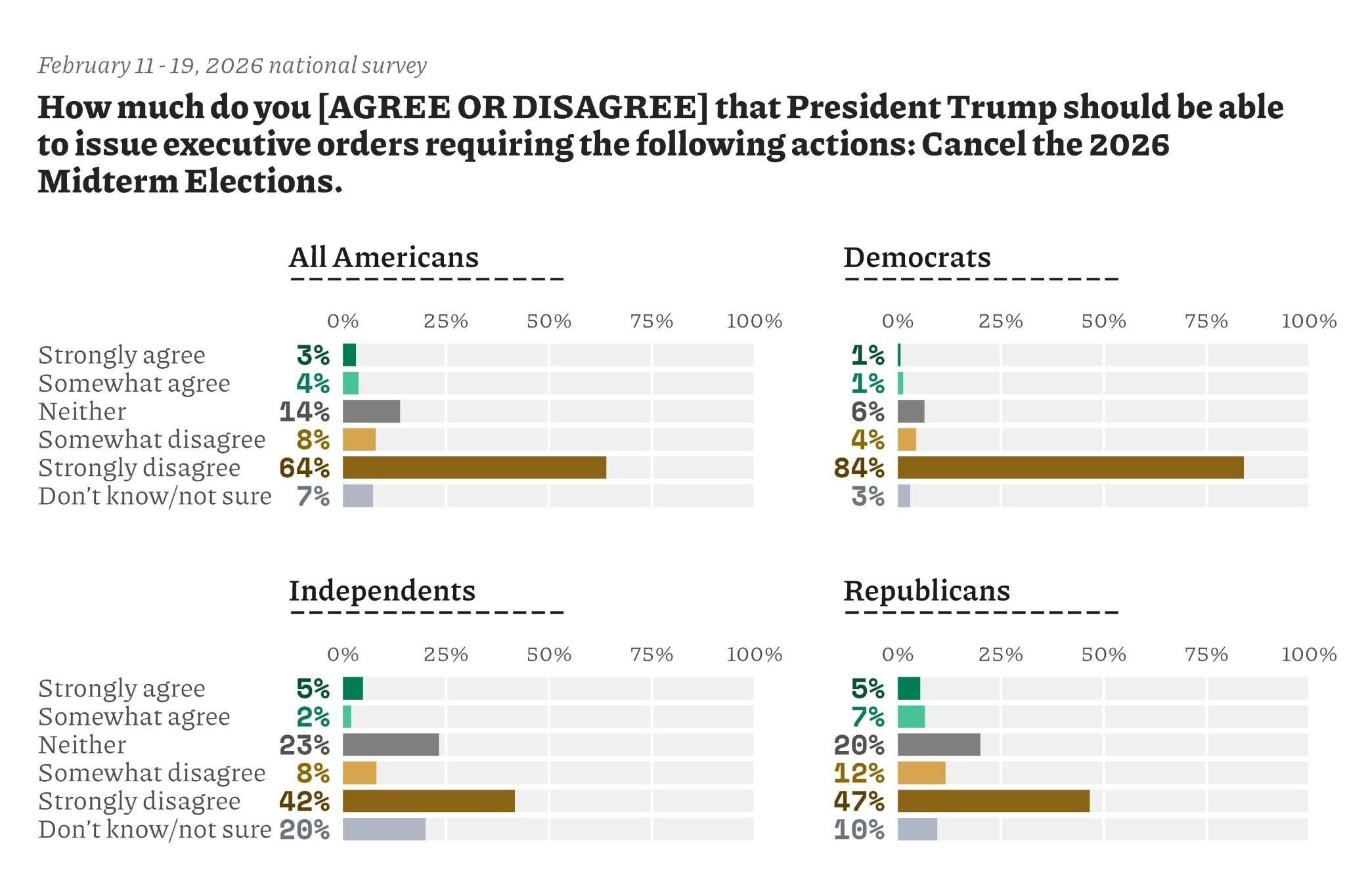
Americans overwhelmingly oppose the idea of President Trump canceling the midterms by issuing an executive order. Majorities of Republicans, Democrats, and independents say President Trump should not be allowed to do this. There is no constituency for canceling the midterms.
Overall, 72% of respondents somewhat or strongly disagree that Trump should be able to sign an executive order canceling the 2026 midterm elections. Only 7% say that they somewhat or strongly agree that he should be able to do so. The net agreement on this survey is –65, extraordinarily low. Canceling the midterms is exceptionally unpopular.
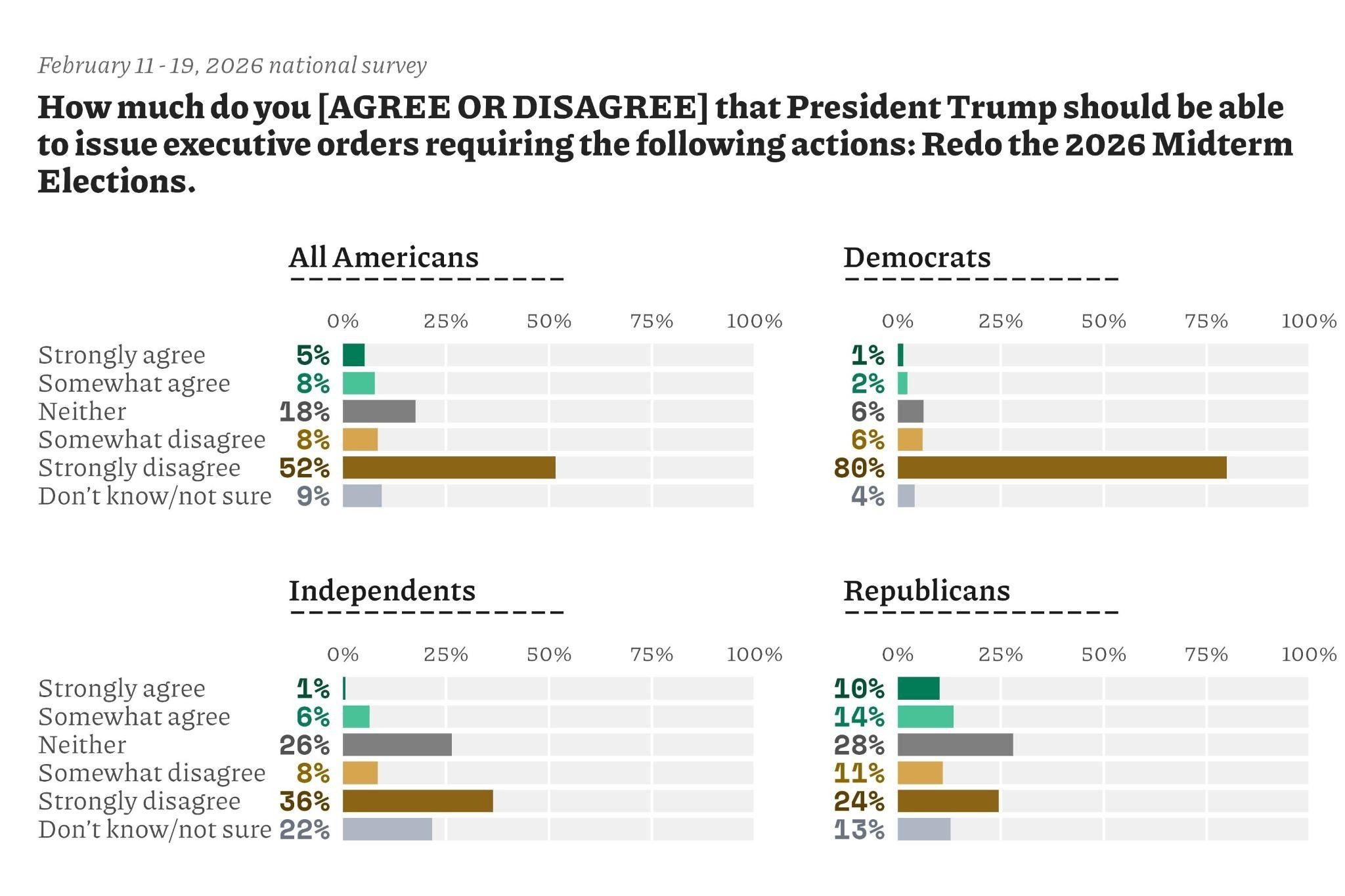
Americans are also strongly opposed to Trump issuing an executive order to redo the 2026 midterms. About 60% disagree that Trump should be able to redo the election, compared to just 13% who agree. With a net agreement of –47, there is no constituency for redoing the midterms.
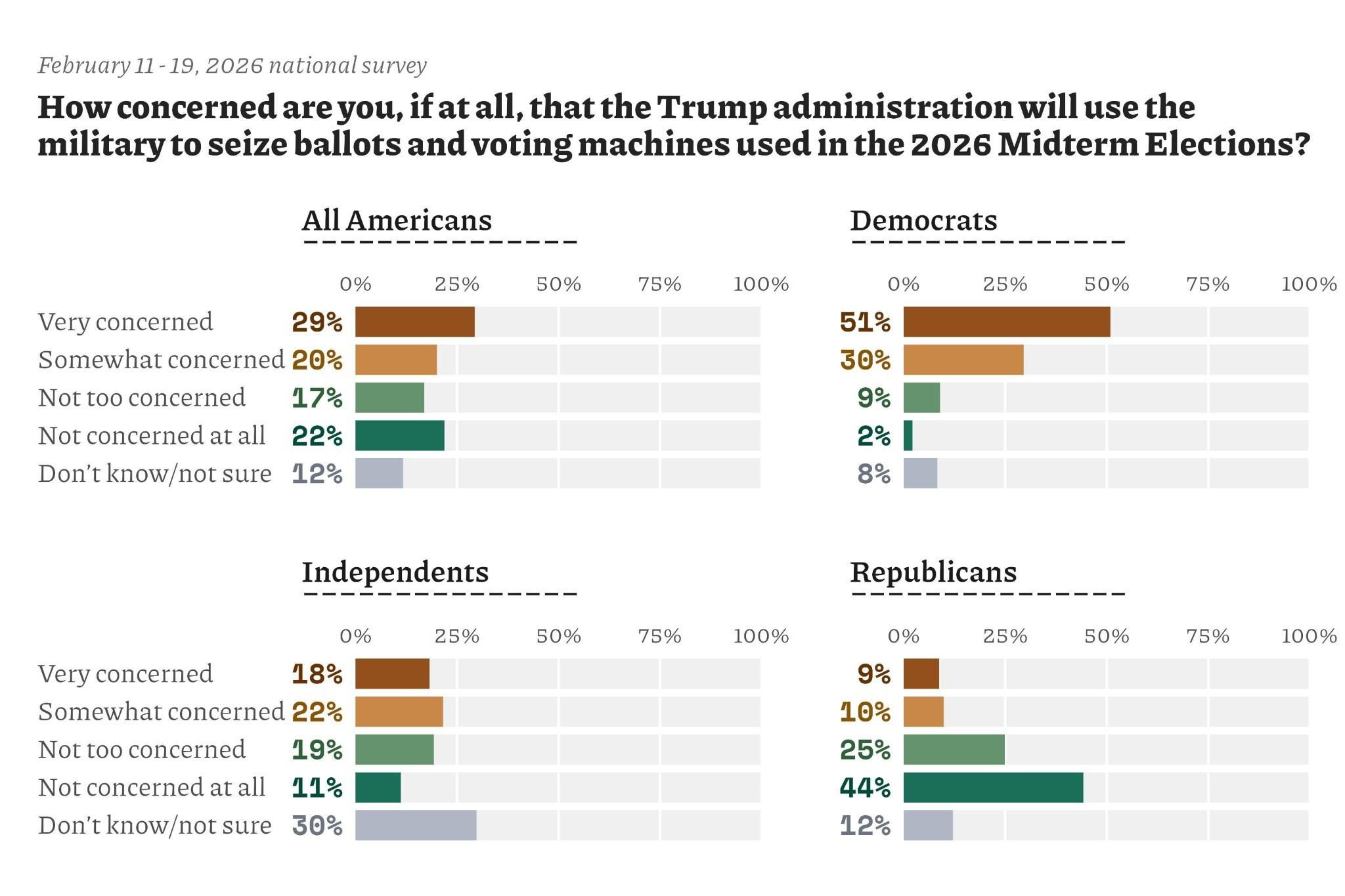
Americans are concerned that Trump might use the military to seize ballots and voting machines used in the midterm elections.
Just shy of half of Americans (49%) express concern that the Trump administration will use the military to seize ballots and voting machines used in the 2026 midterms. A smaller share (39%) say they are not too concerned or not concerned at all about this possibility. Democrats express notably higher levels of concern (81%) than independents (40%) and Republicans (19%). Overall, the net 10 percentage point gap shows that many Americans are concerned about military seizure of ballots and voting machines during the 2026 midterms.
These data are taken from a States United survey based on 1,570 interviews conducted on the internet of U.S. adults. Participants were drawn from YouGov’s online panel and were interviewed from February 11 to 19, 2026. Respondents were selected to be representative of American adults. Responses were additionally weighted to match population characteristics with respect to gender, age, race/ethnicity, education of registered voters, and U.S. Census region based on voter registration lists, the U.S. Census American Community Survey, and the U.S. Census Current Population Survey, as well as 2022 midterm turnout and 2020 and 2024 Presidential vote. The margin of error for this survey is approximately ± 2.7 percentage points, though it is larger for the analysis of partisan subgroups described above. Therefore, sample estimates should differ from their expected value by less than the margin of error in 95% of all samples. This figure does not reflect non-sampling errors, including potential selection bias in panel participation or measurement error.
In keeping with best research practices, we classify independent voters who reported “leaning” toward either the Democratic or Republican parties as partisans. Therefore, we define “independents” as those respondents who professed no partisan attachments whatsoever.