Election Denial on the Ballot: 2022 to 2026
Fewer Election Deniers are running in the 2026 midterms, but candidates remain on the ballot across 43 states
In 2022, States United began tracking Election Deniers running for statewide and congressional office. We define an Election Denier as someone who either participated in spreading President Trump’s false claim that the 2020 presidential election was stolen, refused to certify the legitimate results of that election, or attempted to overturn those results. Since then, we have tracked 577 Election Denier candidates across the country.
Four years later, election denial remains a significant part of the political landscape. Election Deniers are embedded in the federal government and are once again seeking offices with important roles in our elections. These offices include governors, attorneys general, and secretaries of state—who help set state election policies, administer voting, and defend election results—as well as members of Congress, who certify presidential election results.
This report compares the prevalence of Election Denier candidates in 2022 and 2026. The data show that fewer Election Deniers are running this year: The number of candidates running for statewide office in the general election fell 33%, from 49 to 33, while the number of Election Denier candidates running for Congress declined 31%, from 236 to 164. And while the geographic reach of election denial narrowed slightly, it remains substantial: Election Denier candidates ran in 48 states in 2022, compared to 43 states in 2026.
These declines are notable, but the number of candidates on the ballot tells only part of the story. It measures the size of the field, not the authority held by those who win. Election Deniers in statewide or congressional office play consequential roles in how future elections are administered and certified. That makes it important to understand not only how many Election Deniers are running in 2026, but where they are running and what powers they would hold if elected.
- In 2022, Election Deniers appeared on the general election ballot for statewide and congressional races in 48 states. In 2026, that figure declined to 43 states.
- The total share of Election Deniers on the general election ballot dropped from 2022 to 2026. The number of candidates running for statewide office fell from 49 to 33, a 33% decline in that period. The number running for Congress fell from 236 to 164, a 31% decline.
- The steepest statewide decline was among Election Denier candidates running for secretary of state, which fell from 13 to seven. Candidates for governor fell from 24 to 17. Candidates for attorney general fell from 12 to nine.
- Illinois was the only state with a significant increase in Election Denier candidates, with five more running for Congress in 2026 than in 2022. Florida and California recorded the largest declines over that time period, with 10 fewer candidates for Congress in each state.
- Election Deniers candidacies are concentrated in a small number of states, for both statewide or congressional office. Texas, Florida, Michigan, California, and Pennsylvania account for about 30% of all Election Deniers on the November ballot, in both 2022 and 2026.
The number of Election Deniers who appeared on the general election ballot declined between the 2022 and 2026 midterms. The statewide total fell from 49 to 33, a 33% decline. The congressional total fell from 236 to 164, a 31% decline. Although many more congressional seats are on the ballot, the pattern holds across both statewide and congressional races: fewer Election Deniers appeared on the ballot for the November 2026 election.
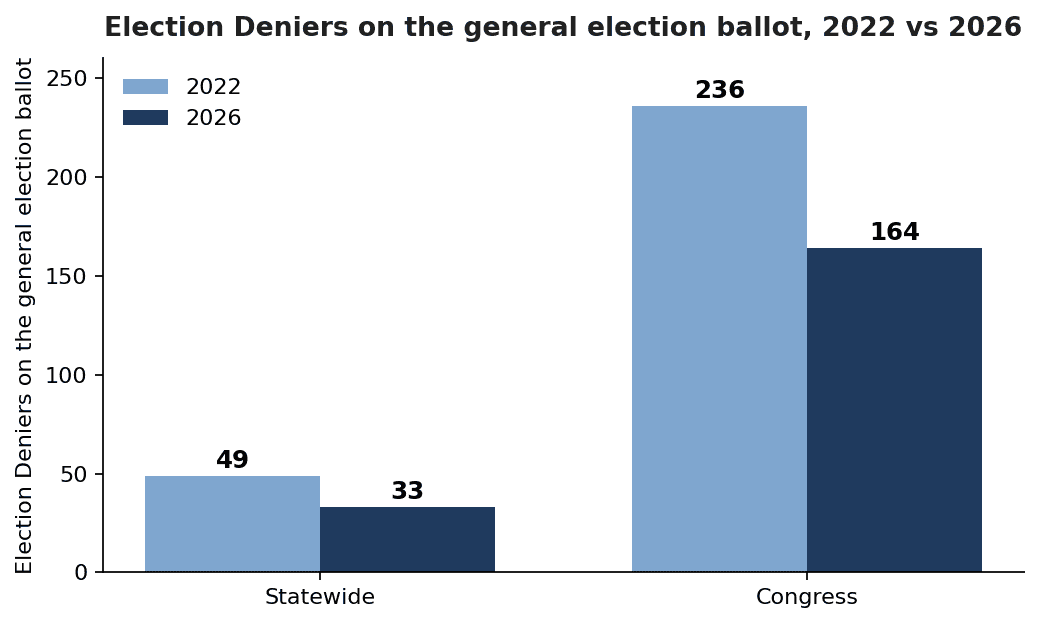
Figure 1. Election Deniers on the general election ballot, statewide and congressional, 2022 versus 2026.
The 2022-2026 decline in Election Denier candidacies spans all three statewide offices that help run elections or enforce election laws. The drop is largest among candidates for secretary of state, the chief election official in most states. The number of Election Deniers who reached the general election ballot for secretary of state fell from 13 in 2022 to seven in 2026. The number running for governor fell from 24 to 17, while the number running for attorney general fell from 12 to nine. Compared with the previous midterm, fewer Election Deniers are competing in 2026 for offices with direct responsibility for elections.
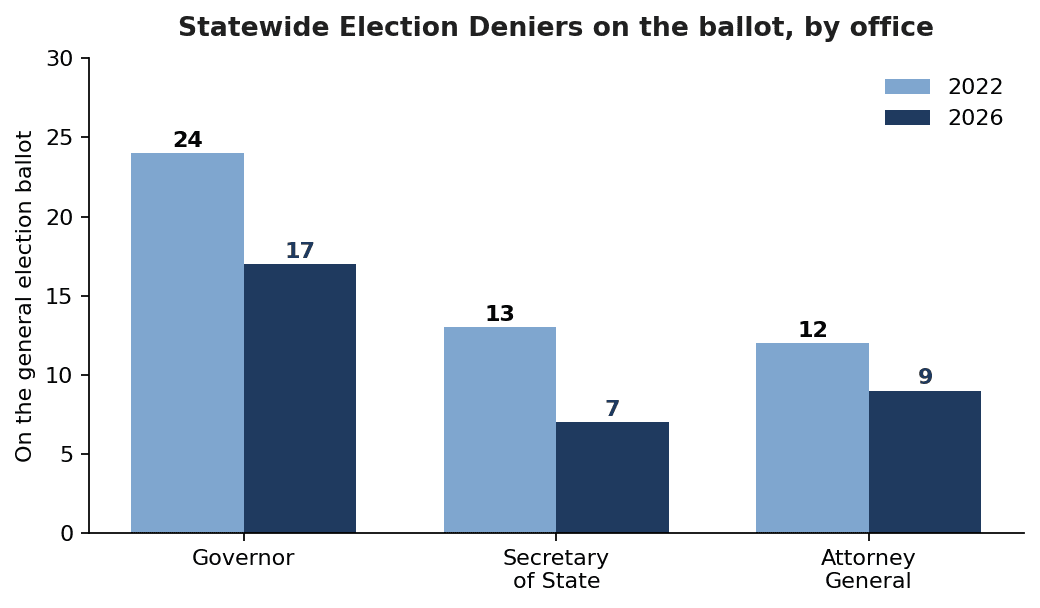
Figure 2. Election Deniers on the general election ballot by statewide office, 2022 versus 2026.
A few states saw small increases in the number of Election Deniers appearing on the general election ballot for statewide office: Colorado, Nebraska, Oklahoma, Rhode Island, and Wisconsin each added one. In every other state, the total held steady or declined between 2022 and 2026.
Congressional tallies show a broad decline in Election Denier candidacies—with one exception, Illinois, discussed below. Florida fell from 22 to 12 and California from 16 to six—declines of 10 candidacies in each state. Texas declined by six. Arizona, Georgia, New York, and Ohio each declined by five, and Washington by four.
California’s decline from 16 Election Deniers on the congressional ballot in 2022 to six in 2026 is most plausibly explained by the state’s mid-decade redistricting. Under Proposition 50, approved by California voters in November 2025, the state adopted a new congressional map that resulted in Election Deniers being redistricted out of opportunities to run for office. The Election Deniers who remain on the ballot are concentrated in districts whose district makeup on the new map did not substantially change. The total also fell because Darrell Issa, an Election Denier, is not seeking re-election.
Florida’s total also fell from 22 to 12, but for different reasons. The decline in Election Denier candidacies appears to reflect a narrower, more incumbent-heavy field. Two Florida Election Deniers who held seats after the 2024 election are not on the 2026 ballot: Matt Gaetz, who resigned before the current Congress convened, and Mike Waltz, who resigned in January 2025 to join the Trump administration. Florida’s 2026 Election Denier slate consists entirely of incumbents: No Election Deniers are running as challengers or for open seats this cycle, whereas the 2022 total included candidates in both categories. Some who first ran as non-incumbents in 2022 won their races and appear again in 2026, now as incumbents. So, the decline in Florida therefore reflects the absence of new challenger and open-seat candidacies rather than a map that limited Election Deniers’ path to the general election.
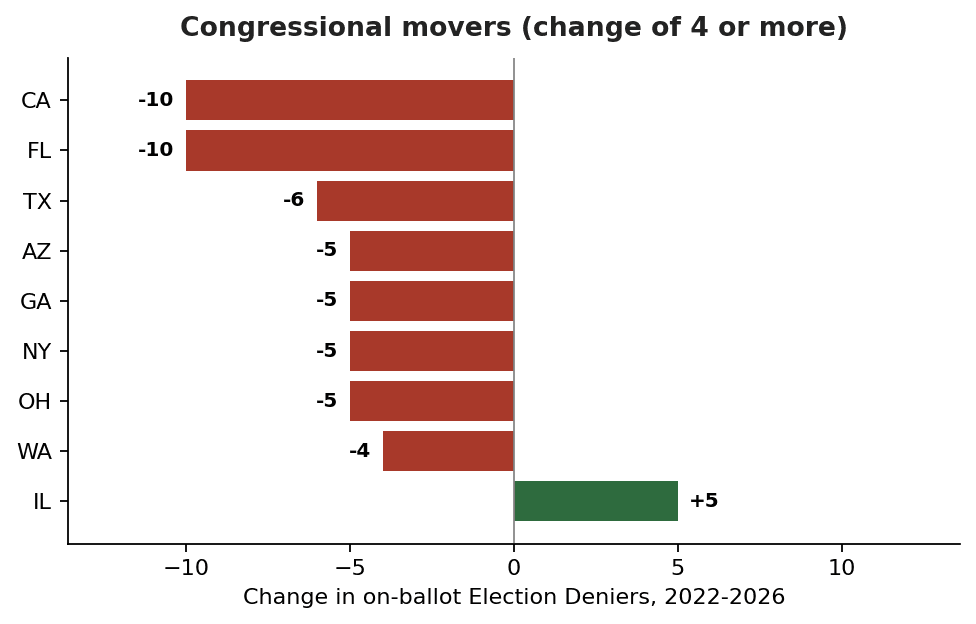
Figure 3. States with the largest changes in congressional Election Deniers on the ballot, 2022 to 2026. Red indicates a decline, green an increase.
Illinois was the only state with a significant increase in congressional Election Denier candidacies, rising from four to nine. Illinois used the same congressional map as in the previous election. Three of the nine Election Deniers are incumbents. Six are challengers. The increase therefore reflects more Election Denier candidacies in districts one party already controls, rather than a broader shift into open or competitive districts.
A handful of large states stand out for having a high concentration of Election Deniers on the general election ballot. Across both cycles, Texas had 44, Florida 37, Michigan 25, California 22, and Pennsylvania 20. Together, those five states account for about 30 percent of all Election Deniers on the ballot.
The reasons differ by office. States with more congressional districts generally have more congressional candidates, so the largest states tend to have the highest totals. For statewide elections, Election Denier candidates are concentrated in the states where efforts to overturn the 2020 presidential election were most intense (Arizona, Georgia, Michigan, Nevada, Pennsylvania, and Wisconsin). Across both cycles, the six states at the center of those efforts averaged approximately one Election Denier per statewide race on the ballot, compared with approximately 1 for every 3 statewide races in other states.
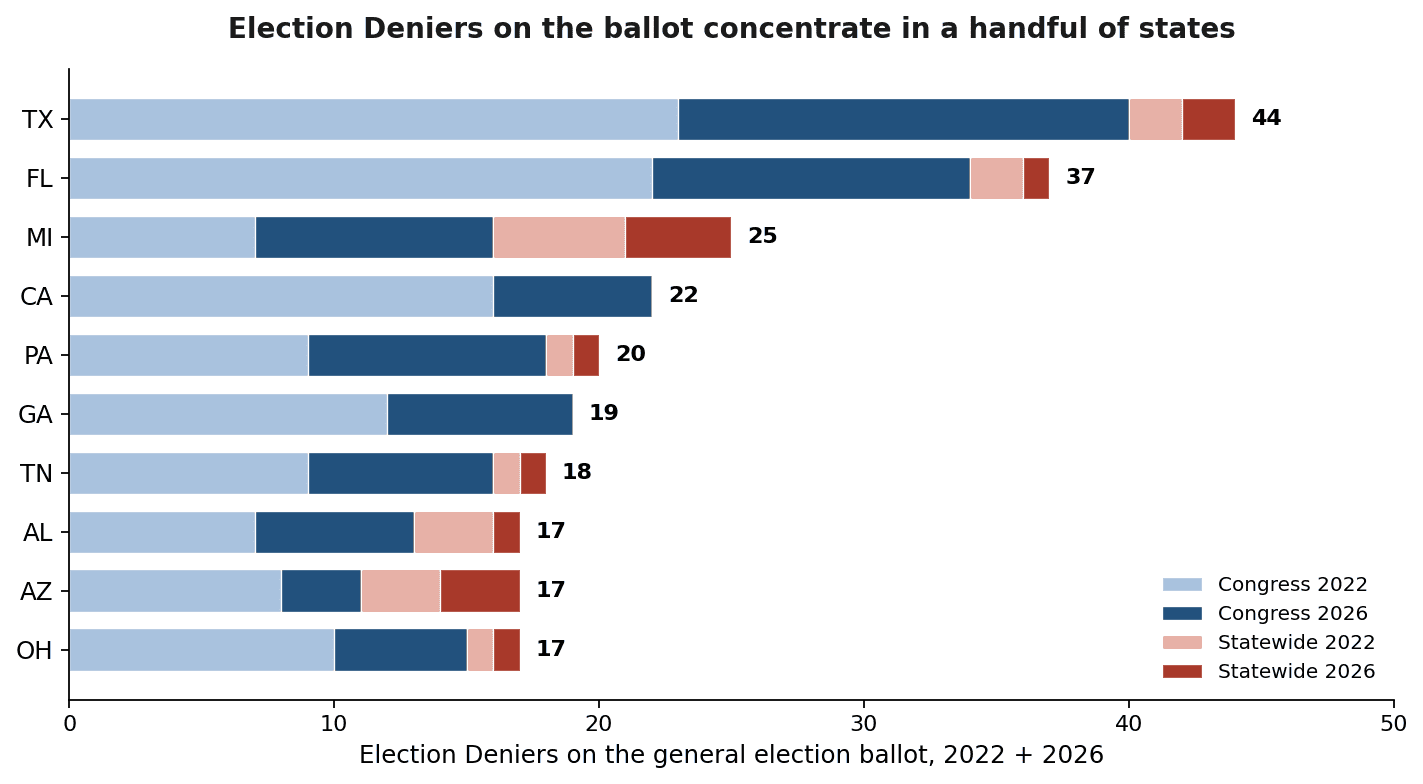
Figure 4. States with the most Election Deniers on the general election ballot, 2022 and 2026 combined, by office type.
The declines in Election Denier candidacies from 2022 to 2026 are real, but they should not be mistaken for a diminished threat to the electoral system. The number of candidates on the ballot measures the size of the field, not the authority held by those who win. A single Election Denier serving as a governor, secretary of state, or attorney general—or as a member of Congress with a role in certifying the 2028 presidential election—can shape how future elections are administered, contested, or certified, regardless of how many sought office.
Many of the Election Deniers who appear on the 2026 general election ballot are incumbents in safe seats who are likely to return to office. Those in contested races are concentrated in states where the effort to overturn the 2020 election was most intense, and where a close or disputed result may be more likely to be challenged by an Election Denier. The concern, in other words, does not scale down with the count. What matters is not only how many Election Deniers appear on the ballot, but whether those who win take office in positions with real power over how future elections are run.