Americans Continue to Agree: The President Should Respect Court Orders
In This Resource
Frustrated by a series of court decisions that found its actions were unconstitutional, the Trump administration has repeatedly ignored judicial orders, evaded contempt proceedings, and sued judges with whom it has disagreed. Americans continue to disapprove of these actions.
Recent polling from States United and YouGov shows that a substantial majority of Americans agree that President Trump should respect rulings from courts, including the U.S. Supreme Court.
Support extends across party lines, with overwhelming agreement among Democrats and independents and strong agreement among Republicans.
Even as the president has disregarded courts, Americans have remained steadfast in their opinion that it is not acceptable. These latest results are consistent with previous States United polling from February and June 2025. Compared to one year ago, even fewer Republicans disagree that Trump should respect court rulings.
Judges have lambasted the administration for ignoring the courts. Supreme Court Justice Sonia Sotomayor has even called out the administration’s judicial evasion, writing in a June 2025 dissent that the administration has “openly flouted” court orders.
States United partnered with YouGov on national surveys of adults in May 2026 and June 2025 to better understand Americans’ views on this issue.
- Most Americans agree that Trump should respect court rulings, even when they rule against him. Levels of disagreement are low, including among Republicans.
- Even more Americans believe Trump should respect rulings from the U.S. Supreme Court. Most Democrats, independents, and Republicans agree.
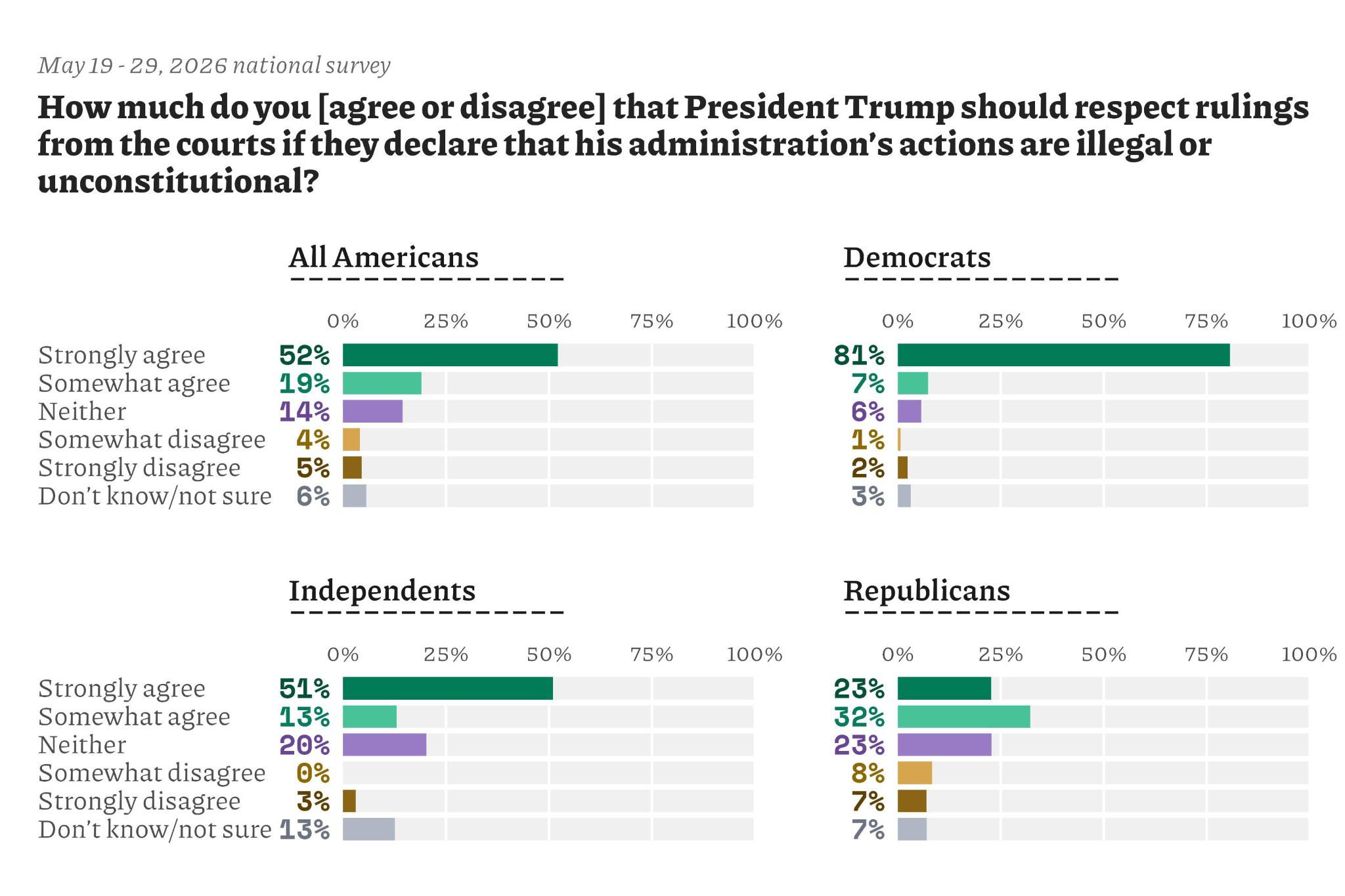
As of May 2026, about 7 out of 10 Americans express some level of agreement that Trump should respect rulings from the courts if they declare that his administration’s actions are illegal or unconstitutional; a majority (52%) strongly agree with this. About 9 out of 10 Democrats agree that Trump should respect court rulings, as do nearly two-thirds (64%) of independents. More than half of Republicans (55%) also agree the Trump administration should respect these decisions. Disagreement among Republicans (15%) is higher than any other partisan group, but has gone down 8 percentage points compared to June 2025.
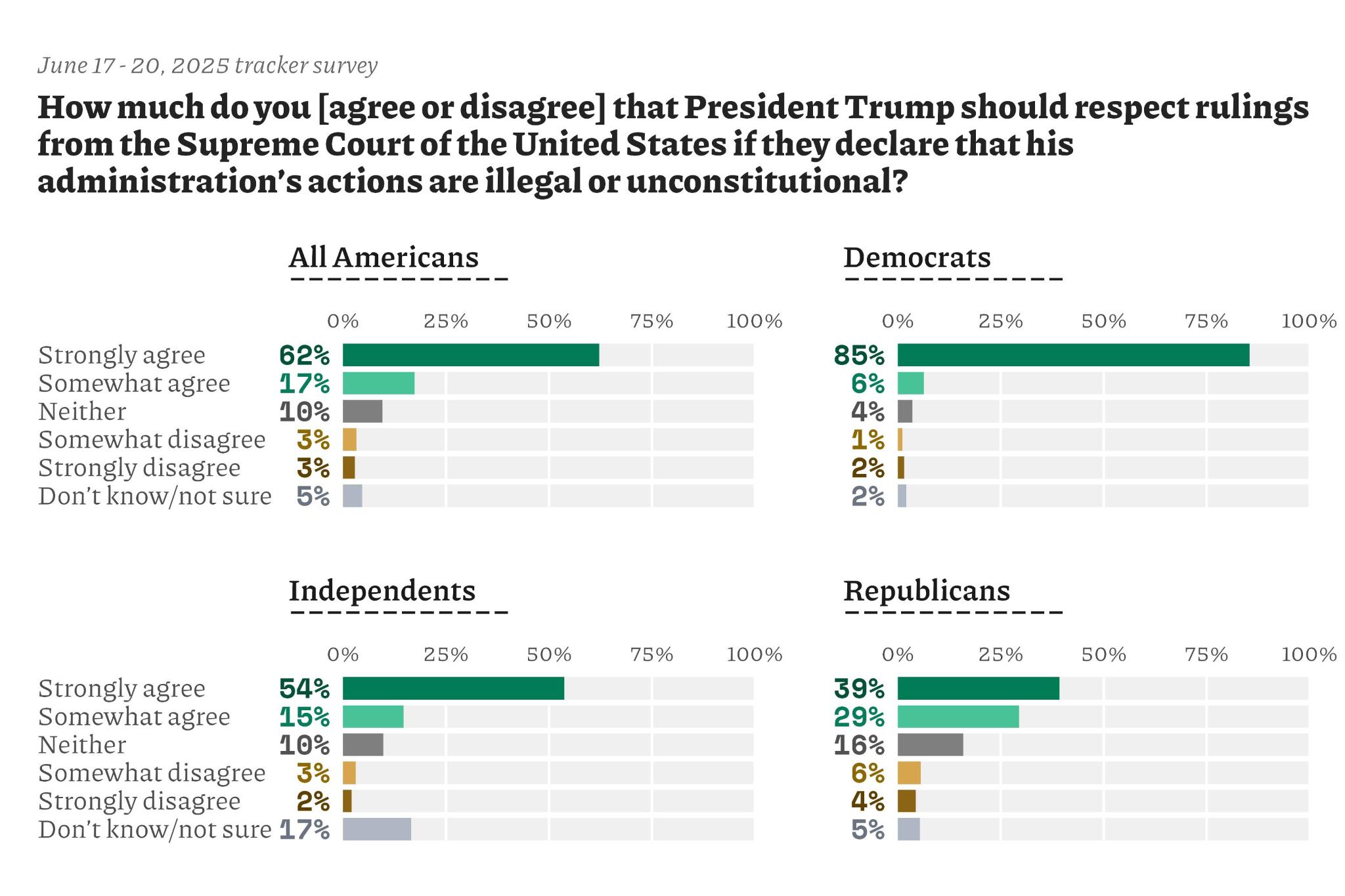
States United and YouGov also asked people whether they agreed that Trump should respect U.S. Supreme Court rulings in June 2025. Nearly 8 in 10 Americans say that they somewhat or strongly agree that Trump should do so, and 62% say that they strongly agree. This is higher than when respondents are asked about courts in general terms. Among those surveyed, 91% of Democrats, 69% of independents, and 68% of Republicans express some level of agreement that the president should respect Supreme Court rulings. Republicans in particular seem to be more open to agreeing that Trump should comply with the Supreme Court than they are when it comes to courts generally. This pattern is consistent with prior polling.
The 2026 results are taken from a States United survey based on 1,537 interviews conducted on the internet of U.S. adults. Participants were drawn from YouGov’s online panel and were interviewed from May 19 to 29, 2026. Respondents were selected to be representative of American adults. Responses were additionally weighted to match population characteristics with respect to gender, age, race/ethnicity, education of registered voters, and U.S. Census region based on voter registration lists, the U.S. Census American Community Survey, and the U.S. Census Current Population Survey, as well as 2022 midterm turnout and 2020 and 2024 Presidential vote. The margin of error for this survey is approximately ± 2.9 percentage points.
The 2025 survey was conducted between June 17 and 20, and had a sample of 1,515 U.S. adults. Responses were additionally weighted to match population characteristics with respect to gender, age, race/ethnicity, education of registered voters, and U.S. Census region based on voter registration lists, the U.S. Census American Community Survey, and the U.S. Census Current Population Survey, as well as 2020 presidential vote. The margin of error for this survey is approximately ± 2.7 percentage points.
For both surveys, sample estimates should differ from their expected value by less than the margin of error in 95% of all samples. Margins of error are larger for the analysis of partisan subgroups described above. This figure does not reflect non-sampling errors, including potential selection bias in panel participation or measurement error.
In keeping with best research practices, we classify independents who reported “leaning” toward either the Democratic or Republican parties as partisans. Therefore, “independents” are defined as those respondents who professed no partisan attachments whatsoever.