ICE-y Conditions
Plus: U.S. Supreme Court considers mail-in ballot deadlines. 🗳️
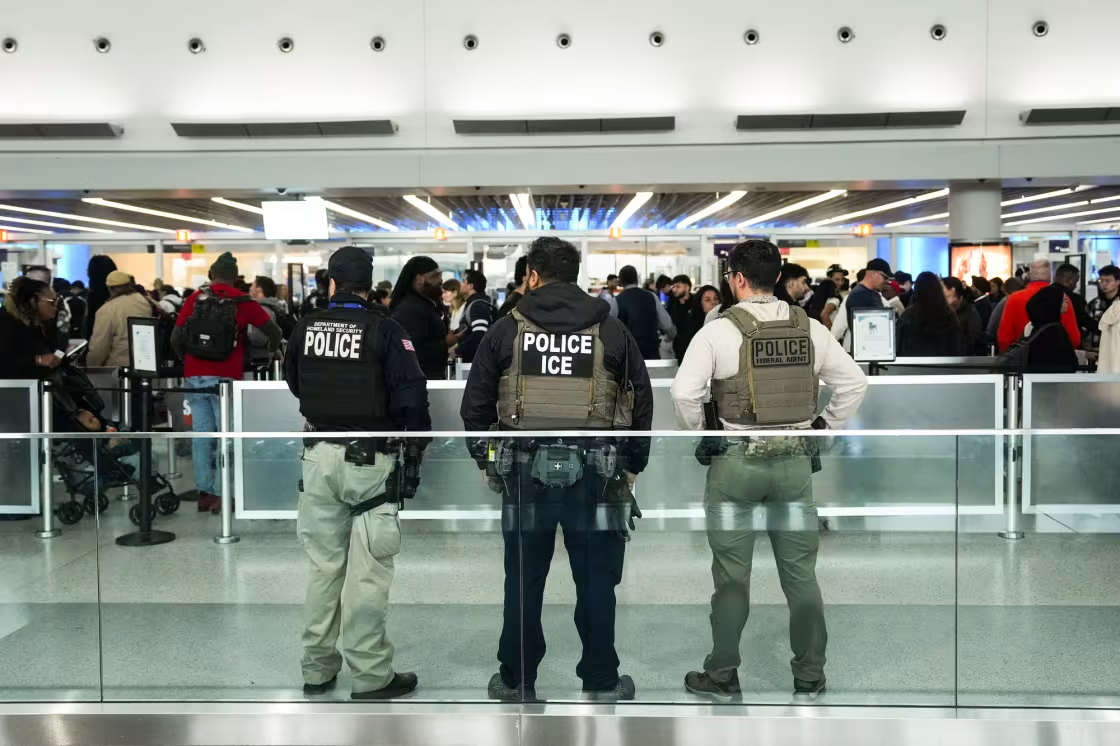
- President Trump sent U.S. Immigration and Customs Enforcement (ICE) agents to more than a dozen airports this week as the ongoing impasse over funding for the U.S. Department of Homeland Security continues to impact Transportation Security Administration staffing.Not only has the deployment not reduced security lines, but members of the president’s inner circle suggested it was a “test run” for this year’s midterm elections.
When asked about sending ICE agents to polling locations this fall, White House border czar Tom Homan didn’t rule it out despite several assurances from other Trump administration officials. “I mean, bottom line is, what are they afraid of?” Homan asked, referring to critics of the idea. Deputy Attorney General Todd Blanche had similar comments.
➡️ READ: What’s Breaking Through About Deploying Federal Agents to Polling Places
- The U.S. Supreme Court seemed primed to overturn laws in more than a dozen states that allow mail-in ballots to be counted if they were postmarked on, but not received by, Election Day. The case centers on a Mississippi law—passed with bipartisan support in 2020—that allows late-arriving ballots. The high court’s decision could have far-reaching consequences for voters around the country just months before voting begins in the midterms. Several states are already preparing for that possibility, especially as Postal Service changes could delay mail in rural areas.
- A federal judge ruled that the Pentagon’s restrictions on members of the press violate the First Amendment of the U.S. Constitution. Judge Paul Friedman, of the U.S. District Court for the District of Columbia, ordered the U.S. Department of Defense to restore credentials to news outlets. Friedman wrote that the policy limited journalists to publishing “only stories that are favorable to or spoon-fed by department leadership.” However, days later, The New York Times accused the Pentagon of defying the court order.
➡️ READ: Survey: Americans Don’t Believe Critical Press Coverage of Trump Is ‘Really Illegal’
- The U.S. Senate confirmed Markwayne Mullin as the next Homeland Security secretary. The former senator from Oklahoma replaced Kristi Noem, whose tenure at the department was marred by surges of federal agents to American cities. Without coordinating with state and local law enforcement, those agents used violent tactics that led to the deaths of Americans, crackdowns on peaceful protests, and the firing of tear gas in neighborhoods.
➡️ READ: What’s Breaking Through About Federal Law Enforcement Tactics
- A coalition of 20 states and the District of Columbia sued the U.S. Department of Agriculture for creating “vague” and “ideological” requirements to receive $11.6 billion in federal funding for school meals and other childhood nutritional programs. The coercive funding demands could have “grave” consequences for millions of children who depend on those meals, the states argued.“These new conditions put essential programs at risk and cause chaos for states that rely on this funding to feed families, support farmers and keep communities safe,” New York Attorney General Letitia James said in a press release.
State of the States
In Arizona, the state Senate released the grand jury subpoena from the FBI’s investigation into Maricopa County’s results in the 2020 election. The subpoena revealed that the Justice Department is relying on the flawed Cyber Ninjas “audit” that has been discredited by election experts, including States United. State leaders are worried the Trump administration is using the investigation to grab election power and gain access to sensitive voter data.
In Georgia, the state Court of Appeals overturned a ruling that forced the Fulton County Board of Commissioners to seat two activists who had previously challenged the voter registrations of tens of thousands of Georgia residents. The commissions “were exercising their constitutional prerogative to exercise their judgment as to these appointments on behalf of the people who elected them,” the three-judge panel wrote.
In Illinois, the Chicago Transit Authority sued the Trump administration, accusing it of “political retaliation” for withholding more than $2 billion in federal funding. Without that money, the city would not be able to complete infrastructure projects for its train services, impacting both riders and workers. The administration also targeted New York City and New Jersey. All three jurisdictions are run by the president’s political opponents.
In Minnesota, state and local prosecutors sued the Trump administration for access to evidence in the killings of Renee Good and Alex Pretti and the shooting of Julio Cesar Sosa-Celis by federal agents. Minnesota leaders criticized the federal government for its lack of cooperation, which has been common practice in previous administrations.
“It’s astonishing this lawsuit is even necessary, but in Minnesota, nobody is above the law,” said Attorney General Keith Ellison. Hennepin County Attorney Mary Moriarty told reporters this is a “fight for transparency and accountability.”