Americans Oppose ICE at Polling Places
In This Resource
Americans do not want federal immigration agents at or near their polling places during midterm elections this year.
When asked in a recent survey about the idea of President Trump sending immigration enforcement officers agents to polling places to ensure that only Americans are voting, people showed notably more opposition than support. When asked separate questions about stationing local law enforcement, the National Guard, or immigration enforcement officers at voting locations, most Americans opposed having immigration officers present.
The results clearly show that having immigration agents at the polls is unpopular with Americans.
While it is illegal for there to be armed federal agents at polling places, the president’s inner circle has pushed for it. Though some officials at the U.S. Department of Homeland Security have insisted it won’t happen, the president has not explicitly said whether he would send ICE to the polls.
States United partnered with YouGov on a national survey of 1,528 adults from Au. 17 through 21, 2026, to better understand Americans’ views on this issue.
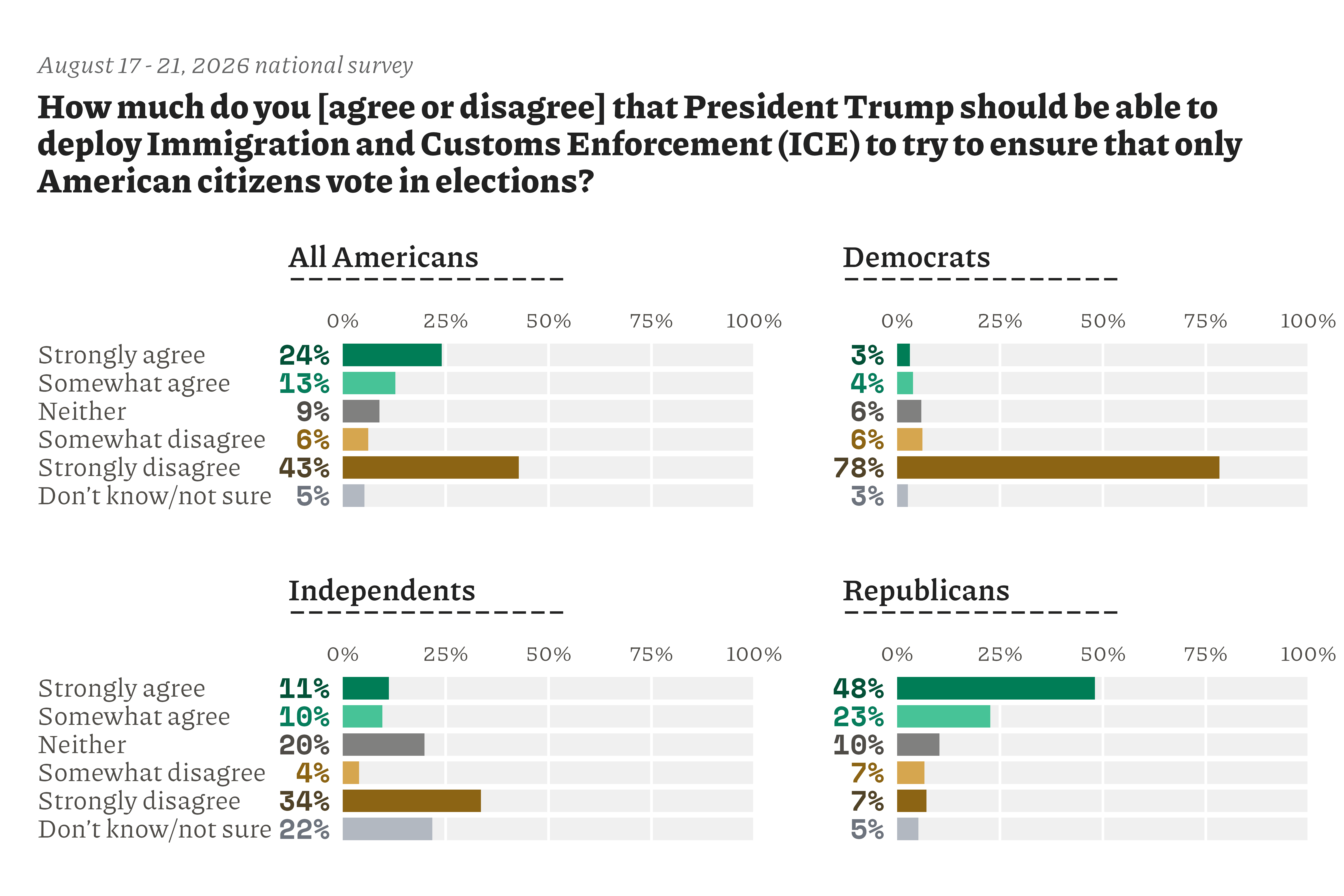
- In the first question, more Americans disagreed than agreed that the president should be able to deploy Immigration and Customs Enforcement (ICE) to ensure only American citizens vote in elections.
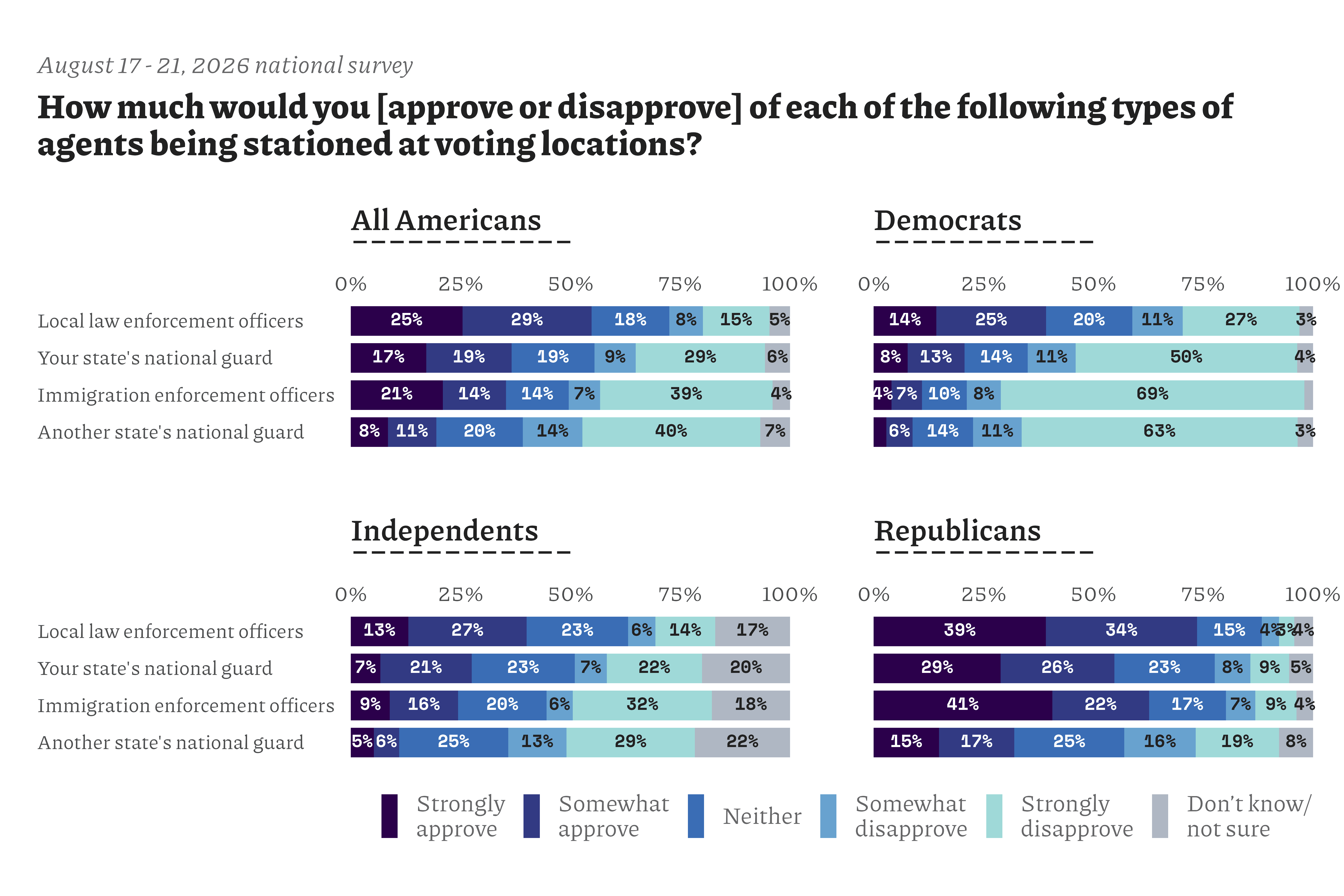
- In the second set of questions, a majority of Americans approves of having local law enforcement stationed at voting locations. But many more Americans disapprove than approve of immigration enforcement officers being stationed at voting locations, and less than a fifth of Americans approve of another state’s National Guard being at voting locations.
- Public opinion on immigration officers at polling places is split along party lines. In both questions, most of the support came from Republicans, though it was a little higher when asked if ICE should be stationed at polling locations to ensure that only citizens vote. Across the two questions, the coalition of those who disagree that immigration officers should be deployed to the polls is largely made up of Democrats and independents.
We asked how much Americans agreed or disagreed that President Trump should be able to deploy ICE to try to ensure that only American citizens vote in elections. Just under half (49%) said that they strongly or somewhat disagreed that he should be able to deploy ICE, compared to 37% who expressed some level of agreement that Trump should be able to do so.
Among Democrats, 84% disagree (78% strongly so) with the notion of President Trump sending ICE to the polls, compared to 71% of Republicans who agree. The plurality of independents say that they somewhat or strongly disagree (38%) and just 21% of them say that they agree.
We also asked how much Americans approve or disapprove of local law enforcement officers, the National Guard (but from their own states and from other states), and immigration enforcement officers being stationed at voting locations. While a majority (54%) strongly or somewhat approve of people from local law enforcement agencies being there, substantially fewer say that they approve of the presence of immigration enforcement personnel (35%) and members of the National Guard from their own states (36%) or from other states (19%). Many more Americans (46%) disapprove than approve of immigration officers being present at the polls.
Approval differs across partisan groups: About 77% of Democrats disapprove of having immigration enforcement officers at their polling locations while just 11% approve of it. Approval among independents is also low (25% approve and 38% disapprove), but the policy has support among Republicans (63% approve and 16% disapprove).
These data are taken from a States United survey based on 1,528 interviews conducted on the internet of U.S. adults. Participants were drawn from YouGov’s online panel and were interviewed from Aug. 17 to 21, 2026. Respondents were selected to be representative of American adults. Responses were additionally weighted to match population characteristics with respect to gender, age, race/ethnicity, education of registered voters, and U.S. Census region based on voter registration lists, the U.S. Census American Community Survey, and the U.S. Census Current Population Survey, as well as 2022 midterm turnout and 2020 and 2024 Presidential vote. The margin of error for this survey is approximately ± 2.8 percentage points, though it is larger for the analysis of partisan subgroups described above. Therefore, sample estimates should differ from their expected value by less than the margin of error in 95% of all samples. This figure does not reflect non-sampling errors, including potential selection bias in panel participation or measurement error.
Following best research practices, we define “independents” as respondents with no partisan attachments and classify independent leaners as partisans.