Access Denied
Plus: Protests continue in Minnesota. 🗳️
This Week in Democracy
- A federal judge in California dismissed the Justice Department’s case that sought to force state officials to give the department an unredacted list of the state’s registered voters. “It is not for the Executive, or even this Court to authorize the use of civil rights legislation as a tool to forsake the privacy rights of millions of Americans,” the judge wrote.
The federal judge overseeing the Justice Department’s lawsuit against Oregon officials for similar information said that he was likely to dismiss that case, too. The department has sued 21 other states and Washington, D.C., for voters’ personal information, according to the Brennan Center for Justice.
➡️ READ: Sharing the Facts About Federal Efforts to Compile State Voter Data
- Protests against the Trump administration’s immigration enforcement operations continued in Minnesota after a federal agent shot and killed an American citizen last week. President Trump threatened to invoke the Insurrection Act in order to deploy the military against protestors, while the U.S. Department of Homeland Security sent hundreds more federal agents to Minnesota to continue operations.
Minnesota Attorney General Keith Ellison and officials from Minneapolis and St. Paul sued the Trump administration, arguing that the surge of forces into the state and tactics used by agents violate the Constitution. Illinois Attorney General Kwame Raoul and Chicago officials also sued, making similar arguments about operations in their state.
At least six federal prosecutors in Minnesota resigned over concerns about the federal investigation into last week’s shooting. A law enforcement official said the prosecutors were troubled by the decision to not include state and local authorities in the investigation.
➡️ READ: What’s Breaking Through About Federal Law Enforcement Tactics
- A federal judge in Washington state blocked parts of Trump’s election-focused executive order that threatened to withhold federal funding from states if they didn’t comply with its demands. “[T]he Constitution assigns no authority to the President over federal election administration,” the judge wrote. Two other judges have also blocked parts of the order.
Oregon Attorney General Dan Rayfield brought the case alongside Washington Attorney General Nick Brown. “This is a win for Oregon voters and a defeat for President Trump’s effort to interfere in our elections,” Rayfield said. “Thanks to today’s ruling, Oregonians can register to vote and have their ballot counted without fear that the President’s made-up rules will stop them from voting.”
➡️ READ: Sharing the Facts About Federal Overreach of States’ Authority to Administer Elections
- Federal Reserve Chair Jerome Powell announced that federal prosecutors had launched a criminal investigation into him, the latest example of the Justice Department targeting the president’s political enemies.
“The threat of criminal charges is a consequence of the Federal Reserve setting interest rates based on our best assessment of what will serve the public, rather than following the preferences of the President,” Powell said in a statement, later adding: “Public service sometimes requires standing firm in the face of threats. I will continue to do the job the Senate confirmed me to do, with integrity and a commitment to serving the American people.”
➡️ READ: Sharing the Facts About Misusing Federal Law Enforcement for Political Retaliation
- Five members of Congress, all military veterans, said that they were being investigated by the Justice Department after they participated in a video in which they urged members of the military to refuse illegal orders.
U.S. Sen. Mark Kelly of Arizona, a U.S. Navy veteran, sued Defense Secretary Pete Hegseth after Hegseth took retaliatory measures against him for appearing in the video. “The First Amendment forbids the government and its officials from punishing disfavored expression or retaliating against protected speech,” Kelly’s lawsuit argues.
- A federal judge in New York temporarily blocked the Trump administration from cutting $10 billion in federal funding for childcare and family support programs. The attorneys general of five states sued last week to stop the cuts.
- The FBI searched the home of a Washington Post reporter as part of an investigation into a government contractor, heightening First Amendment concerns.
“[T]his extraordinary, aggressive action is deeply concerning and raises profound questions and concern around the constitutional protections for our work,” Matt Murray, the Post’s executive editor, wrote in an email to his colleagues.
➡️ READ: Survey: Americans Don’t Believe Critical Press Coverage of Trump Is ‘Really Illegal’
State of the States
In Colorado, Secretary of State Jena Griswold and the leaders of the Colorado County Clerks Association sent a letter to Gov. Jared Polis, urging him to not pardon Tina Peters, as he is reportedly considering doing. Peters is a former county clerk who was convicted in 2024 of participating in a 2021 security breach of her county’s election equipment.
Election officials from other states have made similar arguments as those from Colorado: Stephen Richer, the former recorder of Maricopa County, Ariz., published an open letter to Polis in The Bulwark.
In D.C., the U.S. Supreme Court ruled that candidates for Congress have the right to challenge in court the laws that govern their own election. The case was brought by U.S. Rep. Mike Bost of Illinois, who sought to challenge a state law that allows election officials to count mail ballots that arrive up to two weeks after Election Day.
The justices did not determine whether the law challenged by Bost is constitutional—they only decided that Bost, as a candidate in the election, had the right to sue. The issue of whether state election officials can count late-arriving mail ballots is set to be decided in a different case this year.
Fourteen states allow mail ballots received after Election Day to be counted, as long as they are postmarked on or before Election Day.
In Rhode Island, construction on an offshore wind farm can resume after a federal judge ruled that the Trump administration did not sufficiently justify its order to stop work on the project. It’s the second time a judge has reversed the administration’s efforts to halt construction.
Lawyers from States United are serving as pro bono counsel to the state of Rhode Island on the case.
➡️ READ: More about the case
Recommended Reading
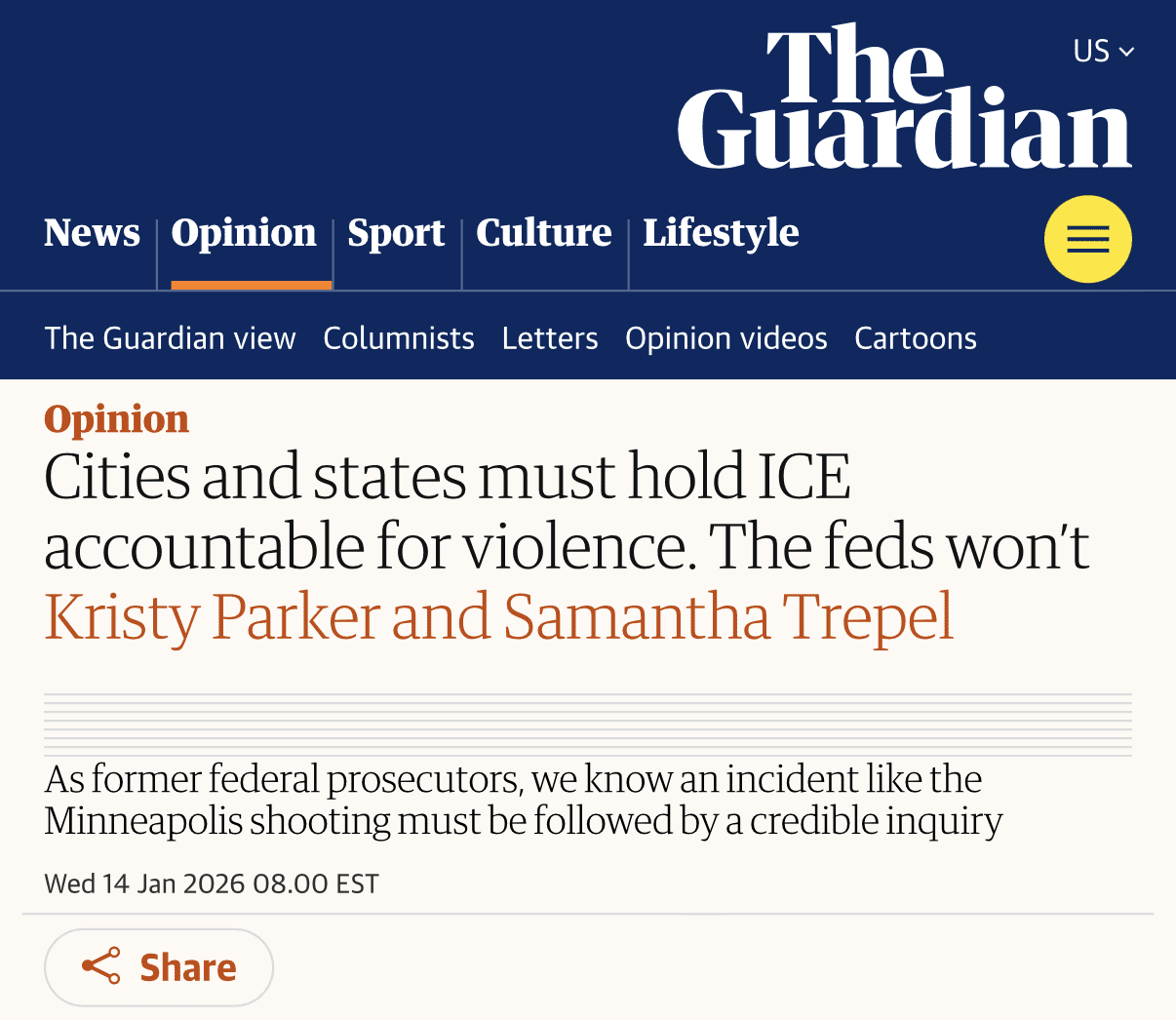
Kristy Parker of Protect Democracy and Samantha Trepel of States United, both formerly of the Justice Department’s Civil Rights Division, write in The Guardian that state and local officials should hold federal agents accountable for violations of the U.S. Constitution in their states.
“Even if the federal government brings no charges, the public deserves an account of its investigative efforts and decision,” the pair writes.