Survey: Americans Want to Increase Federal Spending on Elections
In This Resource
Americans across party lines want the federal government to invest more in elections, even as most oppose the Trump administration taking on a larger role in running them.
The findings come at a time when the Trump administration is cutting federal support for election security. The administration has slashed funding for programs that help state and local election officials identify and respond to cybersecurity threats, reduced federal election security staff, and proposed eliminating federal election security grants. These resources have helped states maintain voting equipment, strengthen cybersecurity, and protect election infrastructure.
While states and local officials are responsible for running elections, the federal government has long provided funding and security assistance to support their work. And Americans overwhelmingly support that investment, even as they oppose greater federal control over elections.
States United Democracy Center partnered with YouGov on two national surveys of more than 1,500 adult Americans each in February and August 2026 to better understand Americans’ views on federal spending on election administration and cybersecurity.
- In both February and August, many more Americans said the federal government should increase spending on elections than said it should decrease spending. Support for increased spending grew between February and August.
- Support for increased election funding crosses party lines. Pluralities of both Republicans and Democrats want more federal spending on election administration, and majorities of both groups support increased spending on election cybersecurity.
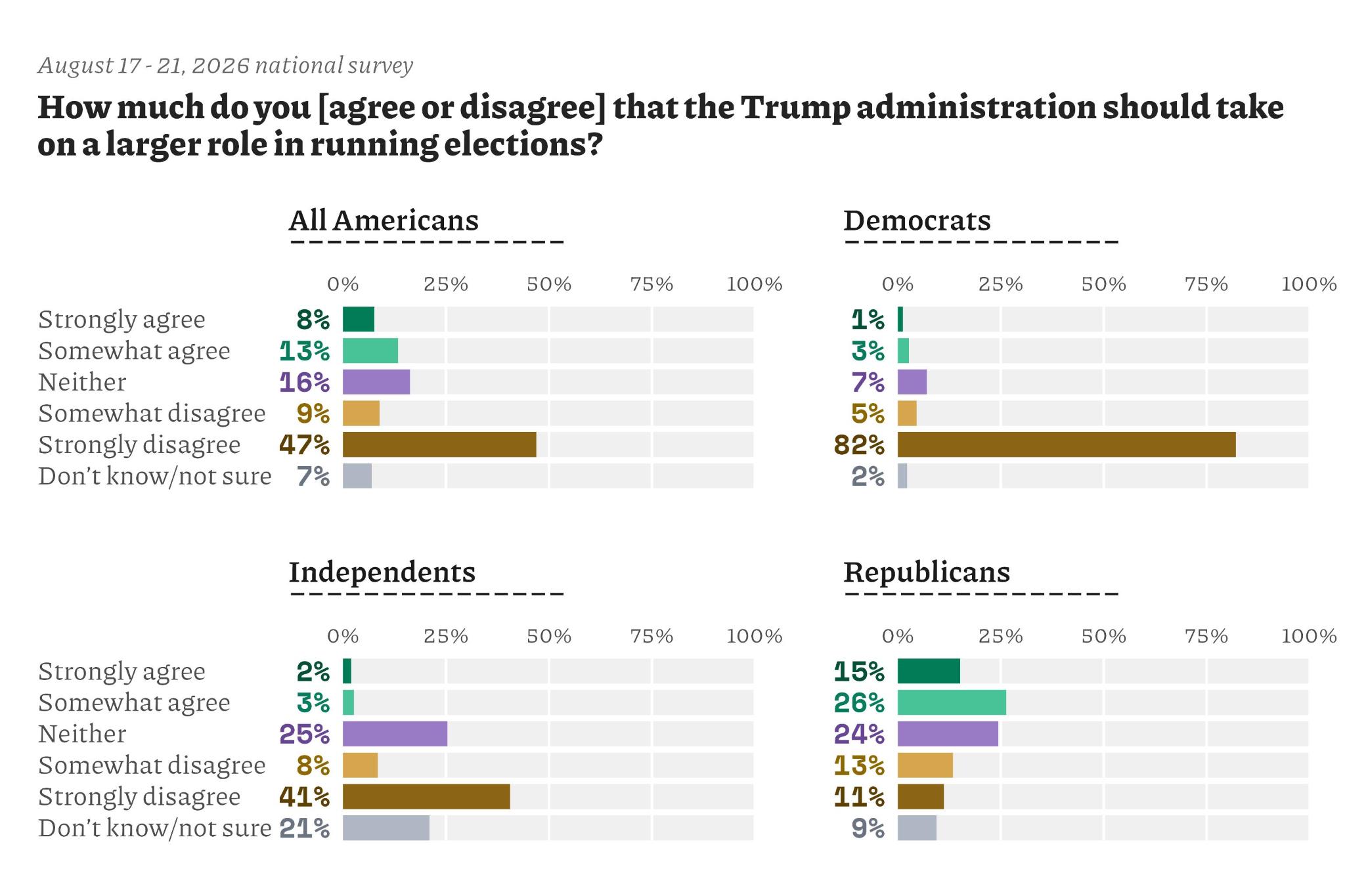
- Despite widespread support for more federal investment in elections, most Americans (56%) disagree with the Trump administration taking on a larger role in running elections.
In both February and August, Americans were more likely to say the federal government should increase spending on election administration and cybersecurity than decrease it.
In August, 43% of Americans said the federal government should increase spending on election administration, while 72% supported increased spending on cybersecurity in elections. Both figures increased since February, by 9 and 8 percentage points, respectively.
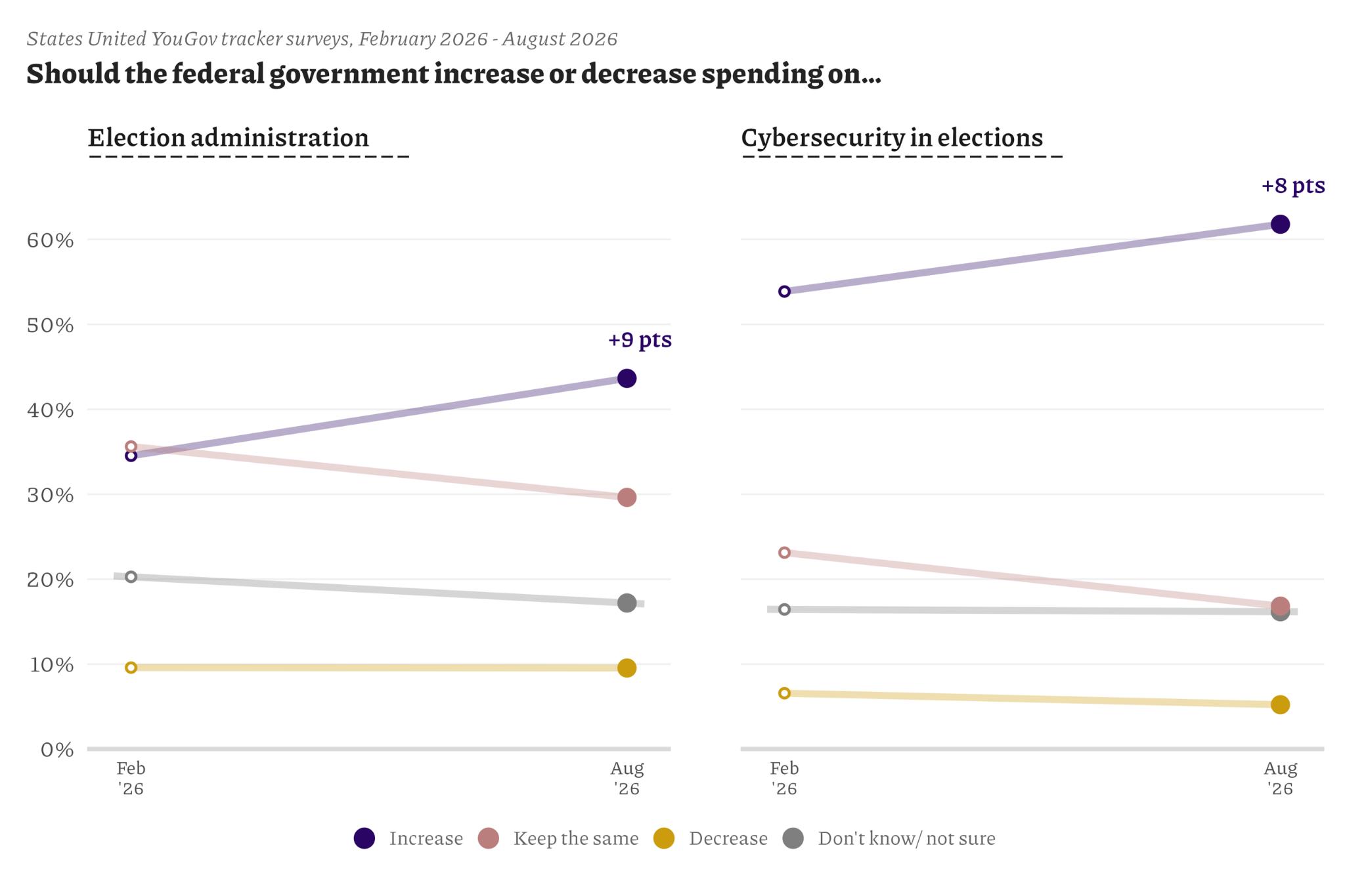
Support for increased federal funding also crosses party lines. In August, pluralities of Republicans (50%) and Democrats (40%) said they wanted the federal government to spend more on election administration. Majorities of Republicans (67%) and Democrats (60%) also supported increased spending on cybersecurity in elections.
But support for more federal funding does not translate into support for more federal control. In August, 56% of Americans disagreed with the Trump administration taking on a larger role in running elections. The vast majority of Democrats (87%) disagreed, along with about half of independents. Republicans were more divided, though a plurality (41%) supported the administration taking on a larger role.
These data are taken from two States United surveys conducted on the internet of U.S. adults. Respondents were selected to be representative of American adults. The first survey included 1,570 participants drawn from YouGov’s online panel and who were interviewed from Feb. 11 to 19, 2026. Responses were additionally weighted to match population characteristics with respect to gender, age, race/ethnicity, education of registered voters, and U.S. Census region based on voter registration lists, the U.S. Census American Community Survey, and the U.S. Census Current Population Survey, as well as 2022 midterm turnout and 2020 and 2024 presidential vote. The margin of error for this survey is approximately ± 2.7 percentage points, though it is larger for the analysis of partisan subgroups described above.
The second survey included 1,528 participants drawn from YouGov’s online panel and who were interviewed from Aug. 17 to 21, 2026. Weighting followed the same procedure as the February survey. The margin of error for this survey is approximately ± 2.8 percentage points, though it is larger for the analysis of partisan subgroups described above. Therefore, sample estimates should differ from their expected value by less than the margin of error in 95% of all samples. This figure does not reflect non-sampling errors, including potential selection bias in panel participation or measurement error.
Following best research practices, we define “independents” as respondents with no partisan attachments and classify independent leaners as partisans.